ATtiny Hacks: An Audio Alert For Cell Phones Accidentally Left On Vibrate

ATtiny Hacks Theme Banner
vibe2tone_cell_phone_vibration_alert

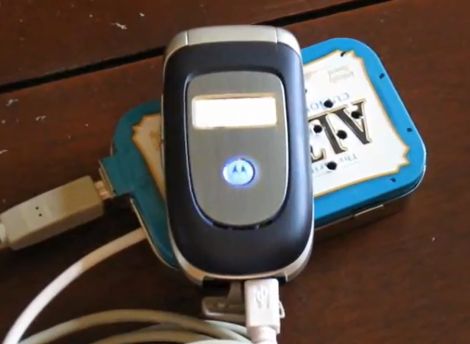
[John Thomson] usually keeps his phone on vibrate when it’s in his pocket, and he often forgets to turn the ringer back on when setting it down to charge. This typically results in a bunch of missed calls in the meantime, so he had to devise a way to counteract his forgetfulness.

You might remember [John] from the Santa-pede contest we held last December. He wanted to try his hand at yet another competition, the Avnet Dog Days of Summer contest, so he scrambled to come up with a quick fix for his situation. He concocted a simple circuit based on [ChaN’s] design for a “Simple SD Audio Player with an 8-pin IC” that would alert him to incoming calls, even when his phone was on vibrate.

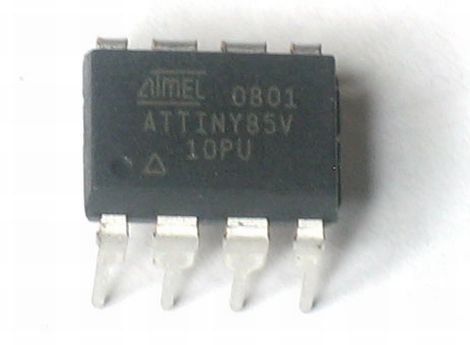
[John] used an ATtiny85, just as [ChaN] did, adding a speaker for sound output and a piezo sensor to detect his phone’s vibrations. When the piezo senses a bit of motion, the audio player kicks in, blaring a series of sounds that are sure to get [John’s] attention.

Speaker-mounted WAV Player For Street Performances

This naked speaker is the basis for [MaoMakMaa’s] newest project called the Wavedrone. He plans on using the autonomous and cable-less device during street performances. You can hear the effect of some stretched jazz cords being played on it in the video clip after the break. The sound is kind of an ethereal background noise that observers might not immediately realize is there.

You can see the 9V battery which serves as the power source clinging to the frame of the speaker. A 7805 linear regulator tames that battery and feeds the two IC’s on the circuit board seen to the right. The ATtiny85 is reading music from an SD card and playing it back in mono (obviously) with the help of an LM386 audio amplifier chip. The trimpots that go into the high pass and low pass filters in between the microcontroller and amplifier allow for a bit of sound manipulation, but we’re more impressed with the quality of the sound this is getting when properly trimmed.

Continue reading “Speaker-mounted WAV Player For Street Performances”

Auxiliary Display For Beat707 Works Via I2C

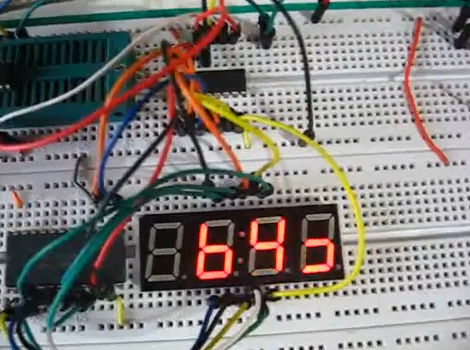
Bigtime is a simple way to create an auxiliary display for the Beat707 MIDI controller. The right half of the display shows the beat pattern that the drum machine is using, while the left half keeps track of the current measure.

Just a few components went into the extra hardware. A four-digit seven segment display is fed data from an ATtiny85. Since that microcontroller has only eight pins, a 595 shift register and CD4067 take care of translating serial data into the outputs necessary to light the display. The entire thing connects to the Beat707’s I2C bus, which means you don’t need to make hardware alterations to the original, and this leaves plenty of room for more addons.

The code package includes a Fritzing file, but for your convenience we’ve embedded a PNG of the hardware connections after the break. You’ll also find the demo video where [Guilherme] explains how this works.

Continue reading “Auxiliary Display For Beat707 Works Via I2C”

Tiny Morse Code Trainer

[Eric] wanted to teach his kids Morse code, so he built a tiny Morse code trainer.

[Eric] built the trainer around an ATtiny85, and the rest of the circuit follows this minimalist idea. After connecting a piezo beeper and 6-pin ISP header, the only thing left to do was write a little code and start teaching his kids Morse. The Morse trainer is programmed to repeat the message, “SOS the moon rover has broken down and I am stuck in the trash can in the garden shed,” [Eric] planted a Lego moon rover in his shed as a prize for learning Morse, making him one of the coolest dads ever.

Although learning Morse isn’t required for an amateur radio license anymore, it’s a requirement for continuous wave radio. We think this is a great way to learn Morse the right way – actually hearing the characters – instead of memorizing the Huffman tree of Morse characters.

Programming An ATtiny Using An Arduino

attiny

[Scott] is a big fan of the Arduino platform, and he’s not afraid to admit it. It does all the things he needs, but now and again he would like to use something a bit smaller, without all the bells and whistles the Arduino has to offer. He contemplated using an ATtiny for smaller projects, but after looking into what he would need to program the chip under Linux, he could never find the motivation to give it a go.

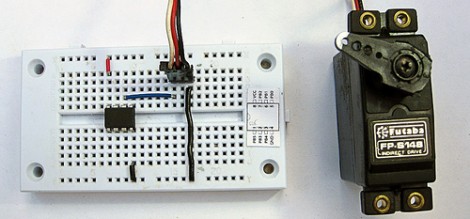
That all changed when he discovered the Arduino-Tiny project, which aims to bring a limited Arduino IDE to the ATtiny line of microcontrollers. He found the project to be quite useful, so he put together a brief tutorial that walks through everything you need to get started.

The tutorial is fairly straightforward, and even demonstrates how the Arduino can be used as an ISP for the ATtiny, removing the need to purchase a standalone programmer. Be sure to check it out if you are searching for an easy way to get started with ATtiny chips under Linux.

A Charlieplex Display And A Board Layout Tip

[Ben] is getting himself up to speed with microcontrollers. He jumped into the deep end by taking on this Charlieplex LED matrix build. As you can see after the break, he not only made the display work, but coded Conway’s game of life to run on the ATtiny85 that drives the device. What you see above is the prototype version that [Ben] used to make sure he had the hardware just right. He’s seeing the project through to a manufactured board and this is where the layout tip comes from. In order to make sure he had enough space for all of his components he printed out the board artwork, taped it to some Styrofoam, and then inserted all of the through-hole parts. Now he can be sure that physically the design works, we’ll keep our fingers crossed that everything is also kosher electrically.

Continue reading “A Charlieplex Display And A Board Layout Tip”

LED Lighthouse Simulator

This Christmas [Bill Porter] decided to show his parents that those college dollars were well spent. He upgraded the custom lighthouse light which he originally designed in high school for their garden fountain. He even went so far as to craft some retail-worthy packaging for the gift.

We think it’s a wonderful design, on a custom PCB and based around an ATtiny85. A real lighthouse has a spinning lens to aim the beam of light. When the lens sweeps across your viewpoint there is a sudden flash and he’s recreated that effect using PWM. Take a look at the video after the break and you’ll see what we mean.

Also, during development he was plagued by a startup glitch which we got majorly sidetracked reading aboutContinue reading “LED Lighthouse Simulator”