A Simple Switch For Simply Too Much Current

A switch is simple: connect two pieces of metal together and bam! Except, it’s not that simple at high currents. How much current? Just about 400 car batteries worth would certainly cause some issues. This is the issue that [Technology Hobby] hoped to fix with his clever switch design.

While many content creators are great at finding or making high-current sources (looking at you, Styropyro), their switches can’t always hold up to the abuse. [Technology Hobby] found that many of the switches used by these creators had issues based on an inconsistent and limited contact area. Making a bigger contact patch is always fairly easy; keeping those contacts from skipping can be a bit more difficult.

Continue reading “A Simple Switch For Simply Too Much Current”
Car Batteries: More Than Just Wet Lead

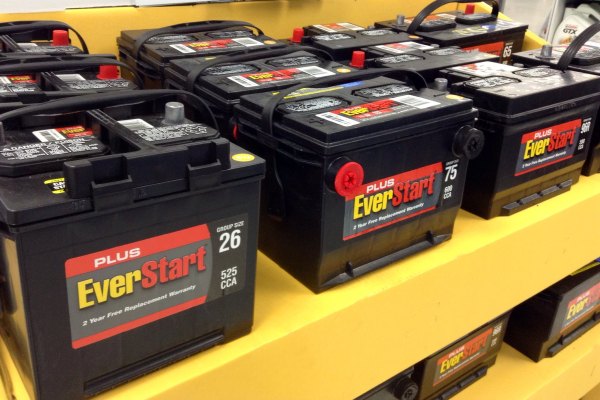
Working on car electrical systems used to be easy. The battery simply provided power for the car’s starter motor when starting or to run the small number of accessories when the engine wasn’t running. The rest of the time, the alternator charged the battery and provided power for the rest of the vehicle and the ignition system. While very early cars didn’t have batteries, and some old cars had 6 V positive ground systems, most of us have lived our entire lives where car batteries come in several sizes (controlled by Battery Council International) and cars have a 12 V, negative ground system.

Times have changed. Cars don’t have distributors anymore, they have computers. They also have lots of gadgets from GPS to backup cameras and cellphone chargers. Batteries have had to get beefier and the modern trend is to also require less maintenance So, today, you’ll find that there isn’t just one kind of car battery. But how do these other batteries work and what was wrong with the good old lead acid wet cell?

For the purposes of this post, I’m not talking about electric car batteries which is a whole different topic — and most of them have a regular car battery, too. Continue reading “Car Batteries: More Than Just Wet Lead”

How A Hacker Jump Starts A Car

Here’s the Scenario: you need to get somewhere in a hurry. The problem is that your car has a dead battery and won’t turn over. The Obvious solution would be to call a friend for a jump. But is the friendless hacker out of luck in such a situation? Not if you can whip up a quick parts bin jump starter.

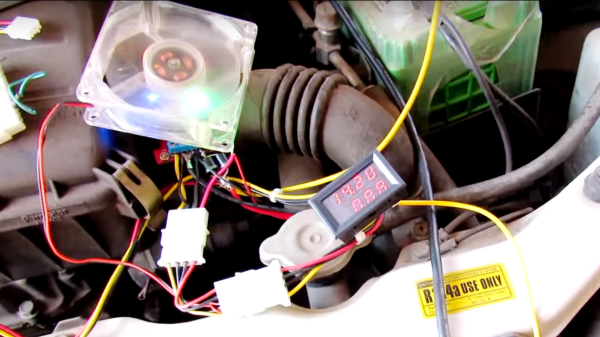
Clearly, [Kedar Nimbalkar]’s solution would be practical only under somewhat bizarre circumstances, so we’ll concentrate on what we can learn from it. A spare PC power supply provides the electrons – [Kedar]’s 250W supply pushes 15A at 12 volts, which is a pretty respectable amount of current. The voltage is a little anemic, though, so he pops it up to 14.2 volts with a 150W boost converter cooled with a PC fan. A dual panel meter reads out the voltage and current, but a VOM could substitute in a pinch. About the only thing you might not have on hand is a pair of  honking 10A diodes to keep current from creeping back into the boost converter. [Kedar] claims he got enough of a charge back in the battery in five minutes to start his car.

As jump-starting goes, this hack is a bit of a stretch. It’s not the first time we’ve seen a MacGyver’d jump starter, though, and you never know when the principles and hardware behind these hacks will come in handy.

Continue reading “How A Hacker Jump Starts A Car”