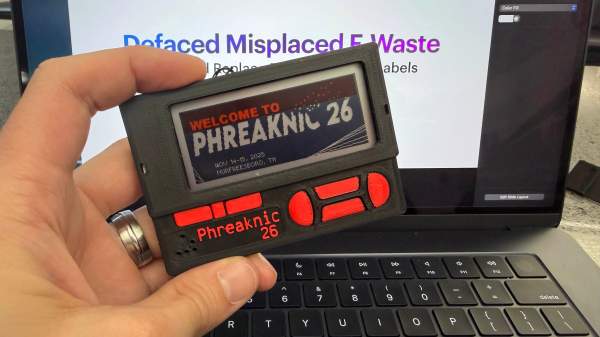
PN26 badge

Shelf Life Extended: Hacking E-Waste Tags Into Conference Badges

Ever wonder what happens to those digital price tags you see in stores once they run out of juice? In what is a prime example of e-waste, many of those digital price tags are made with non-replaceable batteries, so once their life is over they are discarded. Seeing an opportunity to breathe new life into these displays, [Tylercrumpton] went about converting them to be the official badge of the Phreaknic 26 conference.

Looking for a solution for a cheap display for the upcoming conference badge, [Tylercrumpton] recalled seeing the work [Aaron Christophel] did with reusing electronic shelf labels. Looking on eBay, he picked up a lot of 100 ZBD 55c-RB labels for just $0.70 a piece. When they arrived, he got to work liberating the displays from their plastic cases. The long-dead batteries in the devices ended up being easily removed, leaving behind just the display and the PCB that drives it.
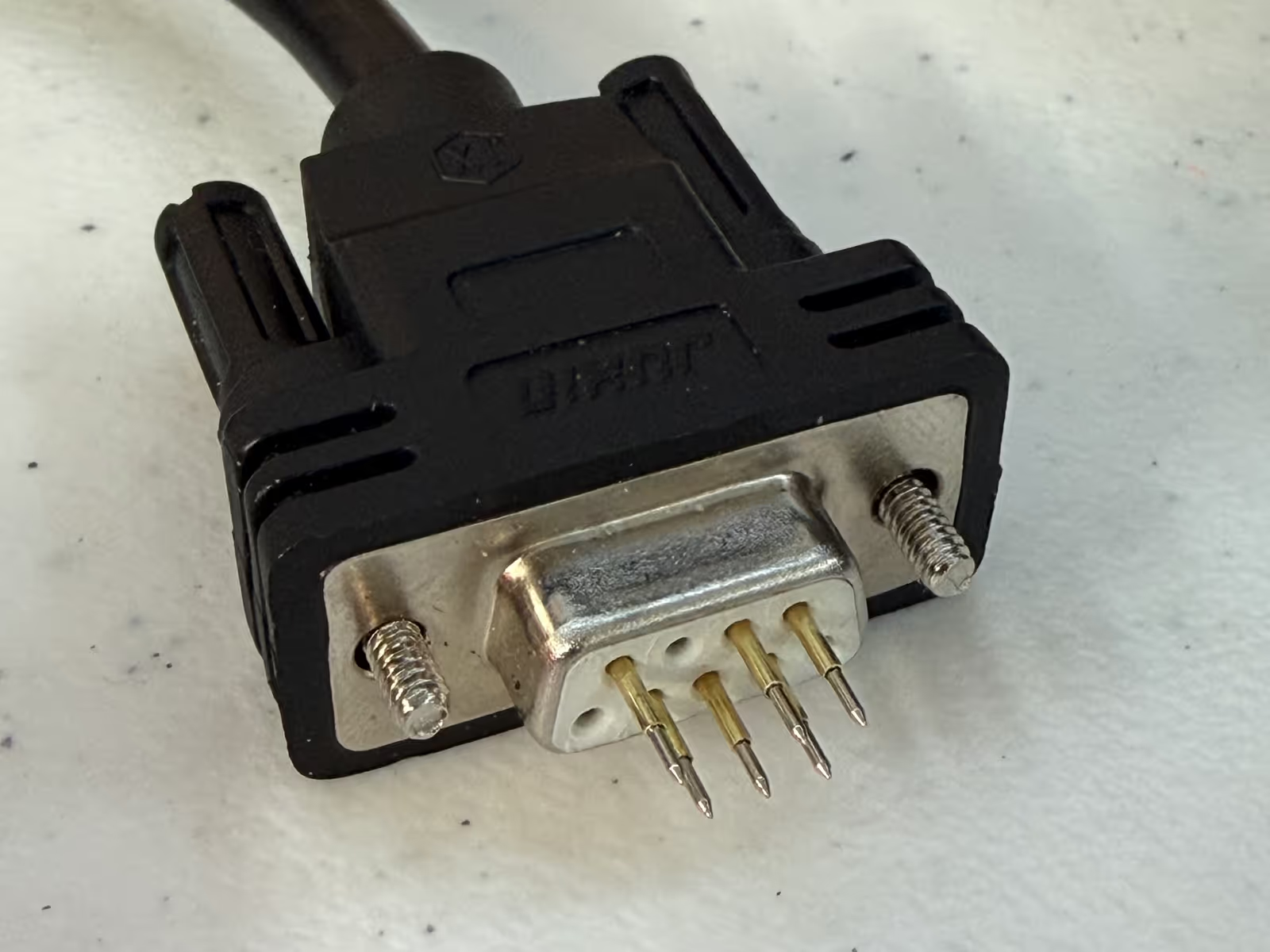
db9 programmerAnother hacker assisting with the badge project, [Mog], noticed that the spacing of the programming pads on the PCB was very close to the spacing of a DB9/DE9 cable. This gave way to a very clever hack for programming the badges: putting pogo pins into a female connector. The other end of the cable was connected to a TI CC Debugger which was used to program the firmware on the displays. But along the way, even this part of the project got an upgrade with moving to an ESP32 for flashing firmware, allowing for firmware updates without a host computer.

The next challenge was how to handle customizing 200 unique badges for the conference. For this, each badge had a unique QR code embedded in the back of the 3D printed case that pointed to an online customization tool. The tool allowed the user to change which of the images was used for the background, as well as input the name they wanted to be displayed on the badge. Once finished, the server would provide a patched firmware image suitable for flashing the badge. The original intent was to have stations where attendees could plug in their badge and it would update itself; however, due to some 11th hour hiccups, that didn’t pan out for this conference. Instead, [Tylercrumpton] ran the update script on his machine, and it gave him a great opportunity to interact with conference attendees as they stopped by to update their badges.

For the Phreaknic 27 badge, the plan is to once again use electronic shelf labels, but this time to utilize some of the advanced features of the tags such as the EEPROM and wireless communications. We’re eager to see what the team comes up with.

Continue reading “Shelf Life Extended: Hacking E-Waste Tags Into Conference Badges”
Chipcon CC1110/CC1111 Serial Bootloader

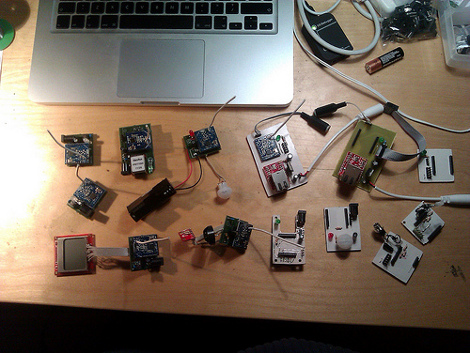
[Joby Taffey] just rolled out a serial bootloader for the Chipcon CC1110/CC1111 processors. The project is called CCTL and aims to make prototyping with the Girltech IM-ME a bit less tedious. Up until now firmware for the device had to be pushed in with a GoodFET or TI proprietary programmer which was quite slow. But this bootloader makes it possible to push your code via the chip’s serial port at 115200 baud. But the pretty pink pager isn’t the only device using these chips and to prove it [Joby] send this picture of all the electronics he has on hand running this architecture.

Once the 1KB CCTL bootloader has been flashed to the chip, a serial port or USB to Serial converter can be used as a programmer. [Joby] warns that the Chipcon processors are not 5V tolerant so you need to either use a 3V serial converter or add a level converter into the mix.

CCTL provides the features you’d expect from a bootloader. It uses the chip’s watchdog timer to guard against failure due to broken code. And there is an upgrade mode available at power up. Instruction for use are included in the Github repo linked at the top.

Printable Gripping Rover Is Wristwatch Controlled

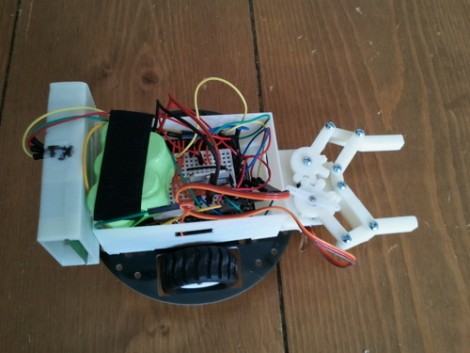
[Lars Kristian Roland] is using a wristwatch to control this rover. The bot itself is a utilitarian build with a gripper based on this Thingiverse project. As you can see in the video after the break, it’s got variable speed control based on accelerometer data from a TI ez430 Chronos wristwatch.

The watch connects to the bot wirelessly thanks to a CC1110 development board which relays communications to the on-board Arduino through a serial connection. It looks like it’s a bit of a bother to make slow and precise movements using this setup, but this can probably be changed by tweaking how accelerometer values are interpreted (using a non-linear equation would allow you more control at low speeds without sacrificing top speed for the motors).

Because this is using the same RF hardware that the IM-ME does, we can’t help but wonder if the CC1110 development board could be swapped out for an unused IM-ME dongle?

Continue reading “Printable Gripping Rover Is Wristwatch Controlled”

IM-ME USB Dongle Hacking

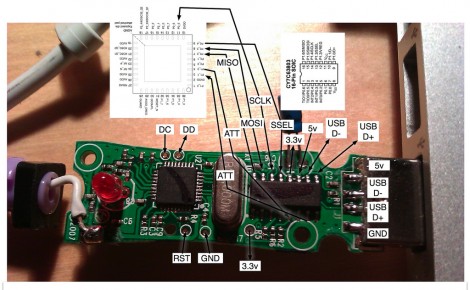
This circuit board is from the USB dongle of a Girl Tech IM-ME. [Joby Taffey] took it apart and poked around to learn its secrets. These dongles come along with the pink pager that has become a popular low-cost hacking platform. But we haven’t seen much done with the dongle itself up until now.

[Joby] used the OpenBench Logic Sniffer to gain some insight on what’s going on here. The board has two chips on it, a Cypress CY7C63803 USB microcontroller which talks to the computer over USB and also communicates over SPI with a Chipcon CC1110 SoC radio. It looks like reprogramming the Cypress chip is a no-go, so he went to work on the CC1110. The inter-chip communications data that he acquired by sniffing the SPI lines gave him all he needed to reimplement the protocol using his own firmware. As a proof of concept he to reflashed the CC1110 and can now send and receive arbitrary commands from the dongle. There’s a tiny video after the break showing a script on the computer turning the dongle’s LED on and off.

Continue reading “IM-ME USB Dongle Hacking”

Pulling Data From The IM-ME Spectrum Analyzer

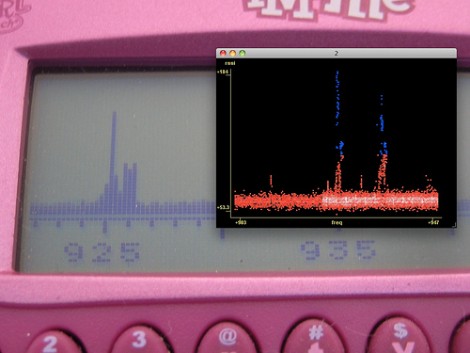
A small, cheap spectrum analyzer with an LCD can be a fun thing to play with. But to be truly usefully you need access to raw data, and lots of it. [Travis Goodspeed] set out to make that possible by pulling data with a GoodFET and a Python script.

He started with [Michael Ossmann’s] IM-ME spectrum analyzer, which uses a CC1110 chip. The two of them are giving a lecture at Toorcon 12 (called Real Men Carry Pink Pagers) and this will be used as a demonstration device. After studying the datasheet he found the starting RAM address and did some further work to deciphered how the data is stored in it. From there it was a matter of working out the timing for grabbing the data, and coding a method for storing it. Now he’s looking for brave souls to help him trailblaze with this newly-discovered tool. It seems that if you know what you are doing, and have abundant patience, you can use this for a bit of old-fashioned reverse engineering.