Expensive Batteries Hide Cheap Tricks

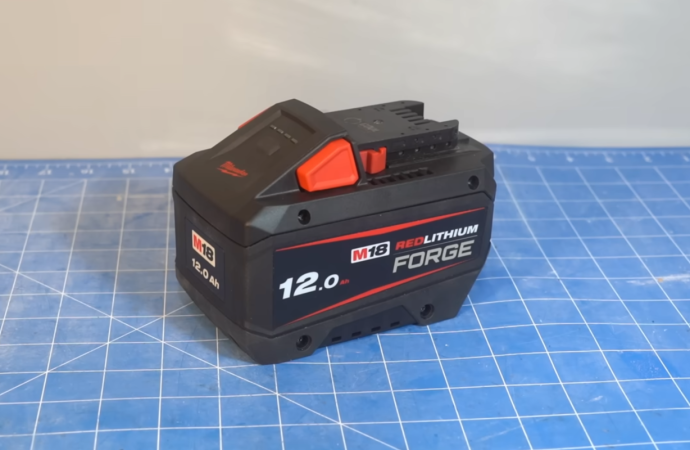
In our modern world full of planned obsolescence helping to fuel cycles of consumerism, the thing that really lets companies dial this up to the max is locked-down electronics and software. We all know the key players in this game whether it’s an automotive manufacturer, video game console producer, smart phone developer, or fruit-based computer company of choice, but there are some lesser known players desperately trying to make names for themselves in this arena too. Many power tool manufacturers like Milwaukee build sub-par battery packs that will wear out prematurely as [Tool Scientist] shows in this video.

Determining that these packs don’t actually balance their cells isn’t as straightforward as looking for leads going to the positive terminal of each. The microcontrollers running the electronics in these packs are hooked up, but it seems like it’s only to communicate status information about the batteries and not perform any balancing. [Tool Scientist] tested this hypothesis through a number of tests after purposefully adding an imbalance to a battery pack, first by monitoring i2c communications, measuring across a resistor expected to show a voltage drop during balancing, let a battery sit 21 days on a charger, and then performing a number of charge and discharge cycles. After all of that the imbalance was still there, leading to a conclusion that Milwaukee still doesn’t balance their battery packs.

Giving them the benefit of the doubt, it could be that most packs will be just fine after years without balancing, so the added cost of this feature isn’t worth it. This video was put out nearly a year ago, so it’s possible Milwaukee has made improvements since then. But a more realistic take, especially in a world dominated by subscription services and other methods of value extraction, is that Milwaukee is doing this so that users will end up having to buy more batteries. They already make user serviceability fairly difficult, so this would be in line with other actions they’ve taken. Or it could be chalked up to laziness, similar to the Nissan Leaf and its lack of active thermal management in its battery systems.

Thanks to [Polykit] for the tip!
Continue reading “Expensive Batteries Hide Cheap Tricks”

Connecting (And Using) High-Capacity Batteries In Parallel

For those willing to put some elbow grease into it, there is an almost unlimited supply of 18650 lithium ion batteries around for cheap (or free) just waiting to be put into a battery pack of some sort. Old laptop and power tool batteries are prime sources, as these often fail because of one bad cell while the others are still perfectly usable. [limpkin] built a few of these battery packs and now that he’s built a few, he’s back with a new project that allows him to use four custom packs simultaneously.

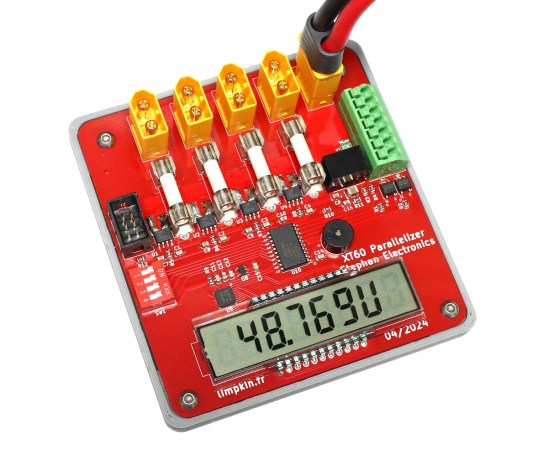
The problem with using different battery packs in parallel is that unless the batteries are charged to similar voltages, they could generate a very high and potentially dangerous amount of current when connected in parallel. This circuit board, powered by a small ATtiny microcontroller, has four XT60 connectors for batteries and a fifth for output. It then watches for current draw from each of the batteries and, using a set of solid-state relays, makes sure that no dangerous over-current conditions occur if the batteries are connected with mismatched voltages. The code for the microcontroller is available on this GitHub page as well.

An array of batteries with a balancing system like this has a number of uses, from ebikes to off-grid power solutions, and of course if you build your own packs you’ll also want to build a cell balancer of some sort as well. Batteries go outside the realm of theory and into that of chemistry, so we’ll also provide a general warning about working in potentially dangerous situations without specialized knowledge, but you can see how [limpkin] built his original packs here if you want to take a look at one person’s strategy for repurposing old cells.

Continue reading “Connecting (And Using) High-Capacity Batteries In Parallel”

Disposable Vape Batteries Turned USB Power Bank

It’s another one of those fun quirks about our increasingly cyberpunk world — instead of cigarette butts littering our streets, you’re more likely to find disposable vaporizers that have run out of juice. Unfortunately, while the relatively harmless paper remnants of a cig would eventually just fall apart when exposed to the elements, these futuristic caltrops are not only potentially explosive thanks to their internal lithium-ion battery but aren’t going anywhere without some human intervention.

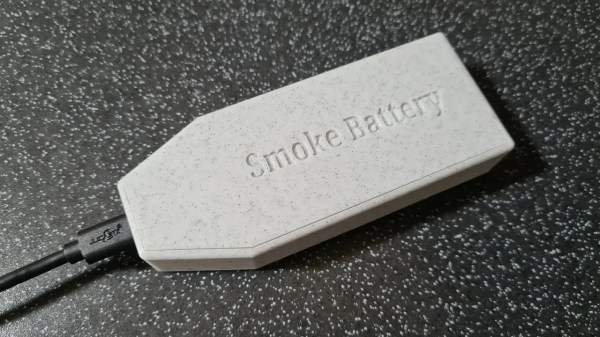
So do the environment and your parts bin a favor: pick them up and salvage their internal cells. As [N-Ender_3] shows with this build, it’s cheap and easy to turn the remnants of a few vapes into a useful USB power bank. In this case, the enclosure is 3D printed, which makes it particularly form-fitting, but you could just as easily pack the cells into something else if you’re not a fan of extruded plastic.

Continue reading “Disposable Vape Batteries Turned USB Power Bank”

A 48 Volt Battery Pack With Carefully Balanced Cells

Many readers will have at some time or another built their own lithium-ion battery packs, whether they are using tiny cells or the huge ones found in automotive packs. A popular choice it to salvage ubiquitous 18650 cylindrical cells, as [limpkin] has with this 48 volt pack. It’s based around an off-the-shelf kit aimed at the e-bike market, but it’s much more than a simple assembly job.

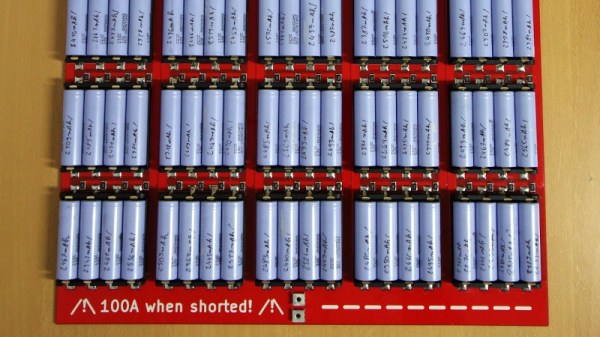
Faced with a hundred salvaged cells of unknown provenance, the first thing to do was ensure that they were all balanced and showed the same voltage. Some might do this the inefficient way by hooking each one up to a charger and a programmable load, but in this case a much more radical route was taken. A huge PCB was designed with sockets for all hundred cells, connected in parallel through individual series resistors. This allowed them to balance to a common voltage before being discharged to a safe voltage for assembly. Their individual ESRs were the measured, and the best performing examples were then spot-welded into the final 13s-6p final pack.

We all use lithium-ion batteries, but how many of us know how they work?