Wrangling Datacenter GPUs Into A Desktop

As we’ve seen many times before, there’s usually some way wrangle a bit more life out of what would otherwise be considered old and obsolete technology. Perhaps one thing that has been passed over by the masses a bit to early is older datacenter GPUs, which is understandable in one sense because of the rate NVIDIA is pumping out new ones, but these cards have plenty of useful life left in them for the average person, as [Andrew] demonstrates.

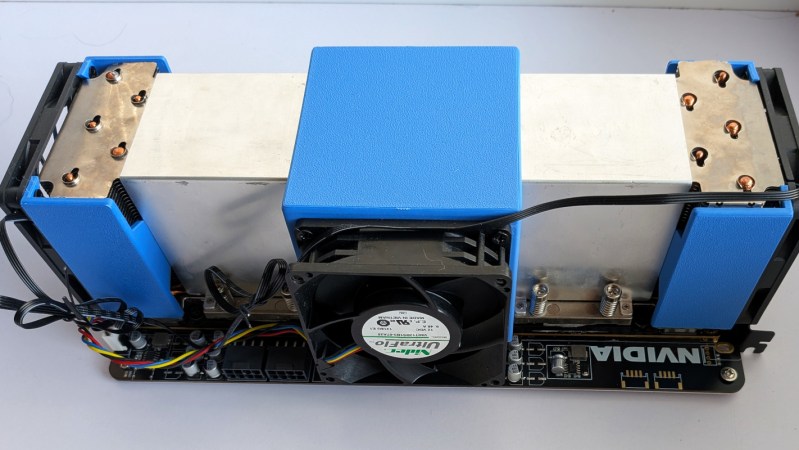
The cards [Andrew] is using are Tesla V100s of 2017 vintage. Despite being older hardware they have high-speed memory which allows them to run modern LLMs locally, competitively with online models. In this test, Gemma 4 26B and Qwen3 35B are run, with Gemma being a bit faster because it fits entirely in GPU memory and Qwen3 being a bit more capable but more hungry for resources. [Andrew] built a PCI card that can host two V100s, allowing these larger models to fit completely in memory.

Even though these don’t perform at the same level as the latest top-tier online models, they’re surprisingly capable and also have the benefit of running completely locally. This might be concerning for those looking at the global economy being propped up by companies that essentially have no moat for motivated users, especially as more and more datacenter hardware becomes available on the secondhand market. While this build by [Andrew] goes into detail on getting the software stack up and running, we recently featured another build using the same GPUs that focuses a bit more on hardware for those looking to get started with local hosting.
Underwater Datacenter Proves To Be A Success

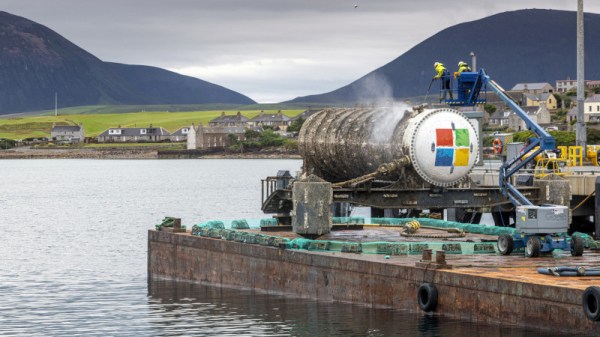
Back in 2018, Microsoft began Project Natick, deploying a custom-designed data center to the sea floor off the coast of Scotland. Aiming to determine whether the underwater environment would bring benefits to energy efficiency, reliability, and performance, the project was spawned during ThinkWeek in 2014, an event designed to share and explore unconventional ideas.

This week, Microsoft reported that the project had been a success. The Northern Isles data center was recently lifted from the ocean floor in a day-long operation, and teams swooped in to analyse the hardware, and the results coming out of the project are surprisingly impressive.

Continue reading “Underwater Datacenter Proves To Be A Success”

Monitoring The World’s DNS Status Using A Display Straight Out Of WarGames

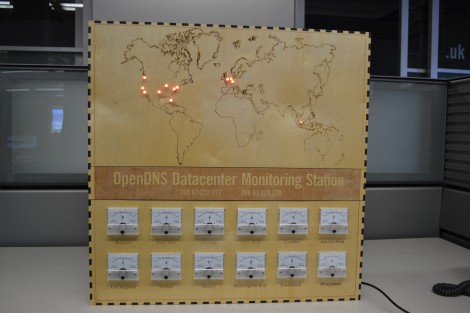
Nothing says Cold War like a map of the work with LEDs embedded in it. Throw in some analog dials for good measure and you’ve got a piece that would be comfortable mounted next the WOPR in everyone’s favorite ’80s-computers-run-amok movie. We think [Dima] really hit the mark when building this status panel for OpenDNS datacenter monitoring.

[Dima] works for OpenDNS and wanted to make something special for its upcoming 5 year anniversary. He’d already been toying with making boxes from laser-cut wooden pieces. This was just a matter of choosing a size that would fit the dials and leave a suitable area for a laser-etched map. Each of the twelve panel meters gets a PWM signal from the Arduino Mega that he used to bring the device to life. It shows a comparative server load for each data center based on the previous day’s numbers. There is an LED in the map for each of these centers. Right now they’re all red, but he used RGB LEDs and plans to upgrade the capability soon. He should have no problem doing this as he sourced some TLC5940 drivers to extend his I/O capabilities.

Don’t forget the check out the clip embedded after the break. Continue reading “Monitoring The World’s DNS Status Using A Display Straight Out Of WarGames”

Microsoft’s Data Centers Growing By The Truckload

The growing demands of Microsoft’s core customers necessitate dramatic alterations in the way Microsoft’s data centers are set up. Before their server racks were replaced one at a time, Microsoft’s new solution to server management is to truck in servers in sealed shipping containers and set them up without even taking them out. If a core number of servers start to fail within the shipping container it is removed, returned to the manufacturer, and replaced. This strategy helps Microsoft manage the desires of its consumer base for search, video, photo services and other services provided under the Microsoft Online umbrella. Although Microsoft’s method of server management makes the process of running data centers more efficient, thereby saving costs and power, Microsoft still has to contend with old networking protocols. It’s counting on the industry to innovate in these areas.

[via Boing Boing]