The Heat Island Effect Is Warming Up The AI Data Center Controversy

There’s been a lot of virtual ink spilled in environmental circles about the cooling water requirements of data centers, but less consideration of what happens with all the heat coming out of these buildings. Naturally, it’s going to warm the surrounding environment, but how much? Around 2 C (3.6 F) on average, and potentially much more than that, according to a recent study on the data heat island effect.

It’s common sense, of course: heat removed from the data center doesn’t go away. That heat might go into a body of water if one is available, but otherwise it’s out into the atmosphere to warm up everybody else’s day. In some places — like a Canadian winter — that might not be so bad. In others, where climate change and urban heat islands are cranking up the summertime temperatures, it very much could be. Especially if you’re in the worst-case scenario micro-climate described by the paper, which saw a predicted increase of 9.1 C (16 F).

Now, these results are theoretical and need to be ground-truthed, but anyone who has huddled next to the air-exchange unit of a large building for warmth knows there’s something to them. Unfortunately there don’t seem to be before-and-after measurements available for existing data-centers — AI or otherwise — to show exactly what their heat output is doing in the real world, but the urban heat island effect from all the dark asphalt in our cities is well known. Cooling paint and green roofs can help with that, but they won’t do much for the megawatts being pumped out to keep your cousin’s AI girlfriend online.

Some would argue that all this heat wouldn’t be a problem if we could launch the data centers outside the environment — just have a care the front doesn’t fall off.


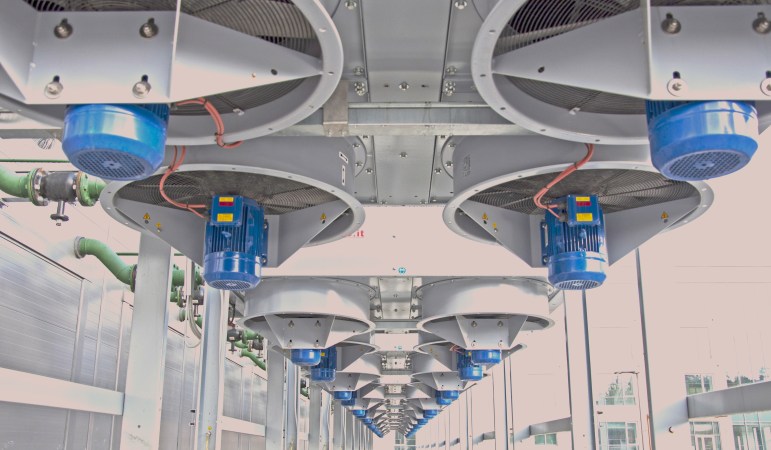
Image of data center cooling by Анна from Pixabay

Underwater Datacenter Proves To Be A Success

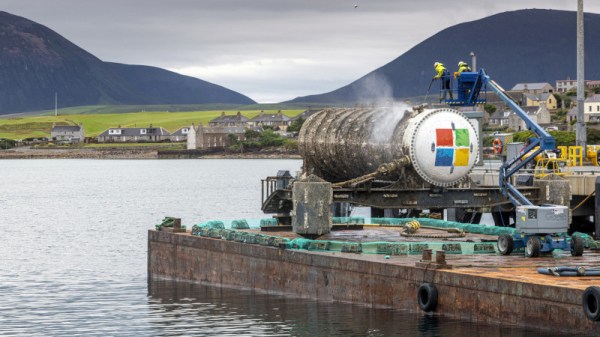
Back in 2018, Microsoft began Project Natick, deploying a custom-designed data center to the sea floor off the coast of Scotland. Aiming to determine whether the underwater environment would bring benefits to energy efficiency, reliability, and performance, the project was spawned during ThinkWeek in 2014, an event designed to share and explore unconventional ideas.

This week, Microsoft reported that the project had been a success. The Northern Isles data center was recently lifted from the ocean floor in a day-long operation, and teams swooped in to analyse the hardware, and the results coming out of the project are surprisingly impressive.

Continue reading “Underwater Datacenter Proves To Be A Success”

Open Compute Project Hosts Hackathon

OCP Summit

The folks at Open Compute Project are running their annual summit in January, but this year they’ll be adding a hardware hackathon to the program. The hackathon’s goal is to build open source hardware that can be applied to data centers to increase efficiency and reduce costs.

The Open Compute Project (OCP) is a foundation that develops open hardware for data centers. This includes power supplies, motherboards, and storage disk arrays. The project started up at Facebook, but it’s now an independent foundation.

The hackathon will take place over the two day summit on January 16th and 17th, 2013 in Santa Clara. The registration is now open, and it’s free but limited to the first 100 people.

The hackathon is being put on with collaboration from Upverter, Github, and GrabCAD, who will be providing tools for the event. If you’re in the Santa Clara area and looking to do some hacking early in the new year, you might want to check this out.

Welcome To The Petacentre

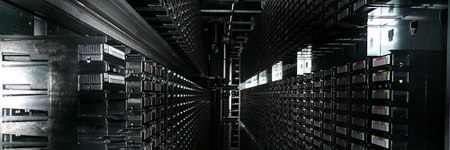
[Cory Doctorow] obtained access to a few data centers that deal in petabyte storage. The demand for data storage and processing doesn’t show any sign of stopping. It’s especially relevant when people need the resources to manage not only things like Google searches, but also email, customer transactions, and in the case of CERN, physics calculations. [Doctorow] drew an interesting conclusion from his experiences with the data centers; any innovation that the petabyte centers work on will eventually drift on down to the ordinary user, in laptop or desktop innovation. The petabyte center is easily duplicated with materials that are available for purchase to the average computer user; the only obstacles are price and space.

[via Boing Boing]