

Secret Ingredients

We were talking on the podcast about rope. But not just any rope – especially non-stretchy rope for using in a mechanical context. The hack in question was a bicycle wheel that swapped out normal metal spokes for lighter and stronger high-density polypropylene weave, and if you can tension up a bike wheel and ride it around, you know it’s not your garden-variety twine.

Now, it just so happens that I’ve got basically the same stuff in my parts drawer: some 1 mm diamaeter Dyneema-brand rope. This is an amazing material. It’s rated to a breaking strength of 195 kg (430 lbs) yet it weighs just under one gram per meter, and if you buy the pre-stretched variant, it’s guaranteed to stretch less than 1% of its length under load. It’s flexible, wears well, and is basically in every way superior to braided steel wire.

It’s nearly magical, and it’s just what you need if you’re making a cable robot or anything where the extreme strength and non-elongation characteristic are important. It’s one of those things that there’s just no substitute for when you need it, and that’s why I have some in my secret-ingredients drawer. What else is in there? Some high-temperature tape, low-temperature solder, and ultra-light-weight M3 PEEK screws for airplane building.

But our conversation got me thinking about the parts, materials, and products that are unique: for which there is just no reasonable substitute. I’m sure the list gets longer the more interesting projects or disciplines that you’re into. What are your secret ingredients, and what’s the specific niche that they fit into?
Gas-Powered Fly Swatter Slightly Over-Engineered

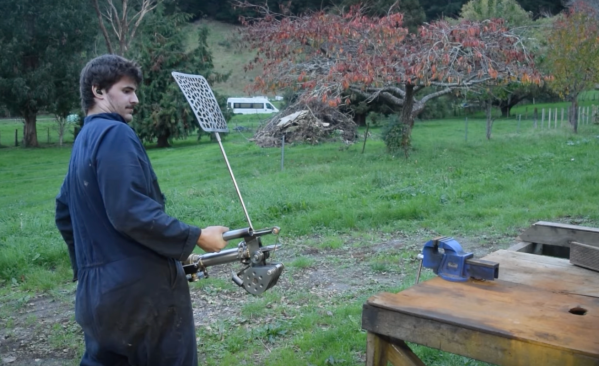
Any good flyswatter ought to be able to break through a hefty piece of wood. At least, that is how [Finn] explains the design philosophy behind this enormous, overpowered flyswatter. Although we don’t know if everyone needs as robust a machine as this to deal with a minor annoyance like a house fly, we can certainly appreciate the over-engineered, extremely powerful (and dangerous) machine that can swat flies but also break through a two-by-four with ease.

The build comes to us in two parts, with the first part documenting the construction of some of the parts of the flyswatter, including the piston-driven gas cylinder. As a bit of a tangent, [Finn] first tests this part by using it to shoot lemons at pieces of plywood. After this initial testing of the gas cylinder, a cam mechanism is installed on the top, and the gas cylinder is slightly modified to pull on a piece of Dyneema rope attached to the cam. At the other end of the rope is a long metal lever with the flyswatter on the end, in this case, made out of a sheet of laser-cut plate steel.

With the addition of a few safety features, like a spring-assisted bumper to keep the flyswatter from swinging too far and hitting its operator, the machine is ready for use. It also eventually received some other upgrades as well including extra weights to prevent the flyswatter from bouncing after firing and a reinforced metal rod to hold the flyswatter after its demonstrations on various dimensional lumber destroyed it. In all likelihood, this is the largest insect-control device we’ve seen since this microwave-powered bug zapper. Now if you are building an insect

Continue reading “Gas-Powered Fly Swatter Slightly Over-Engineered”

The Goalie Mask, Reenvisioned

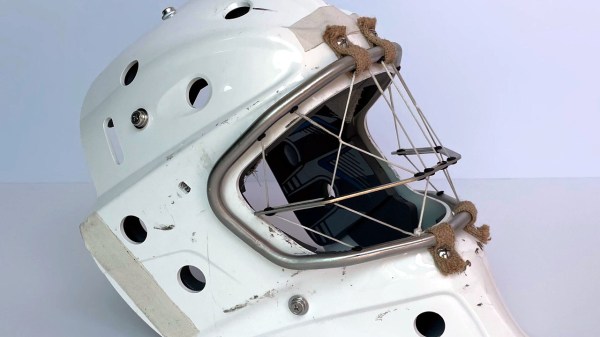
The goalie mask, at least the retro-styled fiberglass types from the 60s and 70s, hasn’t been used in hockey for about 50 years —  it’s instead made many more appearances in horror movies than on ice rinks. Since then, though, there’s been very little innovation surrounding the goalie mask even though there’s much more modern technology that could theoretically give them even greater visibility. [Surjan Singh] is hoping to use his engineering and hockey backgrounds to finally drive some improvements.

The “uncage” is based on Dyneema thread, a polyethylene fiber known for its strength and durability. It’s often used in applications that demand high strength with minimal weight, such as for sails or backpacking equipment. Using strands of Dyneema woven through a metal support structure is what gives this mask its high strength while also improving the visibility through it dramatically. [Surjan] has been prototyping this design extensively, as there were some issues with the fibers chafing on attachment points on the metal frame, but most of these issues have been ironed out or are being worked on currently.

In the meantime, [Surjan] has been looking for a professional-level goalie to help refine his design further and does seem to have some interest, but it doesn’t seem to have progressed past testing in the more controlled test environments yet. It’s not too far-fetched to imagine this as the future of goalie masks in professional hockey though since some innovation after 50 years of relative stagnation seems to be due. For something more accessible to those of us not currently playing in the NHL, though, you can wheel, snipe, and celly on this air hockey table instead.

Continue reading “The Goalie Mask, Reenvisioned”









