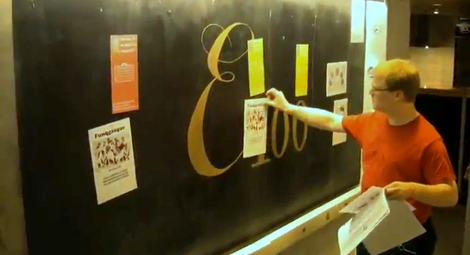
Electrical Engineers don’t need push pins. That’s because they know how to control electrons! [Sven] put his knowledge of these subatomic particles to use when building his high voltage bulletin board. It uses a set of vertically strung wires to keep paper pinned against the board. The wires have high voltage at low current travelling through them. They’re in front of the board, but not touching it, and the board is serving as a ground plane. In this way an electrostatic charge pushes (or should that be pulls?) against the paper to keep each sheet right where he places it.
In the video after the break [Sven] gives us a tour of the hardware at work here. It starts with a 12V psu which feeds a buck converter. The regulated feed is patched into a high voltage supply which was designed as a CCFL driver. Finally, a voltage doubler is used to reach the final voltage, measuring about 20 kV per wire.
Don’t worry, [Sven] says the bare wire is “almost completely safe” because of the low current being conducted.
Continue reading “20 Kilovolts Replaces Push Pins On This Bulletin Board”