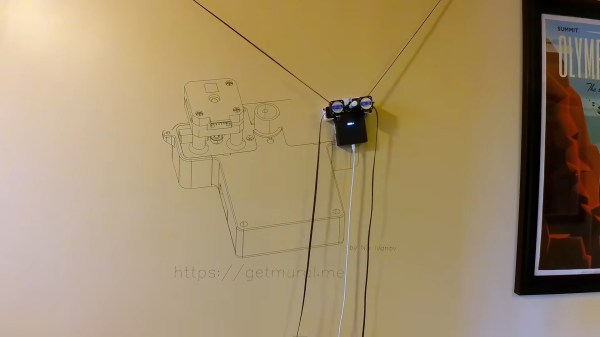
Back in our day you were told not to draw on the walls; nowadays we have robots for that– like Mural 2.0 by [Nik Ivanov]. If the name doesn’t give it away, this is a large format pen plotter made to draw, well, murals. It’s also not [Nik]’s first rodeo, though this version seems considerably improved from the orignial version.
He’s now using a FluidNC board based on an ESP32 and TMC2209 stepper drivers, while the steppers they drive are a pair of NEMA 17 pancake units. Using pancakes for this application makes sense, as the steppers are on the machine and must pull themselves up against gravity using the single belt that is anchored at ceiling level. The kinematics of that mean you don’t get the full area between the anchor points– you lose 20% at the edges– but you can still get a pretty big mural going. In the demo/build video embedded below, it looks like you’re more limited by marker life, [Nik] cautioning that past about 500 m of line things can start to get a bit weak as the pen dries out. He’s working on a ‘pause and replace pen’ routine for the next firmware version to help with that project.
For now, the WiFi-based interface [Nik] has on the ESP32 gives you that path length in advance, and can even process both SVG and raster images with both a sine-wave style squiggle and finite-curve style space filling. This isn’t the fastest pen plotter we’ve seen on these pages, and it might not quite be the simplest, either, but [Nik] has put together a very easy build that you could do with your nieces and nephews content in the knowledge that the easy-to-use firmware will let them keep making murals when you aren’t there– assuming, that is, that their mother lets them draw on the walls.
Continue reading “A Pen Plotter To Draw You Up (on) The Wall”