LEDs Turn The Heat Up On Flameless Pumpkin Lights

led-peter

When tea lights just won’t do, why not move up to a 5 channel LED candle simulator?

Halloween is fast approaching. Peter’s local hackerspace, The Rabbit Hole had a meeting to carve pumpkins and talk Halloween hacks. After seeing how poorly a tea light illuminated a medium size pumpkin, this hack was born. We’ve seen LED jack-o’-lantern hacks before, but this one was worth a second look.

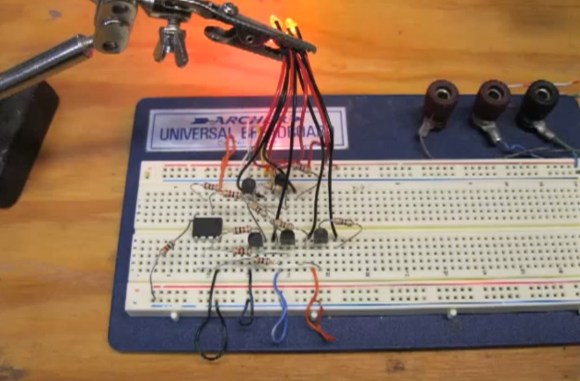
In true hackerspace style, [Peter] used what was available to him. A PIC12F508 is the heart of the project. The 12X508/9 series has been around for at many years, and is still a great chip to work with. We remember using the ‘C’ version of this chip to bypass region locks on original PlayStation systems. [Peter] created a simple circuit with two basic modes. In “value mode” the 508 drives LED’s directly from its I/O pins. This limits the total output to 60mA. In “premium mode”, some 2N3904 NPN transistors are brought in to handle the current.  This allows the PIC to drive up to 5 LEDs.

Candles can be tricky to simulate with LEDs. [Peter] used 5 independent 16 bit linear feedback shift registers to generate pseudo random bit streams. The effect is quite impressive. A “wind simulation” completes the illusion of a real flame. Continue reading “LEDs Turn The Heat Up On Flameless Pumpkin Lights”

Flickering Pumpkin Lanterns

epumpkins1

Halloween is coming and [Paulo] decided to make some flickering jack-o-lanterns by hijacking the flickering circuit of a cheap LED tea light to drive a much more powerful light!

He has tons of old 12V incandescent bulbs collecting dust, so he decided to make use of them for some holiday fun. He wondered if he could steal the circuit from the flickering LED tea lights and use them to drive the incandescents. Upon taking the LED tea candle apart, he discovered there was no circuit, as it was in fact embedded in the LED itself! Not to worry though, he simply integrated the flickering LED into his circuit! Coupling a capacitor with the LED, he used a transistor amplifier to take the signal, and then finally boosted it using a MOSFET to drive the light bulbs. He then powered the entire thing using an old laptop power brick. Nice one [Paulo]!

Do you have any cool Halloween hacks? Don’t forget to send them in to the tip line! For other pumpkin fun, check out last year’s Pumpkin Tetris!

Robotic Tentacles For A Disturbing Haunted House

testicles

[ivorjawa] is putting on a haunted house this Halloween that we really don’t want to go to. His robot tentacle is already supremely creepy, and we’re assuming it will only be more frightening once it’s covered in fabric and foam rubber.

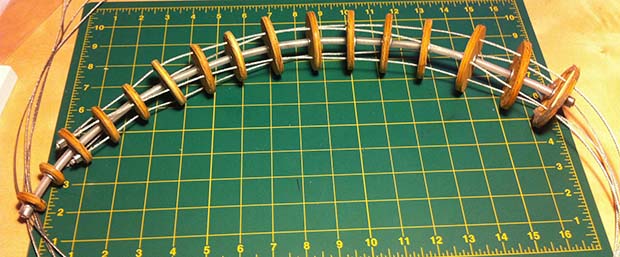
Each tentacle can move on two axes thanks to four steel cables running through this strange Geiger-esque contraption. In the base of the tentacle are two stepper-motor driven cylinders that take up slack on one cable and draw out another cable. Two of these control boxes, driven by a stepper motor and an Arduino motor shield, allow the tentacle to reach out and grab in any direction. You can check out the mechanics of the build on [ivorjava]’s flickr

On a semi-related note, even though we’re more than a month out from Halloween, we should have more Halloween builds in our tip line by now. If you’re working on one, don’t be afraid to send it in, even if you’re just showing off a work in progress.

Continue reading “Robotic Tentacles For A Disturbing Haunted House”

Roomba And Virtual Walls Make Up This Theme Family Halloween Costume

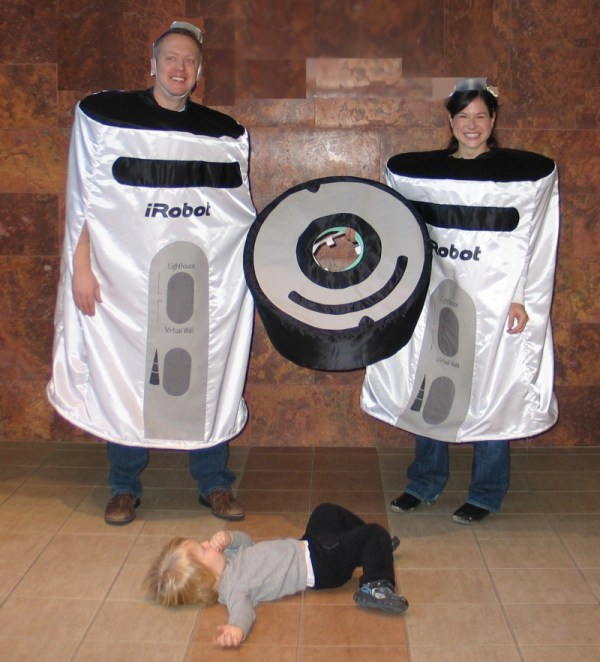
It figures. You spend a ton of time making a cool set of costumes and then you can’t get your kid to pose for a picture. It’s okay though, we still get the point. This themed set of costumes dresses the little one as a Roomba vacuuming robot while mom and dad are suited up as virtual walls (modules that are used to keep the bot from falling down stairs, etc.). It’s fun and unique, but had it not been for some additional electronics this would have been relegated to a links post. For safety sake each costume was outfitted with a ring of LEDs. As a challenge, the lights were given the ability to sync up patterns with each other.

Each costume has a circular frame at the top with a set of RGB LED strings attached. To get them to display synchronized patterns an IR transmitter/receiver board was designed and ordered from OSHPark. Each costume has four of these modules so no matter where the wearers are facing it should not break communications. A demo of the synchronized light rings can be seen after the break

Continue reading “Roomba And Virtual Walls Make Up This Theme Family Halloween Costume”

Computers Not Candy With The Geek Group

This year for Halloween, The Geek Group, decided to take a very different approach to outreach. Instead of making animatronics, or converting their giant (seriously HUGE) space into a haunted house, they held an event called “Computers Not Candy” where they teamed up with a large local company to bring 100 tablet computers to 100 youths.

If you’re not already familiar with the Geek Group, you should check them out. They’re a huge hackerspace that really seems to have their act together. They put out really cool videos regularly, our favorite being the equipment autopsies.

While we really do admire the work they did to introduce these kids to hackerspaces, we also love candy and silly spooky projects. Next year how about Computers AND Candy!

Rock ‘Em Sock ‘Em Robot Costumes Make Party Conversation Awkward

Don’t get us wrong, we love these Rock ‘Em Sock ‘Em Robot costumes. But as with that Samus Helmet it must make party conversation a bit weird. And how do you hold on to your beer? But you’ve got to commend [EyeHeartInk] and his friend for their commitment. Not only did they wear them to the party, but they spent two months building the things.

Pretty much everything was made from cardboard. All of it was hand cut with a box cutter and a hobby knife. Duct tape and glue were the adhesives of choice, and according to this thread a total of fifteen rolls of tape were used. The half spheres on the side of either helmet were molded from expanding spray foam inside a ping-pong ball which had been lopped in half. And of course there are a pair of LEDs for the eyes of each bot.

We usually try to link to other articles that are related, but it doesn’t look like we’ve seen this concept before So you’ll have to settle for this non-Halloween wristwatch controlled robot boxing game.


Can You Believe This Portal Gun Was Built From Scratch?

This Portal gun will really make [aNoodleJMC’s] costume pop this year. She actually built the video game weapon replica from scratch. It even includes some electronics to light it up blue or orange depending on which portal she’s planning to fire at an available flat surface.

There’s a lot of parts that went into the project, but by far our favorite one on the list is an acrylic toilet plunger. Its handle serves as a light pipe for the colored LEDs and can be seen above as a cloudy rod at the center of the clear barrel. A 4″ and 3″ PVC pipe helped to form the rest of the barrel, along with a 3″ clear acrylic pipe for the transparent areas. The bulbous parts of the body were sculpted from florist’s foam. Once she had all of the parts roughed out it’s obvious that [aNoodleJMC] spent a ton of time filling problem areas with Bondo, sanding everything smooth, and giving it a paint job she can be proud of. We hope she didn’t forget to include GLaDOS in the fun.

We actually just bought our Portal gun. But that’s because we had the big plans of adding the ability to levitate objects.

[vai reddit]