Ham Radio Needs To Embrace The Hacker Community Now More Than Ever

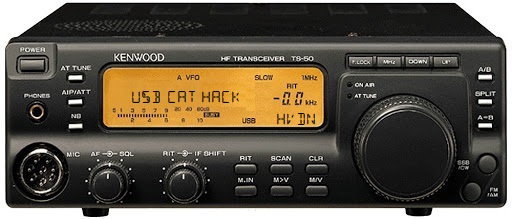
As many a radio amateur will tell you, ham radio is a hobby with as many facets as there are radio amateurs. It should be an exciting and dynamic place to be, but as those who venture forth into it sometimes sadly find out, it can be anything but. Tightly-knit communities whose interests lie in using $1,000 stations to chase DX (long-distance contacts), an advancing age profile, and a curious fascination of many amateurs with disaster communications. It’s something [Robert V. Bolton, KJ7NZL] has sounded off about in an open letter to the amateur radio community entitled “Ham Radio Needs To Embrace The Hacker Community Now More Than Ever“.

In it he laments that the influx in particular of those for whom disaster preparedness is the reason for getting a licence is to blame for amateur radio losing its spark, and he proposes that the hobby should respond by broadening its appeal in the direction of the hacker community. The emphasis should move from emergency communications, he says, and instead topics such as software defined radio and digital modes should be brought to the fore. Finally he talks about setting up hacker specific amateur radio discussion channels, to provide a space in which the talk is tailored to our community.

Given our experience of the amateur radio community we’d be bound to agree with him. The hobby offers unrivalled opportunity for analogue, mixed-signal, digital, and software tinkering in the finest tradition of the path set by the early radio amateurs around a hundred years ago, yet it sometimes seems to have lost its way for people like us. It’s something put into words a few years ago by our colleague Dan Maloney, and if you’re following [KJ7NZL]’s path you could do worse than read Dan’s long-running $50 ham series from the start.

Via Hacker News.

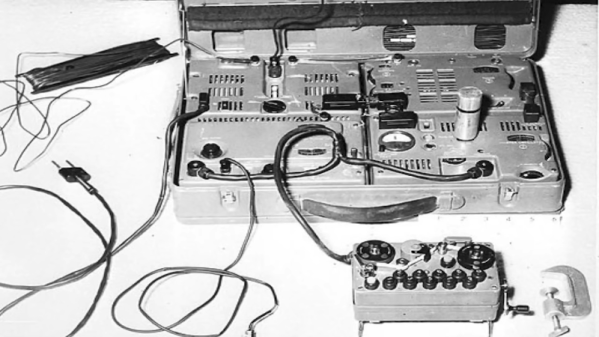
Header image: Unknown author, Public domain.

Portable Ham Antenna Uses SMD Capacitors

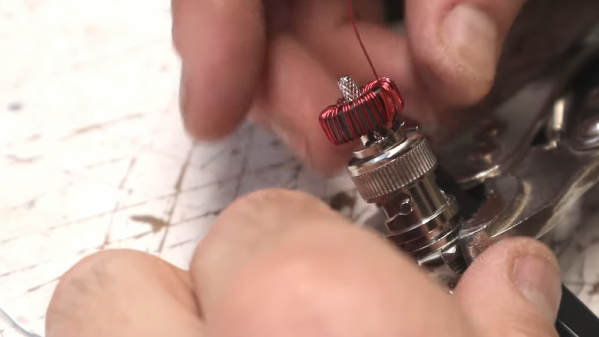
[K6ARK] likes to operate portable, so he puts together very lightweight antennas. One of his latest uses tiny toroids and SMD capacitors to form trap elements. You can see  the construction of it in the video below.

You usually think of toroid winding as something you do when building transmitters or receivers, especially small ones like these. We presume the antenna is best for QRP (low power) operation since the tiny core would saturate pretty quickly at higher power. Exactly how much power you should pass through an FT50-43 core depends on the exact application, but we’ve seen numbers around 5 watts.

Continue reading “Portable Ham Antenna Uses SMD Capacitors”

It Came From Outer Space: Listening To The Deep Space Network

Ham radio operators love to push the boundaries of their equipment. A new ham may start out by making a local contact three miles away on the 2m band, then talk to somebody a few hundred miles away on 20m. Before long, they may find themselves chatting to fellow operators 12,000 miles away on 160m. Some of the adventurous return to 2m and try to carry out long-distance conversations by bouncing signals off of the Moon, waiting for the signal to travel 480,000 miles before returning to Earth. And then some take it several steps further when they listen to signals from spacecraft 9.4 million miles away.

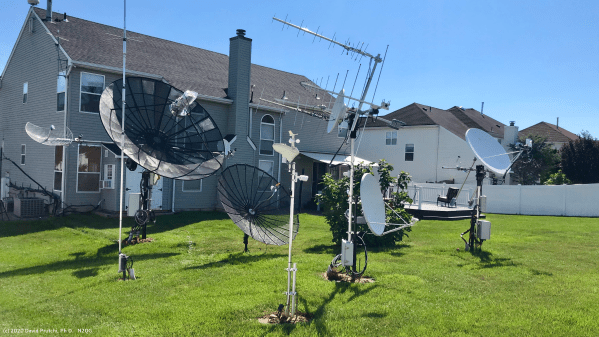
That’s exactly what [David Prutchi] set out to do when he started building a system to listen to the Deep Space Network (DSN) last year. The DSN is NASA’s worldwide antenna system, designed to relay signals to and from spacecraft that have strayed far from home. The system communicates with tons of inanimate explorers Earth has sent out over the years, including Voyager 1 & 2, Juno, and the Mars Reconnaissance Orbiter. Because the craft are transmitting weak signals over a great distance (Voyager 1 is 14 billion miles away!), the earth-based antennas need to be big. Real big. Each of the DSN’s three international facilities houses several massive dishes designed to capture these whispers from beyond the atmosphere — and yet, [David] was able to receive signals in his back yard.

Sporting a stunning X-band antenna array, a whole bunch of feedlines, and some tracking software, he’s managed to eavesdrop on a handful of spacecraft phoning home via the DSN. He heard the first, Bepi-Colombo, in May 2020, and has only improved his system since then. Next up, he hopes to find Juno, and decode the signals he receives to actually look at the data that’s being sent back from space.

We’ve seen a small group of enthusiasts listen in on the DSN before, but [David]’s excellent documentation should provide a fantastic starting point for anybody else interested in doing some interstellar snooping.

M17 Aims To Replace Proprietary Ham Radio Protocols

While M17 might sound like a new kind of automatic rifle (as actually, it is), we were referring to an open source project to create a ham radio transceiver. Instead of paraphrasing the project’s goals, we’ll simply quote them:

The goal here should be to kick the proprietary protocols off the airwaves, replace DMR, Fusion, D-Star, etc. To do that, it’s not just good enough to be open, it has to be legitimately competitive.

Like some other commercial protocols, M17 uses 4FSK along with error correction. The protocol allows for encryption, streaming, and the encoding of callsigns in messages. There are also provisions for framing IP packets to carry data. The protocol can handle voice and data in a point-to-point or broadcast topology.

Continue reading “M17 Aims To Replace Proprietary Ham Radio Protocols”

KiwiSDR Vs RaspberrySDR — A Tale Of Two SDRs

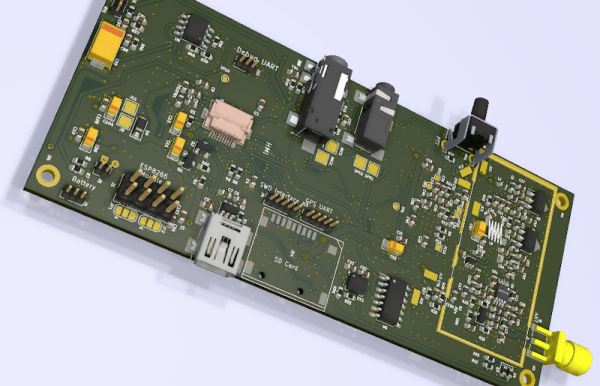
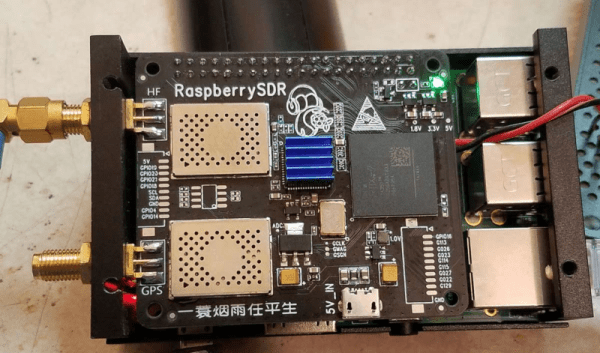
Once you move away from the usual software defined radio (SDR) dongles, you have only a few choices unless you want to drop some serious cash. One common hobby-grade SDR is the KiwiSDR. This popular unit runs Linux and can receive up to 30 MHz. The platform uses a dedicated A/D converter, an FPGA, and BeagleBone computer. Success of course breeds imitators, and especially when you have an open source design like the Kiwi, you are going to find similar devices with possibly different end goals. That’s how the RaspberrySDR came to be. This is a very similar unit to the KiwiSDR but it uses a Raspberry Pi, along with a handful of other differences. What’s different? [KA7OEI] tells us in a recent blog post.

Other than the obvious difference of the computer and all that it entails, the RaspberrySDR has a higher speed A/D (125 MHz vs 66 MHz) and 16-bits of resolution instead of the Kiwi’s 14 bits. This combines to give the Raspberry a wider receive range (up to 60 MHz) and — in theory — better performance in terms of dynamic range and distortion.

Continue reading “KiwiSDR Vs RaspberrySDR — A Tale Of Two SDRs”

ISS Ham Radio Repeater

There is a long history of spacecraft carrying ham radio gear, as the Space Shuttle, Mir, and the ISS have all had hams aboard with gear capable of talking to the Earth. However, this month, the ISS started operating an FM repeater that isn’t too dissimilar from a terrestrial repeater. You can see [TechMinds] video on the repeater, below.

The repeater has a 2 meter uplink and a 70 centimeter downlink. While you can use a garden variety dual-band ham transceiver to use the repeater, you’ll probably need a special antenna along with special operating techniques.

Continue reading “ISS Ham Radio Repeater”

Tutorial For Setting Up Raspberry Pi For Ham Radio Use

There was a time when a ham radio set up sported many dials and switches and probably quite a few boxes as well. Computers have changed all that. Some transceivers now have just a few buttons or are even totally computer-controlled. Where a ham, at one time, might have a TeleType machine, a slow-scan TV monitor, and a fax printer for receiving satellite images, now that can all be on a single computer which can even be a Raspberry Pi. [F4GOH] has a post that takes you from the fundamentals to installing everything from an SDR to many common ham programs for digital modes, APRS, SSTV, and more. You can download the seven-part tutorial as separate PDF files, too.

Even if you aren’t a ham, you might find some of the software interesting. OpenWebRX lets you listen to your software defined radio on the road. You can use other software to pick up weather satellite data.

Continue reading “Tutorial For Setting Up Raspberry Pi For Ham Radio Use”