
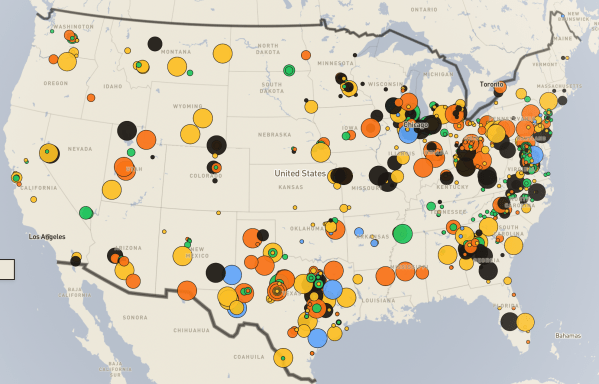
A map of the lower 48 US States with an overlay of various colorful bubbles indicating data center developments, whether proposed, contested, under construction, or operational. There are a lot of bubbles! Hawaii isn't pictured, but looks to have one project currently, but nothing in Alaska for now.

Who’s Building That Data Center?

One of the biggest “David versus Goliath” stories in tech right now is the towns beset by AI data center projects they may or may not have asked for. Powered By Who is tracking data center development in the US on this convenient map.

Currently, there are over 2,100 data centers being tracked by the project ranging from proposals to sites fully up-and-running. While you have to build bypasses data centers to keep the internet running (which we’re partial to here at Hackaday), there are certainly questions around the amount of power and water consumed by these sites, the emissions they’re sending into the surrounding community, and who exactly is reaping the benefits.

Whether you’re pro, against, or ambivalent about the proliferation of “AI” data centers, the map offers an engaging way to look at what projects are happening around the nation, especially when you start looking at clusters and how that interacts with the power generation and political makeup in a region. It’s particularly interesting how only three states account for roughly 70% of all the projects. Let us know if there’s a similar tracker in your area if you’re from one of the other parts of the globe!

Looking past the debate, there’s a lot of interesting engineering involved in keeping these data centers cool, although there are questions about where that heat ends up going. DC distribution inside the site, underwater data centers, and even putting them in space are some of the solutions for keeping the cooling loads tamed.

The Heat Island Effect Is Warming Up The AI Data Center Controversy

There’s been a lot of virtual ink spilled in environmental circles about the cooling water requirements of data centers, but less consideration of what happens with all the heat coming out of these buildings. Naturally, it’s going to warm the surrounding environment, but how much? Around 2 C (3.6 F) on average, and potentially much more than that, according to a recent study on the data heat island effect.

It’s common sense, of course: heat removed from the data center doesn’t go away. That heat might go into a body of water if one is available, but otherwise it’s out into the atmosphere to warm up everybody else’s day. In some places — like a Canadian winter — that might not be so bad. In others, where climate change and urban heat islands are cranking up the summertime temperatures, it very much could be. Especially if you’re in the worst-case scenario micro-climate described by the paper, which saw a predicted increase of 9.1 C (16 F).

Now, these results are theoretical and need to be ground-truthed, but anyone who has huddled next to the air-exchange unit of a large building for warmth knows there’s something to them. Unfortunately there don’t seem to be before-and-after measurements available for existing data-centers — AI or otherwise — to show exactly what their heat output is doing in the real world, but the urban heat island effect from all the dark asphalt in our cities is well known. Cooling paint and green roofs can help with that, but they won’t do much for the megawatts being pumped out to keep your cousin’s AI girlfriend online.

Some would argue that all this heat wouldn’t be a problem if we could launch the data centers outside the environment — just have a care the front doesn’t fall off.


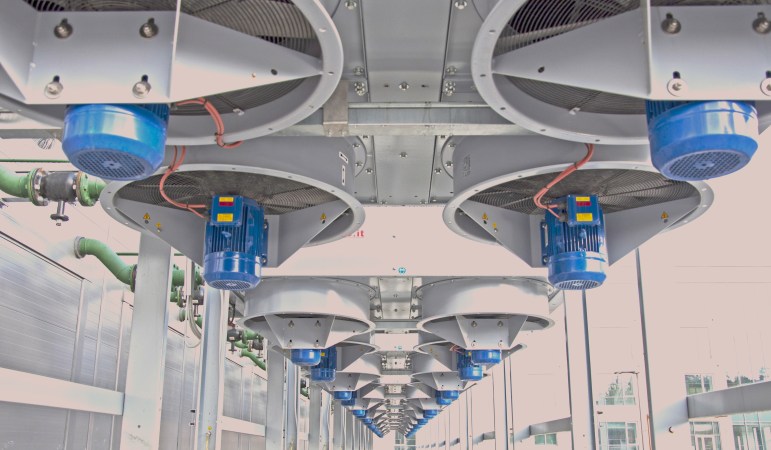
Image of data center cooling by Анна from Pixabay








