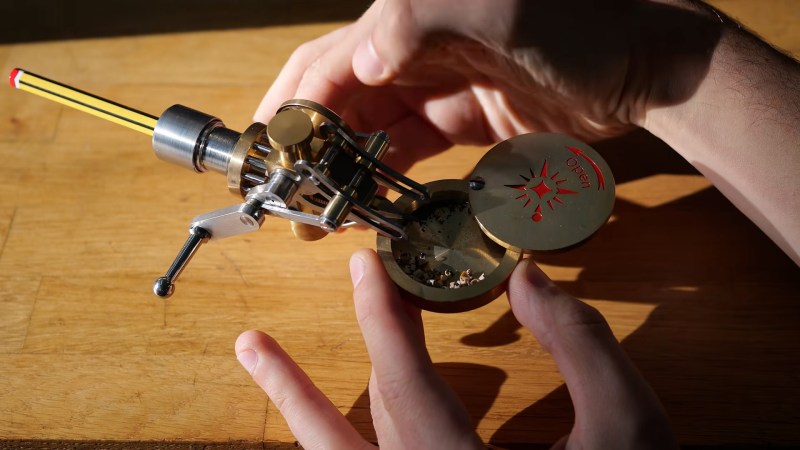
Making A New Mechanism For A Reciprocating Pencil Sharpener

An engineer’s greatest tool is the writing utensil. Be it pen or pencil, we use them for everything from making diagrams to marking out cuts. But as with any practitioner of an art, we can tend to become rather particular about the details. [Choronva Engineering] is not different, and to that end set out to re-invent the pencil sharpener. 

In this case, [Chronova]’s ideal pencil tip shape is a concave cone. This is a shape quite trivial to make by using a knife, but rather impossible with a traditional twisting motion. But what if one automatized the knife whittling motion? This is actually a very old idea, with examples dating back to at least 1910. In this example, the blade is guided along two tracks with a particular curvature to enable the concave cone. This is driven by a cam shaft connected to a little cranking mechanism. Initial tests showed the mechanism works quite well at producing a cutoff of the desired shape, but lacks a pencil rotation mechanism.
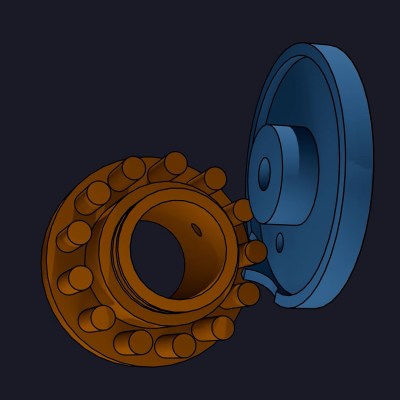
CAD mockup of the lantern-pinion mechanism.

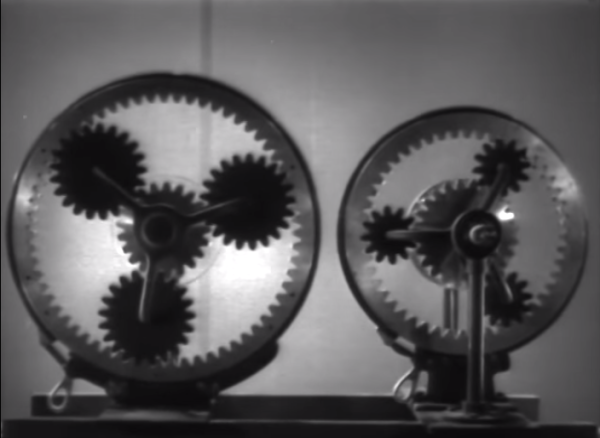
Inspired by the Geneva wheel, [Chronova] developed a fresh intermittent mechanism for improved satisfaction in the sharpener’s operation. Instead of two gear-like mechanisms on a flat plane, the input and output can sit at a 90 degree offset from each other giving room for the blade’s motion. Rotation is input on a part called the indexing pinion which outputs on a lantern pinion.

At every full rotation of the indexing pinion, it interfaces with the lantern pinion moving it two teeth. Because of this quirk, by making the lantern with an odd number of teeth, twice the number of indexing positions are available in the output. At all other points in the pinion’s rotation the lantern is locked in place.

The pencil is held in place with a collect chuck and mounted on a screw coupled to the lantern pinion’s rotational output. This enables the pencil to move forward slightly with every turn of the crank. The project is topped of neatly with a shavings catcher and handle.

It works rather well, but a practical pencil sharpener that does not make. It takes a rather long time, and is fairly laborious to use. But over-engineering machines to do simple tasks is still quite fun!

Continue reading “Making A New Mechanism For A Reciprocating Pencil Sharpener” →
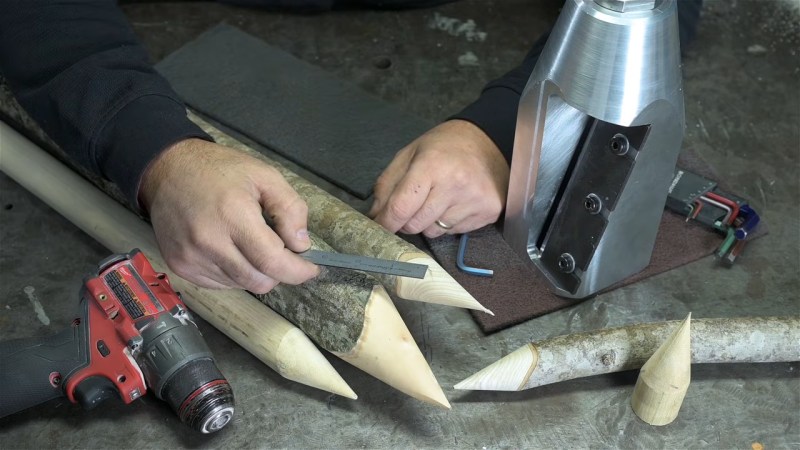
Hand-Machined Stake Sharpener Just In Time For Dracula Season

Vampires aren’t as common as they once were, but in most places they aren’t fully protected and it’s still possible to get a tag for legal hunting come October — at least if you’re using traditional weapons, like a good old wooden stake.

[This Old Tony] on YouTube didn’t have a good old wooden stake handy, but he does have a machine shop. Does he turn stakes on a lathe? Hardly. He turns an aluminum block into a giant pencil sharpener so he can use his drill to make vampire-removers out of any stick he finds.

If you thought that intro was too silly, you can skip the video. [Tony] is a funny guy, and is obviously enjoying himself in the voice over. He also obviously knows his way around a machine shop, and the 22 minute video shows every step of making a tool from a solid block of aluminum and some steel plate. It isn’t as soothing as some machinist’s videos are, though, as roughing out the 30 degree interior cone that will hold the stake against the steel blade is somewhat nerve-wracking to watch. Getting the blade mount tangent to the cone may have been trickier machining overall, but [Old Tony] nails every step. He’s now ready to dust any Nostferatu or Lasombra who darkens his door, assuming he has the strength to hammer the 3″ stakes he’s making through their undead ribs.

We’ve been enjoying [Old Tony] since we saw him build his own CNC table, only to ignore it in favour of his hard-earned skills. If you like that sort of thing, take a look — [Tony]’s cutting wit can make even videos about boring tools entertaining.

Continue reading “Hand-Machined Stake Sharpener Just In Time For Dracula Season” →

Garbage Can RC Car Engine Powers Ridiculous Pencil Sharpener

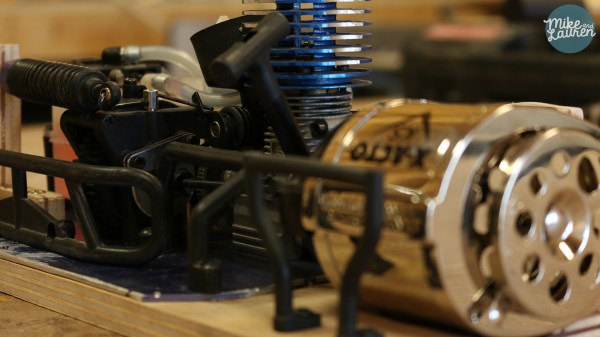
Christmas has come and gone, and no doubt garbage cans are filling with toys that got but a single use before giving up the ghost. If you scrounge around, you might get lucky and score a busted RC car so you can be like [Mike] and build a completely unnecessary nitro-powered pencil sharpener.

This is one from the [Tim The Tool Man Taylor] “more power” files. To be fair, [Mike] acknowledges as much right up front, and as a learning tool for these super-powerful internal combustion engines, we think it’s a pretty cool project. After dealing with a seized cylinder on what looks to be a VX .18 engine rated at about 1.1 horsepower, [Mike] learns the basics of starting and controlling the engine. Once coupled to a pencil sharpener that clearly isn’t engineered to work at a bazillion RPM and jury-rigging a damper for the clutch, [Mike] fires up the engine and races through a pack of 10 pencils in record time.

As silly as this hack seems, it could come in handy if you decide to go into the colored pencil jewelry market at production levels.

Continue reading “Garbage Can RC Car Engine Powers Ridiculous Pencil Sharpener” →

Hackaday Links: Sunday, April 14th, 2013

hackaday-links-chain

We figure we have to start off this week’s links post talking about PETMAN. Boston Dynamics shows off the humanoid robot donning a full chemical suit. It’s a lot scarier than when we first saw it as a couple of legs a few years ago [Thanks Joshua].

Seeing something like that might drive you back to smoking cigarettes. But since that’s pretty bad for your health perhaps you just need a mechanical chain-smoking machine to take the edge off. That thing can really suck ’em down! [Thanks Mike]

Last week’s links included a bit about the Raspberry Pi 2.0 board version’s reset header. [Brian] wrote in to share a link for adding reset to a 1.0 revision board.

Speaking of RPi, [Elvis Impersonator] is using it to automate his garage door with the help of Siri.

In shop news, [Brad] needed to sharpen a few hundred pencils quickly and ended up melting the gears on his electric sharpener. Transplanting the parts to his drill press gave him more power to get the job done in about six minutes.

And finally, you can forget how to decipher those SMD resistor codes. Looks like surface mount resistors might be unmarked like their capacitor brethren. We were tipped off by [Lindsey] who got the news by way of [Dangerous Prototypes and Electronics Lab]

How To Make A Hand Drill Out Of A Pencil Sharpener

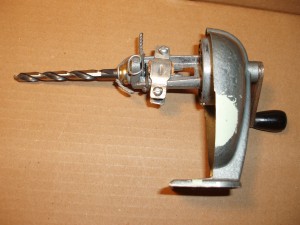
Necessity is the mother of invention, or so they say. [Jason] was in such a situation where he needed to install some safety railing at his grandmother’s house. He didn’t have the necessary tools available, like a drill, so he fashioned one himself out of a pencil sharpener and some fittings and wire that he was able to find.

Although crude, and probably not what one would choose to use if an actual drill was available, this “drill-pencil-sharpener” actually does a pretty decent job of cutting through plywood as seen in the video after the break. Continue reading “How To Make A Hand Drill Out Of A Pencil Sharpener” →