Midi Piano Instructor

[youtube=http://www.youtube.com/watch?v=i7AfiCQQ4nE]

The MIDI piano instructor is a tool aimed at those who wish to learn to play piano, but don’t want to take lessons. The LED bar mounted above the keys lights up to show you exactly what key to press and when. We’ve seen this available in some electronic keyboards for some time, but this unit would be able to fit any standard sized keyboard.  Check the page for schematics and pictures.

[via Flickr]
Extreme Piano Transplant

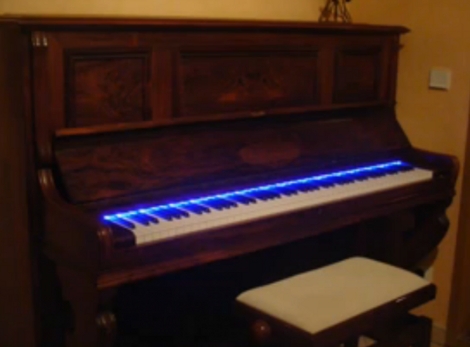
We always wondered what happens to ancient pianos when the internals can no longer be kept in a playable condition. [Jean Philippe Roch] gutted his elderly upright and fit a Korg Triton inside. After the break you can watch a few videos including a slide show of the work log.  [Jean] separates the Korg keyboard from its case and places it in the empty upright piano rank. He then mounts the Korg’s controls in the front panel and adds motorized control to reveal this hidden secret. The project is finished with speakers in the bottom portion of the upright and blue LED lighting effects.

The result is a pretty nice show-piece. It’s not as hacky as vocoding, but we really love the finished look.

Continue reading “Extreme Piano Transplant”

The Subway Never Sounded So Good

[youtube=http://www.youtube.com/watch?v=ivg56TX9kWI]

Reader [Philippe] tipped us off about this video showing a set of subway steps being turned into a piano keyboard (english translation). The creators wanted to make taking the stairs rather than riding the escalator a bit more fun. They added pressure sensors to each step, then covered them with white and black keys to resemble a keyboard. When a passenger puts their weight on a step, the corresponding pitch is played out loud.

We may have lied in the title as this doesn’t really compare to hearing Josh Bell play for pocket change at your train stop. But coming across this setup on an otherwise mundane commute would really brighten up our day.

Vocoding With A Piano

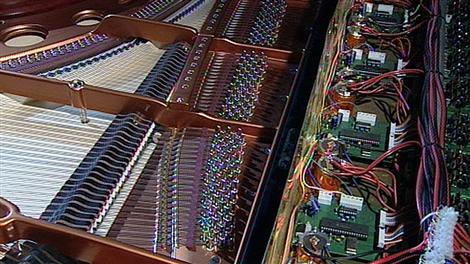
This really cool project allows a grand piano to “speak”.  We don’t know any details about its construction but we had to share. The keys are being hit by solenoids in a manner to replicate human speech.  Click through to the video, it’s worth it. You may have to allow the popup to see the video, and it is in german, but the piano is clearly speaking english. We want one to keep around the office. It could read our emails to us.

(Edit from 2015: The link went bad, but it can be found elsewhere on YouTube.)

[via matrixsynth]

LED Buttons

led_buttons

For their final project in ECE 4760 at Cornell, [Christina] and [Joe] made a small single octave keyboard using LEDs as the input. They used a total of 63 LEDs to make the keys. Each key consists of 9 LEDs, with the center one acting as a sensor. When you lay your finger on it, the light reflects off of your finger and is picked up by the center LED. An ATMega 664 runs custom code to play a sound. You can find out more details about the construction as well as download the source code on the site. You can also download an example movie of it in action ( 7MB .mp4)

AirPiano: Touch Free IR Piano

[youtube=http://www.youtube.com/watch?v=Gh4Ovsh2DZY&hl=en&rel=0&color1=0x3a3a3a&color2=0x999999]
We were excited to learn of [Omer Yosha]’s AirPiano, but being the persnickety nerds we are, we think its more like a theremin than a piano. The device lets users play 24 different notes with a wave of the hand over the AirPiano. The “keys” are arranged in a matrix of three tiers with eight notes per tier; if the user sustains his or her hand over the AirPiano, the corresponding note is sustained.

It’s construction is relatively simple: an Arduino, several infrared sensors, and LEDs corresponding to the notes make up the device. It doesn’t have any built-in audio hardware at all, so it’s most basic use is as a MIDI controller. Still, it is essentially an unspecified input device, so it could theoretically be used for other purposes. For us, it’s fun to just watch the AirPiano in action.