Google Glass Controlled Quadcopter

google-glass-quadcopter-control

For some reason this project makes us think of the Dog Pog Grid from Neal Stephenson’s Diamond Age. It’s not that there’s a ton of drones floating around this guy, it’s that he’s got one which looks like it’s his bodyguard and is controlled by the Google Glass he wears on his head. The future is now!

We find the metamorphosis of this project interesting as well. It started as a Leap motion controlled rover project. We saw a similar hack just the other day that paired a Leap Motion with a Hexapod. But [Blaine] wasn’t satisfied with that. Having had a taste for alternate control inputs he dug in and got to work making Google Glass the control interface. But the problem with moving your head to control a rover is that you can’t actually see it because looking down would cause unwanted motion. His solution was to transition to a quadcopter, which will hover at eye level when he’s looking right at it. Glass is sending raw sensor data to a server, which does the translation to control commands for the quadcopter.


Continue reading “Google Glass Controlled Quadcopter”

Hackaday Links: Sunday, August 4th, 2013

hackaday-links-chain

[Craig Turner] shows that simplicity can be surprisingly interesting. He connected up different colors of blinking LEDs in a grid. There’s no controller, but the startup voltage differences between colors make for some neat patterns with zero effort.

Remember the 3D printed gun? How about a 3D printed rifle! [Thanks Anonymous via Reason]

While we’re on the topic of 3D printing, here’s a design to straighten out your filament.

It takes four really big propellers to get an ostrich off the ground. This quadcopter’s a bit too feathery for us, but we still couldn’t stop laughing.

This Kinect sign language translator looks pretty amazing. It puts the Kinect on a motorized gimbal so that it can better follow the signer. We just had a bit of trouble with translation since the sound and text are both in Hebrew. This probably should have been a standalone feature otherwise.

Work smarter, not harder with this internal combustion wheelbarrow. [via Adafruit]

Hackaday Links: Sunday, July 21st, 2013

hackaday-links-chain

Adafruit tears down a set of brainwave cat ears. They’re made by Necomimi and use your brain waves to adjust a pair of plush cat ears on the headgear.

If your desktop computer is sitting on the floor you may have damaged USB dongles by hitting them with your knees. [Megacier] prevents this from happening again by building a flexible dongle link.

Can anyone help [Brian Benchoff] find a datasheet for this International Rectifier 92-O350 so he can fix up his old VT100 terminal?

Here’s a quick example of how to graph data from a Raspberry Pi on the sen.se cloud service.

Have some extra fun with your oscilloscope by displaying any image. This set of conversions starts with a picture and ends with an audio file that will draw it on the scope’s screen.

You’ve probably already heard that the Sikorsky Prize for human powered helicopter has been claimed. If you didn’t see any footage of the flight now’s your chance. [Thanks Adam]

Flying With A Little Help From Friends

flying-with-a-little-help-from-my-friends

A single cell of this distributed flight system can spin its propeller but it comes at the cost of the chassis flying out of control. To realize any type of stable flight it must seek a partnership with other cells. The more astute reader will be wondering how it can autonomously pair if incapable of controlled solo flight? The designers of the project thought of that, and gave each frame a way to propel itself on the ground.

Along the bottom rails of each cage there are several small knobby wheels. These seem to function similar to omniwheels since they are not aligned in parallel to each other. Pairing is accomplished mechanically by magnets, also helping to align the pogo-pins which connect the cells electronically.

Flight tests are shown in the video below. The array can be oriented in symmetrical or asymmetrical patterns and still work just fine. If they have 3D camera feedback they can hold position and navigate quite accurately. But this can also be piloted by remote control in the absence of such a feedback system.

Continue reading “Flying With A Little Help From Friends”

Electro-permanent Magnets For Quadcopters

electromagnet

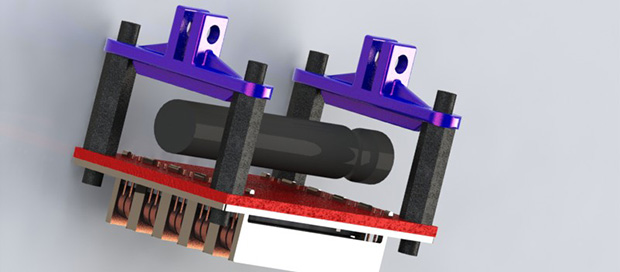
Imagine a quadcopter hovering above a payload – a can of beans, perhaps. The ‘copter descends onto the payload, activates an electromagnet, and flies away with a hobo’s dinner. Right now, this is a bit of an impossibility. A normal electromagnet that powerful would consume an amazing amount of power, something quads don’t usually have in abundance. With the OpenGrab project, the dream of a remote-controlled skycrane is within reach, thanks to some very clever applications of magnetics.

The tech behind the OpenGrab is an electro-permanent magnet, basically an electromagnet you can turn on and off, but doesn’t require any power to stay on. OpenGrab was heavily influenced by a PhD thesis aimed at using these devices for self-assembling buildings.

This project had a very successful Kickstarter campaign and has seen some great progress in the project. While beer doesn’t come in steel cans anymore, we can imagine a whole lot of really cool applications for this tech from infuriating electronic puzzles to some very cool remote sensing applications.

How Do You Think This Quadcopter Feels?

how-does-this-quadcopter-feel

You don’t speak the language of dogs and yet you can tell when one is angry, excited, or down in the dumps. How does that work, and can it be replicated by a robot? That’s the question which [Megha Sharma] set out to study as part of her graduate research at the University of Manitoba in Winnipeg.

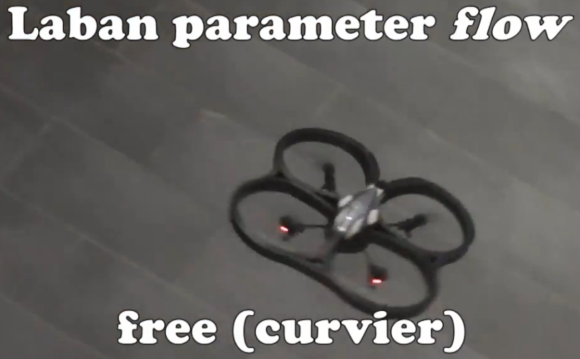
The experiment starts by training the robot in a series of patterns meant to mimic emotion. How, you might ask? Apparently you hire an actor trained in Laban Movement. This is a method of describing and dealing with how the human body moves. It’s no surprise that the technique is included in the arsenal of some actors. The training phase uses stationary cameras (kind of like those acrobatic quadcopter projects) to record the device as it is moved by the actor.

Phase two of the experiment involves playing back the recorded motion with the quadcopter under its own power. A human test subject watches each performance and is asked to describe how the quadcopter feels. The surprising thing is that when asked they end up anthropomorphising the inanimate device even further; making up small stories about what the thing actually wants.

It’s an interesting way to approach the problem of the uncanny valley in robotic projects.

Continue reading “How Do You Think This Quadcopter Feels?”

Kebab Skewer Quadcopter

kebab-skewer-quadcopter

Quadcopters are the epitome of high-tech hobby electronics. We’re quite used to seeing the frames built out of modern materials (carbon fiber, 3d printed, etc). But it’s pretty hard to beat the strength-to-weight ratio of kebab skewers. You heard us correctly. [Shiny Shez] built his quadcopter frame from kebab skewers.

You might want to get that Boy Scout Handbook out and brush up on your lashing skills. Lashing is a method of using rope (string in this case) to fasten together wooden sticks (bamboo kebab skewers). Once the lashed joints are precisely oriented [Shiny] applies a liberal coat of super glue to cement them in place.

He went the easy route when it comes to control hardware. You can get spare parts for the Husban X4, a commercially available quadcopter. Its main controller is used here. The single board controls the motors, monitors an IMU to keep the aircraft stable while in flight, and includes a wireless transceiver. On the receiving side [Shiny] uses an Arduino with a wireless module. This way he can control the quadcopter from his laptop, or go one step further and use an Android phone.