Retrotechtacular: The Mother Of All Tech Demos

Most bits of a computer we take for granted today – the mouse, hypertext, video conferencing, and word processing – were all invented by one team of researchers at Stanford in the late 60s. When the brains behind the operation, [Douglas Engelbart], showed this to 1000 computer researchers, the demo became known as The Mother of all Demos. Luckily, you can check out this demo in its entirety on YouTube.

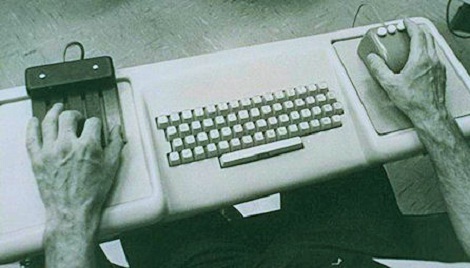
Even though [Englebart]’s demo looks incredibly dated today, it was revolutionary at the time. This was the first demonstration of the computer mouse (side note: they call the cursor a ‘bug’), a chorded keyboard, and so many other technologies we take for granted today. During the presentation, [Englebart] was connected to the SDS 940 computer via the on-line system 30 miles away from Stanford. Yes, this pre-ARPANET, what is normally cited as the precursor to the Internet.

Sadly, most of [Englebart]’s researchers became disillusioned with the time sharing /mainframe paradigm shown in this demo. Those researchers wanted a more decentralized means of computing, so they went off to Xerox PARC where they helped create the first personal computers. Still, most of the ideas from 1968, such as the mouse, hypertext, and word processing, were in those little Xerox boxes.

On a more philosophical note, [Englebart] began his demo with the question, “If, in your office, you as an intellectual worker were supplied with a computer display, backed up by a computer that was alive for you all day and was instantly responsive to every action you had, how much value could you derive from that?” In the 44 years since this Mother of all Demos, we’ve gotten to the point where we already have a computer on our desks all day that is able to do any task imaginable, and it certainty improved our quality of life.

There are a few great resources covering the Mother of all Demos, including the Douglas Engelbart Institute’s history page and the Stanford Mousesite. Looking back, it’s not only amazing how far we’ve come, but also how little has actually changed.
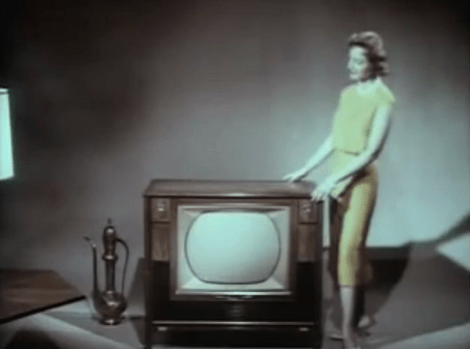
Retrotechtacular: 7-function Remote Control Color Television

Ah, the days when a television was a solid piece of furniture. When it comes to moving, we can’t say we miss it. But looking at this wooden TV cabinet with storage for its 7-function remote we can’t help but think that today’s TVs seem more… trivial… when it comes to the layout of the living room.

The promotional video that goes with this model is a gem of a different era. As you probably have heard, this week [Eugene Polley] passed away. He is credited with inventing the first wireless television remote control. It was not nearly as advance as what’s shown in the video after the break. Instead, it used visible light in conjunction with four light sensors at each corner of the CRT screen. You could turn the set on and off, and flip through channels, but sometimes with the right lighting conditions the set would change all by itself. We wonder if you’d ever come home to find the TV has mysteriously flipped itself on?

Continue reading “Retrotechtacular: 7-function Remote Control Color Television”

Retrotechtacular: Shakey Shows Off Robotics Innovation From 1972

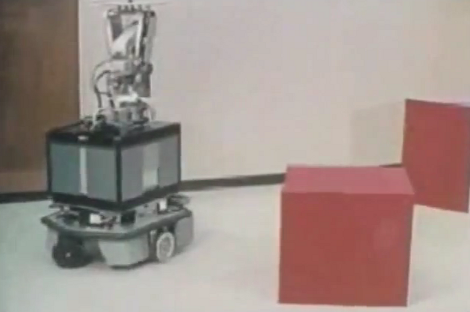
In this installement of Retrotechtacular we’re taking a look at Shakey, a robot developed between 1966 and 1972 at the Stanford Reserach Lab. This was a glorious time when students had long hair but still wore long sleeves and ties to do their research.

The robot is actually communicating wirelessly with the PDP-10 computer which handles the processing. No computer monitor is used for interacting with the robot. Instead, a teletype machine lets you type out your commands on paper, and the response from the machine is printed back to you on the same sheet. There’s a camera which is used for image recognition, and sensors that give feedback when the body comes in contact with an obstacle.

We’d sure love to know what kind of budget this project had, but alas we couldn’t find any info about that. You can go and see Shakey in person if you want to. This info page mentions that the machine is on display at the Computer History Museum in Mountain View, California.

Continue reading “Retrotechtacular: Shakey Shows Off Robotics Innovation From 1972”

Retrotechtacular: The Blit Has Given Me Access To The Power Of Multiprogramming!

We normally try to be descriptive with our titles. But when that statement pops out of the narration with notable excitement it made us chuckle. This installment of Retrotechtacular is a promotional video for the Blit. It’s a graphics-based hardware terminal for Unix systems. It’s biggest boast is the ability to run (and display on screen) several different programs at once — an activity called multiprogramming. But there is also the “digitizing mouse”. On board is a 68000 microcprocessor 256k of RAM (they call it a quarter meg), and connects via RS232. The screen is 800 by 1024; that’s right, it’s a portrait orientation.

Notable in this episode are some classic eyeglass frames, and rad synthesizer sounds for scene transitions. Whatever happened to videography technique that uses a dimwitted companion to ask that all-knowing narrator stupid questions?

Continue reading “Retrotechtacular: The Blit Has Given Me Access To The Power Of Multiprogramming!”

Retrotechtacular: Introducing The Brand New Acorn Risc Machine

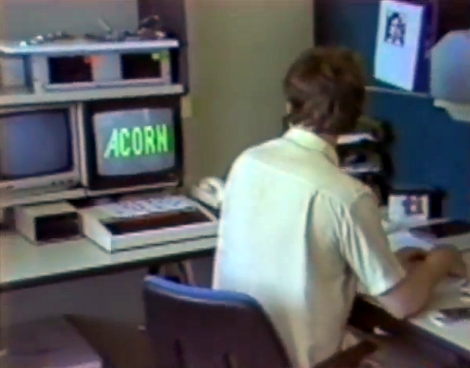
Get ready to be swept off your feet by this Acorn Risc Machine promotional video from the Mid-1980’s (also embedded after the jump). We’re sure most have put it together by now, but for those slower readers, this is the introduction of ARM processors.

The video has a bit of everything. There’s a deadpan narration with just a bit of British accent around the edges. But that’s spiced up considerably by the up-beat synthesizer track playing in the background. You’ll see plenty of programmers in short-sleeve dress shirts, and we challenge you to count the number of mustaches that make it on camera. But jest aside, it’s fun to think of how the advent of this chip affected the world.

This post is just the second installment of our Retrotechtacular series (here’s the inaugural post). We haven’t seen any old movies come in from readers yet. What are you waiting for? Digitize that footage because we want to see it! Of course it doesn’t have to be your own movies, so anything you come across that covers decades-old tech is fair game.

Continue reading “Retrotechtacular: Introducing The Brand New Acorn Risc Machine”

Retrotechtacular: Science Fair Robot Ca. 1984

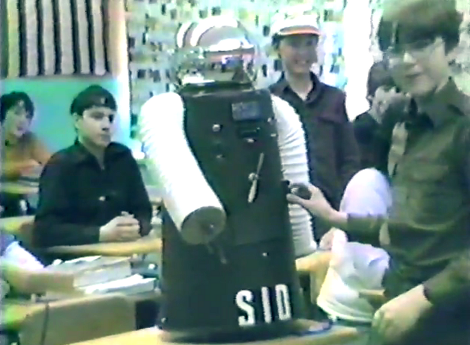
[Michael Surran] just came across this video from his seventh grade science fair project. He really had some fun building and showing off the robot and we’re glad the footage wasn’t lost in the annals of time. Take a look at the clip after the break. That’s not a robot peeing, it’s the ‘fire defense unit’ that pumps liquid to put out very near-range fires. There’s a solar-powered fan on the front, and the claw will spin if you know how to activate it. The shoulders and base are also motorized, and it looks like the keypad from an early calculator gives some extra control on the back of the bot.

We can’t watch this without smiling, and it’s inspired us to launch a recurring feature on Hackaday. We want you to dig out and digitize your old footage. Anything hack-related is fair game… and don’t be bashful! It doesn’t necessarily have to be you either. For example, we loved the video of [Grace Hopper’s] nanosecond lecture. If you’ve got some old time footage send us a link to it!

Continue reading “Retrotechtacular: Science Fair Robot Ca. 1984”