Google Unveils New Process For Installing Unverified Android Apps

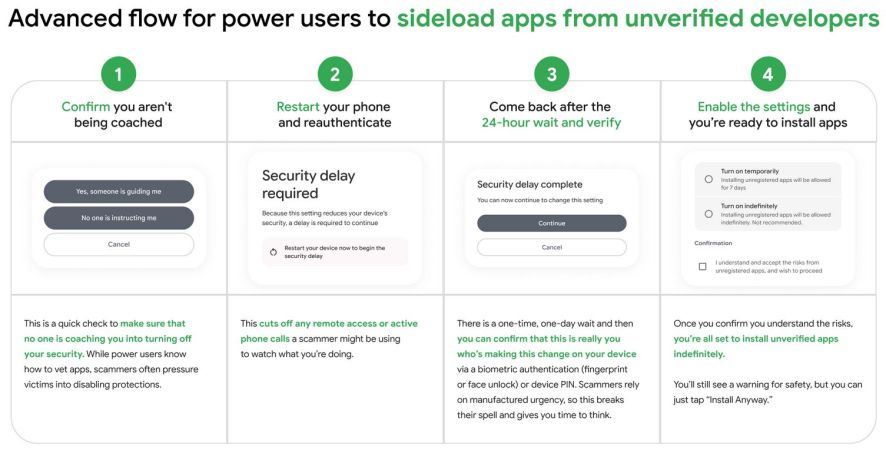
It’s no secret that Google really doesn’t like it that people are installing Android applications from any other source than the Play Store. Last year they proposed locking everyone into their official software repository by requiring all apps to be signed by verified developers, an identity which would be checked against a Google-maintained list. After a lot of pushback a so-called ‘advanced flow’ for installing even unsigned APKs would be implemented, and we now know how this process is supposed to work.

Instead of the old ‘allow installing from unknown sources’ toggle, you are now going to have to dig deep into the Developer Options, to tap the Allow Unverified Packages setting and confirm that nobody is forcing you to do this. This starts a ‘security delay’ of twenty-four hours after you restart the device, following which you can finally enable the setting either temporarily or permanently. It would seem these measures are in place to make it more difficult for a scammer to coerce a user into installing a malicious app — whether or not that’s a realistic concern or not, we’re not sure.

When we last covered this issue this ‘advanced flow’ had just been introduced as an appeasement option. In addition to this a limited free developer account was also pitched, which now turns out to allow for up to only 20 device installations. If you want more than this, you have to pay the $25 fee and provide your government ID.

Although Google’s public pitch is still that this is ‘for user security’, it will also mean that third-party app stores are swept up in these changes, with developers who publish on these stores subject to the same verification rules. This means that Android users will have to learn quickly how to enable this new option as it will be rolled out to more countries over the coming months.

The reality is that scammers will simply work around this issue by buying up already verified developer accounts. At the same time, it’ll cripple third-party app stores and indie developers who had intended to distribute their Android app by simply providing an APK download.
EEVblog Tears Into The White Van Speaker Scam

[Dave Jones] shows us just how bad audio equipment can get with his white van speaker scam teardown (YouTube link). Hackaday Prize judge [Dave] has some great educational videos on his EEVblog YouTube channel, but we can’t get enough of his rants – especially when he’s ranting about cheap electronics. Check out his world’s “cheapest” camcorder teardown for a classic example

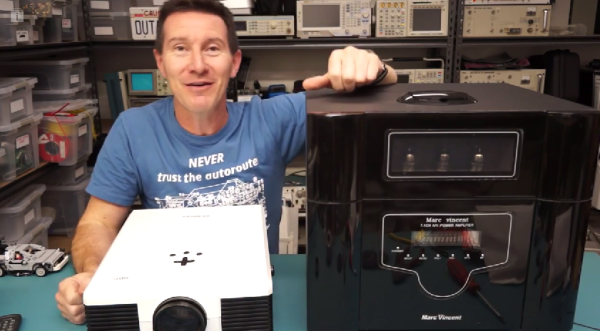
This week [Dave] is tearing down some white van speaker scam A/V equipment. The White Van Speaker Scam (WVSS) is an international hustle which has been around for decades. A pair of guys in a white van stop you in a parking lot, gas station, or other public area. They tell you they’ve got some brand new A/V equipment in the back of their van that they’ll give you for a “great deal”. The speakers are always in fancy packaging, and have a name that sounds like it could be some sort of high-end audiophile brand worth thousands.

Needless to say anyone who buys this equipment finds they’ve been duped and are now the proud owner of some equipment which only sounds good when hitting the bottom of a dumpster. Coincidentally, a dumpster is exactly where [Dave] found his WVSS equipment.

The case of his “Marc Vincent” surround sound system turned out to be nothing more than thin chipboard hot glued together. The electronics were of such shoddy quality that few words describe them – though [Dave] is always ready to improvise. From the ultra cheap subwoofer driver to the 1990’s era vacuum fluorescent display, everything was built down to the lowest cost while still looking nice from the outside. Even the ground wire was just tack soldered to the frame. We especially liked the three vacuum tubes that weren’t even soldered in. The leads were bent over to hold them onto a PCB, while a blue LED lit the tube from below.

Click past the break to see what [Dave] found inside his “3D Optics” projector.

Continue reading “EEVblog Tears Into The White Van Speaker Scam”

ATM Skimmers With SMS

You may want to be more careful where you put that ATM card. There are now ATM skimmers with SMS notification. ATM skimmers are placed over real ATM slots and the information off the cards as they’re inserted. The new models will send the skimmed information via SMS notifications to a phone that’s attached to a computer. This solves the problem of scammers needing to retrieve their skimmers without attracting the attention of police. ATM skimmer manufacturers have so far been really successful because of their commitment to security, from the paint they use to cover their skimmers to their exclusive clientele. The manufacturer of this particular model claims that none of their clients who’ve used this new ATM skimmer has been arrested, and they only accept business from “recommended” clients. We think it’s interesting and ironic how these criminals have adapted their security procedures to deal with institutions we wish were more secure.