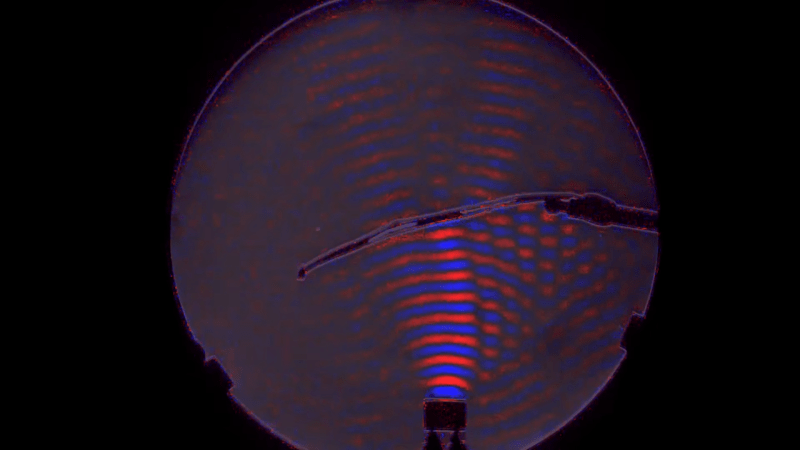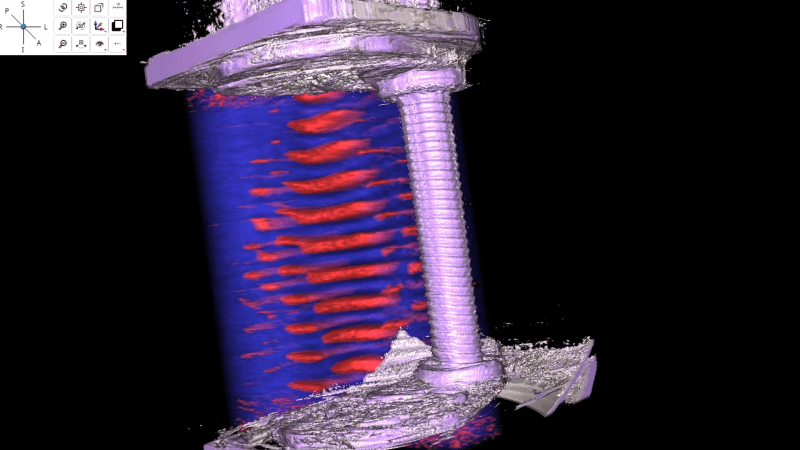
Sound! It’s a thing you hear, moreso than something you see with your eyes. And yet, it is possible to visualize sound with various techniques. [PlasmatronX] demonstrates this well, using a special scanning technique to visually capture the sound field inside an acoustic levitation device.
If you’re unfamiliar, acoustic levitation devices like this use ultrasound to create standing waves that can hold small, lightweight particles in mid-air. The various nodes of the standing wave are where particles will end up hovering. [PlasmatronX] was trying to calibrate such a device, but it proved difficult without being able to see what was going on with the sound field. Hence, the desire to image it!
Imaging the sound field was achieved with a Schlieren optical setup, which can capture variations in air density as changes in brightness in an image. Normally, Schlieren imaging only works in a two-dimensional slice. However, [PlasmatronX] was able to lean on computed tomography techniques to create a volumetric representation of the sound field in 3D. He refers to this as “computerized acoustical tomography.” Images were captured of the acoustic levitation rig from different angles using the Schlieren optics rig, and then the images were processed in Python to recreate a 3D image of the sound field.
We’ve seen some other entertaining applications of computed tomography techniques before, like inspecting packets of Pokemon cards. Video after the break.
Continue reading “Mapping The Sound Field Of An Acoustic Levitator”