
Kids And Hacking: Electromagnetic Eggs

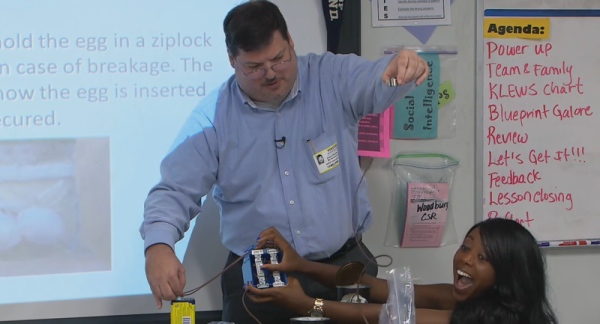
One of my favorite things to do is visit with school kids who are interested in engineering or science. However, realistically, there is a limit to what you can do in a single class that might last 30 to 90 minutes. I recently had the chance to work with a former colleague, a schoolteacher, and The Teaching Channel to create an engineering unit for classroom use that lasts two weeks.

This new unit focuses on an egg drop. That’s not an original idea, but we did add an interesting twist: the project develops a “space capsule” to protect the egg, but also an electromagnetic drop system to test the capsules. The drop system allows for a consistent test with the egg capsule releasing cleanly from a fixed height. So in addition to the classic egg drop capsule, the kids have to build an electromagnet, a safe switching circuit, and a test structure. Better still, teams of kids can do different parts and integrate them into a final product, closely mimicking how real engineering projects work.

There are a few reasons for the complexity. First, given ten class sessions, you can do a lot more than you can in a single day. Second, I always think it is good if you can find exercises that will appeal to lots of different interests. In the past, I’ve used robots and 3D printers for that reason. Some students will be interested in the electronics, others in the mechanics, and still others will be interested in the programming. Some kids will engage in 3D modeling (robot simulation or 3D objects). The point is there is something for everyone.

Continue reading “Kids And Hacking: Electromagnetic Eggs”

CARDIAC Cardboard Computer

A Clever Cardboard Computer

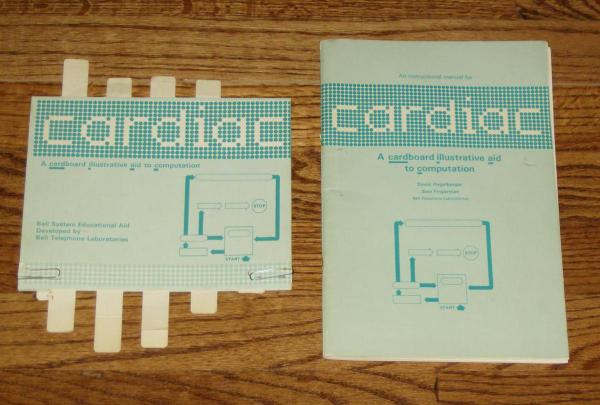
Back in the 70’s when computers were fairly expensive and out of reach for most people, [David Hagelbarger] of Bell Laboratories designed CARDIAC: CARDboard Illustrative Aid to Computation. CARDIAC was designed as an educational tool to give people without access to computers the ability to learn how computers work.

The CARDIAC computer is a single-accumulator single-address machine, which means that instructions operate on the accumulator alone, or on the accumulator and a memory location. The machine implements 10 instructions, each of which is assigned a 3-digit decimal opcode. The instruction set architecture includes instructions common to simple Von Neumann processors, such as load, store, add/subtract, and conditional branch.

Operating the computer is fairly simple–the cardboard slides guide you through the operation of the ALU and instruction decoder, and the flow chart shows you which stage to go to next. The program counter is represented by a cardboard ladybug which is manually moved through the program memory after each instruction completes.

Even though the CARDIAC is dated and very simplistic, it is still a useful tool to teach how microprocessors work. Although modern processors include multi-stage pipelines, finely-tuned branch predictors, and numerous other improvements, the basic principles of operation remain the same.

Feeling adventurous? Print out your own CARDIAC clone and try writing your first cardboard computer program.

[via Reddit]

From 0 To C: Teaching Programming Without A Computer

It’s no secret that learning how to program is very hard, and teaching it doubly so, requiring the student to wrap their head around very unorthodox concepts. [Ubi de Feo] over at the Amsterdam tech collective Hello, Savants! has a unique solution for taking someone who knows nothing of programming and turning them into a computer aficionado capable of deftly wielding semicolons and parens. It’s called From 0 to C, and aims to teach students programming in an environment without computers.

For his class, [Ubi] made up a lot of wooden boxes with eight subdivisions representing the bits in a byte. By putting ping-pong balls in each slot, [Ubi]’s students can grasp the concept of counting by powers of two and quickly move on to hexidecimal and more advanced concepts like bit shifting.

After learning the ins and outs of how stupid computers actually are, [Ubi]’s students then learn the syntax of a language of their choice (C, JavaScript, or Python, for example), and write a few programs.

Although we’re sure most of our readers are far past the ‘learning programming from a blank slate’ portion of their hacker and maker career, anything that gets more people solving their own problems is okay in our book. [Ubi] has a pretty neat take on the pedagogy of teaching programming, and we’d really like to see his work expand outside his Amsterdam collective.









