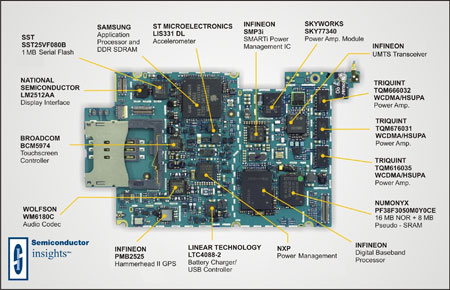
IPhone 3G: Under The Hood


TechOnline has cracked open the iPhone 3G to find out what makes it tick. They’ve released detailed diagrams as well as some videos of the dissection.

Calling this an incremental update, they note that the changes seem to be additions and improvements rather than a total rebuild of the original platform. They get into the nitty gritty, discussing not only the layout and structure, but even the importance of each chip manufacturer.

Some of the improvements are obvious, like 3G. Others include the battery not being permanently attached, and the headphone jack being flush mounted. Most of the changes were in who manufactured each chip.

[via TUAW]

IPhone: 2.0 Firmware Jailbroken, 3G Taken Apart


Oh, iPhone Dev Team, you are a hoot. It isn’t that you managed to jailbreak the iPhone 2.0 firmware on the day of its release, although we can’t help but smirk at that. It isn’t even that you revealed your handiwork in a playful way. We simply love that you expertly work us into a frenzy for the new jailbreak installer with few casual images and some aloof words. Now give us the installer before we get too antsy, please.

Not to be outshined, though, iFixit has posted a full iPhone 3G teardown, stripping away the sleek casing to feast on the goodness inside. They found some interesting changes from the last model: the glass screen, for example, is no longer glued to the LCD, which will no doubt make repairs less expensive. The battery is also unsoldered, meaning you won’t have to send the phone in for repair if the only battery needs maintenance.

Netflix Player Source Code Released


The Netflix Player continues to gain in popularity. Roku has finally released the GPL code for their Netflix Player. Just today Forbes published that Roku would roll out a software update allowing it to stream from other online services. The diminutive device has no internal storage and just enough RAM to buffer the stream. Many have wondered how a Linux box is handling the DRM; this is purely a feature of the NXP PNX8935 processor being used. While waiting for the code, hackers have already popped the box open to see what’s inside. We found [hokiokie7]’s photos of the internals on Roku’s forum. The only really interesting thing we’ve seen so far is that the WiFi is on a daughter card that plugs into the USB. That should make it much easier to support other devices, if users ever manage to get into the system.

UPDATE: [mbailey] points out in the comments that he was able to telnet to the device.

TB-303 Teardown


Flickr member and owner of awesome stuff [Firegroove] brought us a teardown of a Roland TR-909 drum machine before, and now he brings us a new photoset of a TB-303 synth teardown. The machines comprise two thirds of the holy trinity of 80’s electronic music machines, so look after the break for more photos.

Continue reading “TB-303 Teardown”

EMS Synthi AKS Teardown


Here’s another bit of analog synth pr0n for you: Initially sold in 1972, the EMS Synthi AKS was a portable modular analog synthesizer with a built in keyboard and sequencer. The VCS 3 portion of the device had a unique routing matrix pegboard used to connect components together. [firegroove] has opened up his precious machine so that you can see all of the fine little bits that make it tick… and chirp.

[via Matrixsynth]

Eee PC 1000H Dissected


The people at TweakTown completely disassembled a new Eee PC 1000H and documented the entire process. Aside from showing you the side effects of too much tech fetish and not enough regular fetish, the article reveals all the parts of the new Eee, with a few surprises inside. Although it’s an Eee PC, it’s very different from all of its predecessors.

One of the things the teardown shows is that several parts are far more modular than previous Eee PC models. The hard drive, for example, is a standard Seagate Momentus which is made for desktop systems; it can easily be swapped out. Another easily swapped component is the 1GB SIMM from ASint.

Although their (ahem) stripping process was a bit unconventional, a lot of interesting information was yielded from this teardown. Keep ’em coming, TweakTown, just be sure to clean off your tool when you’re done.

[via Gizmodo]

TR-909 Teardown


Flickr user [firegroove] recently had to take apart his Roland TR-909 drum machine in order to fix it, and he photographed the entire teardown, offering detailed pictures of the TR-909’s internal parts. The TR-909 is legendary as one of the first fully programmable drum machines that could store entire songs, and its legend is only boosted by its scarcity: only 10,000 were ever made. If you can’t afford or simply refuse to tear yours apart, look after the break for a few more photos from inside.

Continue reading “TR-909 Teardown”