
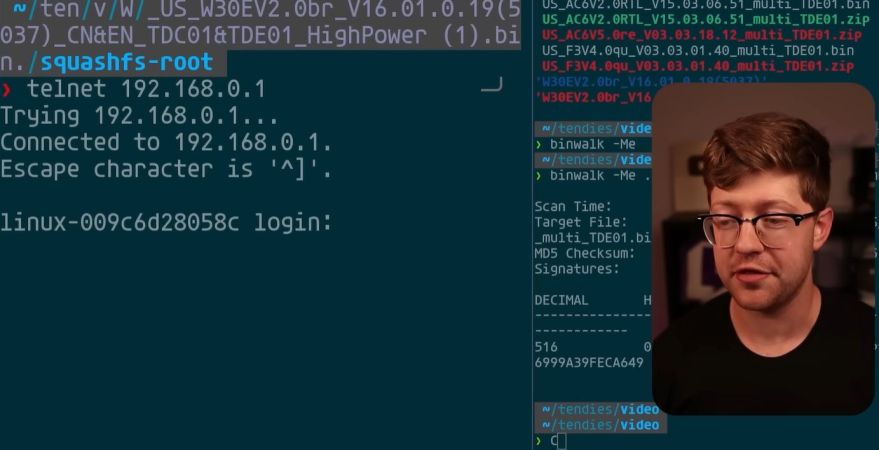
Iz in ur Tenda AC10V6, hax0ring your printf output. (Credit: Low Level, YouTube)

Hacking A Tenda AC1200 Wi-Fi Router With A CVE Combo

It’s rather awkward when you buy a piece of hardware like a sketchy router to make a video about its hidden admin password backdoor – known as CVE-2026-11405 – only to discover that you bought the wrong Tenda router, namely the AC10V6 model. After making this mistake, [Low Level] did the only reasonable thing one ought to do in this case, and try to find an exploit in this ‘wrong’ router as well.

The obvious start here is to do the same as with the other exploit, in that you download a firmware image from the manufacturer’s website, then pluck it apart using binwalk to do an initial check for juicy files. After that tools like Ghidra can be used to do a more in-depth analysis of any binary files, with a special focus on things like user-facing elements like login screen, as input validation will likely forever remain the number one type of exploited CVE.

One major change that Tenda made here was to encrypt the firmware image, which seemed suspicious. With that easy path blocked, the research of others on different Tenda routers was looked at, including the AC20 with the fascinating Telnet exploit in the form of CVE-2025-9090 where merely poking a file on the device turned on the Telnet service. This left the minor issue of finding a password to log into said Telnet session.

Continue reading “Hacking A Tenda AC1200 Wi-Fi Router With A CVE Combo”

This Week In Security: Escaping Linux VMs, Vulnerable Solar, Confusing AI (Again), And Confusing NPM Malware

The Januscape vulnerability allows a user in a guest VM managed by the Linux Kernel Virtual Machine (KVM) to corrupt memory in the host system and break out of isolation.

KVM virtualization is used by major hosting platforms like Amazon AWS, Google GCP, Digital Ocean, and many more. All of the shared hosting platforms count on virtualization to isolate untrusted guest systems from the physical hardware and each other; being able to corrupt memory for all guests or break isolation presents a major threat.

The bug report says the error has been present for 16 years, which is nearly the entire lifetime of the KVM subsystem in Linux. Fixes are available in mainline, and major hosting providers who count on KVM are likely already updating.

Vulnerabilities In Balcony Solar

Micro solar, or “balcony solar”, installs have been gaining traction in Europe as a way to offset rising electrical costs by connecting solar and battery systems to a house or apartment power system.

Vulnerabilities have been found in the popular Hoymiles micro-inverter, which uses a proprietary RF radio protocol to manage the devices. Unfortunately, it looks like this protocol has no encryption or authentication beyond validating the serial number, and the serial number is also available over a wireless probe command.

Armed with a Nordic nRF radio researchers were able to discover nearby inverters in the wild and collect the serial numbers, though of course they stopped short of issuing commands to random users.

The wireless management control allows controlling the device power and output levels, as well as setting a lockout PIN, which the researchers suspect could be used to disable devices and lock the legitimate owners out completely.

There are an estimated 500,000 units in use, and currently the only known mitigation is to unplug the device entirely and disconnect the solar panels, though the team suggests that setting an anti-theft PIN may also help – or at least prevent an unknown PIN being set.

Be sure to check out the link for an in-depth analysis of the protocol and the surprising lack of protection.

Continue reading “This Week In Security: Escaping Linux VMs, Vulnerable Solar, Confusing AI (Again), And Confusing NPM Malware”









