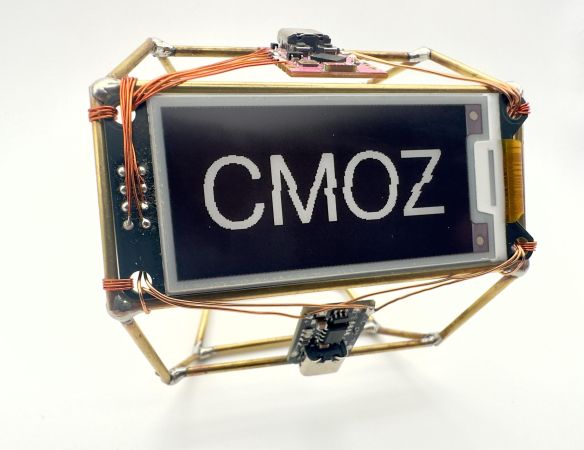
A wearable circuit sculpture in the form of a smart bracelet that shows daily to-dos.

Wearable Circuit Sculpture Is One Smart Bracelet

Well, this might just be a Hackaday first. Certainly not the circuit sculpture part, nor the wearable aspect, but the glorious combination of the two. Behold [CMoz]’s Fashionably on Task: a Smart Bracelet for Forgetfulness. The name may be long, but the intent is concise: to showcase your top five must-dos for the day.

This lovely bracelet uses a tri-color e-paper display, and it’s WiFi enabled in order to receive input from the corresponding phone app. Although the cute pink ESP32-C3 is programmed in PlatformIO, the code will work with the Arduino IDE as well.

To get down to business, just power on the bracelet. If it can’t connect to the network you’ve hard-coded, it will broadcast it’s own access point. Connect with your phone to the custom web page, and Bob’s your uncle. From here, you can enter the tasks, change the colors around, mark tasks as complete, and remove tasks or reset recurring reminders.

The nifty part is that e-paper screen, since it will of course continue to display your list once powered down. Here’s the full code. Then you can deep-dive into the graph theory of circuit sculptures.

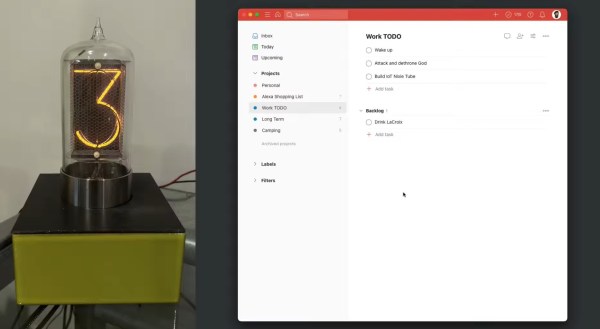
A nixie tube next to a screenshot of a to-do list

Nixie Tube Indicator Tells You How Many Tasks You’ve Got Left To Do

For busy people, keeping track of all the tasks on your to-do list can be a daunting task in itself. Luckily there’s software to help you keep organized, but it’s always nice to have a physical artifact as well. Inspired by some beautiful nixie clock designs, [Bertrand Fan] decided to build a nixie indicator that tells him how many open items are on his to-do list, giving a shot of instant gratification as it counts down with each finished task.

The task-management part of this project is a on-line tool called Todoist. This program comes with a useful Web API that allows you to connect it your own software projects and exchange data. [Bert] wrote some code to extract the number of outstanding tasks from his to-do list and send it to an ESP8266 D1 Mini that drives the nixie tube. Mindful of the security implications of letting such a device connect directly to the internet, he set up a Mac Mini to act as a gateway, connecting to the ESP8266 through WiFi and to the Todoist servers through a VPN.

The little ESP board is sitting in a 3D-printed case, together with the nixie driver circuits and a socket to hold the tube. A ceramic tile glued to the front gives it a bit more of a sturdy, luxury feel to match the shiny glass and metal display device. The limitations of the nixie tube restrict the number of tasks indicated to nine, but we imagine this might actually be useful to help prevent [Bert] from overloading himself with too many tasks. After all, what’s the point of having this device if you can’t reach that satisfying “zero” at the end of the day?

Although nowadays nixie tubes are mostly associated with fancy clocks, we’ve seen them used in a variety of other uses, such as keeping track of 3D-printer filament, adding a display to a 1940s radio, or simply displaying nothing useful at all.

Continue reading “Nixie Tube Indicator Tells You How Many Tasks You’ve Got Left To Do”