Illustrated Kristina with an IBM Model M keyboard floating between her hands.

Keebin’ With Kristina: The One With The Curious Keyboards

I love first builds! They say so much about a person, because you see what’s paramount to them in a keyboard. You can almost feel their frustration at other keyboards come through their design choices. And the Lobo by [no-restarts] is no exception to any of this.

There’s just something about this Corne-like object with its custom case and highly-tappable and variously tilted keycaps. The list of reasons for being begins innocently enough with [no-restarts] wanting a picture of their dog on the case.

A nicely-tented split keyboard with really interesting, 3D-printed keycap profiles.
Image by [no-restarts] via reddit
From there, things get really personal. You may notice the thumb cluster is slightly different — [no-restarts] doesn’t like the thumb tuck required by the Corne to reach the innermost keys. I really dig the homing bumps on the middle thumb keys. Another difference is the splayed layout, as [no-restarts] is especially prone to pinky splay. Finally, there are a pair of OLEDs hiding on the inner sides of the case, which are designed to be visible when tented.

Overall, [no-restarts] is happy with it, but has some ideas for revision. Yep, that sounds about right. The Lobo is all hand-wired, and there’s a PCB with hot swap sockets in its future. If you’re interested in the case files, GitHub is your friend.

Continue reading “Keebin’ With Kristina: The One With The Curious Keyboards”
Gyrotourbillion Blesses The Eyes, Hard To Say

Clock movements are beautifully complex things. Made up of gears and springs, they’re designed to tick away and keep accurate time. Unfortunately, due to the vagaries of the universe, various sources of error tend to creep in – things like temperature changes, mechanical shocks, and so on. In the quest for ever better timekeeping, watchmakers decided to try and rotate the entire escapement and balance wheel to counteract the changing effect of gravity as the watch changed position in regular use.

They’re mechanical works of art, to be sure, and until recently, reserved for only the finest and most luxurious timepieces. As always, times change, and tourbillions are coming down in price thanks to efforts by Chinese manufacturers entering the market with lower-cost devices. But hey – you can always just make one at home.

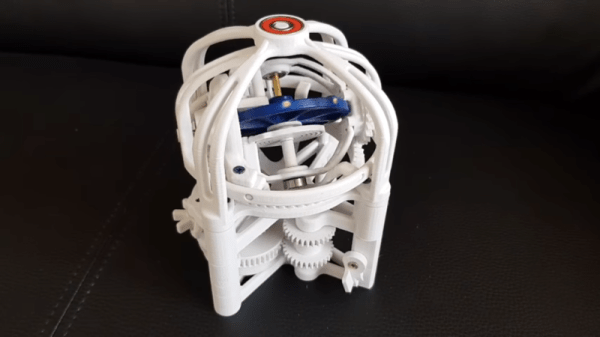
That’s right – it’s a 3D printed gyrotourbillion! Complete with a 3D printed watch spring, it’s an amazing piece of engineering that would look truly impressive astride any desk. All that’s required to produce it is a capable 3D printer and some off-the-shelf bearings and you’ve got a horological work of art.

It’s not the first 3D-printed tourbillion we’ve seen, but we always find such intricate builds to be highly impressive. We can’t wait to see what comes next – if you’re building one on Stone Henge scale for Burning Man, be sure to let us know. Video after the break.

[Thanks to Keith for the tip!]

Continue reading “Gyrotourbillion Blesses The Eyes, Hard To Say”