Reject Modernity, Return To 80s, Learn C.

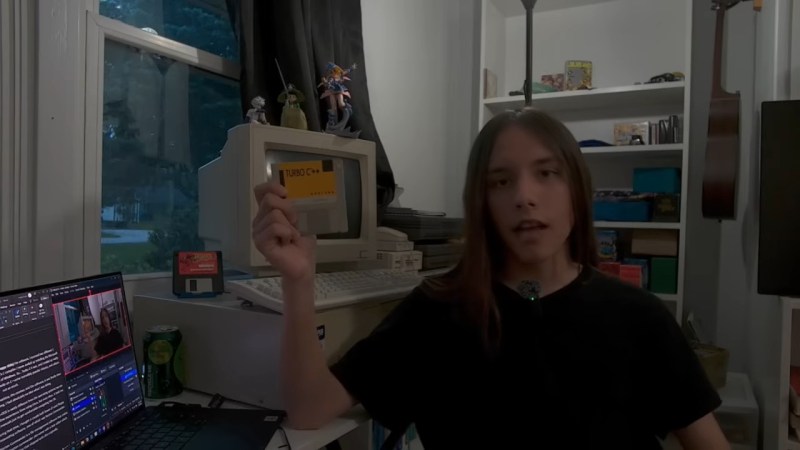
We’re not exactly sure how old [SnailMail] is, but he’s probably a member of Generation Alpha considering that to our wizened eyes the lad looks only slightly older than a fetus– which makes it all the more impressive that he’s written his own text editor, from scratch, in C– on a 386. See, [SnailMail] tried to learn the modern way, with IDEs that have code completion and AI integration, but his thoughts couldn’t gel in the modern environment. So he went online and bought an old IBM-compatible complete with monochrome amber monitor, and a whole 4MB of RAM. Big spender that he is, [SnailMail] upgraded that to 8MB.

Rather than fall victim to the siren song of Wolfenstien 3D or SimCity, he set out to learn to code: C, specifically, since that language bridges four decades between [SnailMail] and his new PC. Even more specifically, he got ahold of disks for Borland Turbo C and Turbo C++, which brings back memories for some of us. Of course the lad also had to learn how to use a DOS PC at the same time, but a teen in the 80s with a fresh box would have climbed the same steep learning curve. Some of you probably remember doing so yourselves. Just like you–or the hypothetical teen in the 80s–[SnailMail] did it not by googling or begging Claude for answers, but by digging into books. Many books.

After all the reading, he started with a text editor, something we remember being a pretty big project not given to first year students. Video evidence suggests he pulled it off. He describes how his solution works from about 8:00 in the video, so you greybeards in the audience can judge his work for yourself.

If you’re a member of Gen Alpha reading this and looking to learn to program, we cannot recommend this technique highly enough– [SnailMail] is going to have a better understanding of the underlying logic of computer science than a lot of CS grads being frocked today. Especially when you consider he ends by promising to learn assembly, something we heartily endorse.

Continue reading “Reject Modernity, Return To 80s, Learn C.”
Revisiting Borland Turbo C And C++

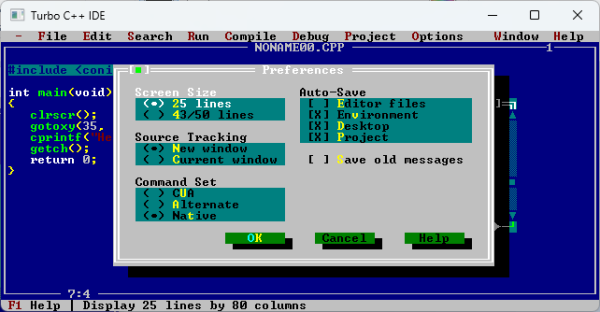
Looking back on what programming used to be like can be a fascinatingly entertaining thing, which is why [Tough Developer] decided to download and try using Turbo C and C++, from version 1.0 to the more recent releases. Borland Turbo C 1.0 is a doozy as it was released in 1987 — two years before the C89 standardization that brought us the much beloved ANSI C that so many of us spent the 90s with. Turbo C++ 1.0 is from 1991, which precedes the standardization of C++ in 1998. This means that both integrated development environments (IDEs) provide a fascinating look at what was on the cutting edge in the late 80s and early 90s.

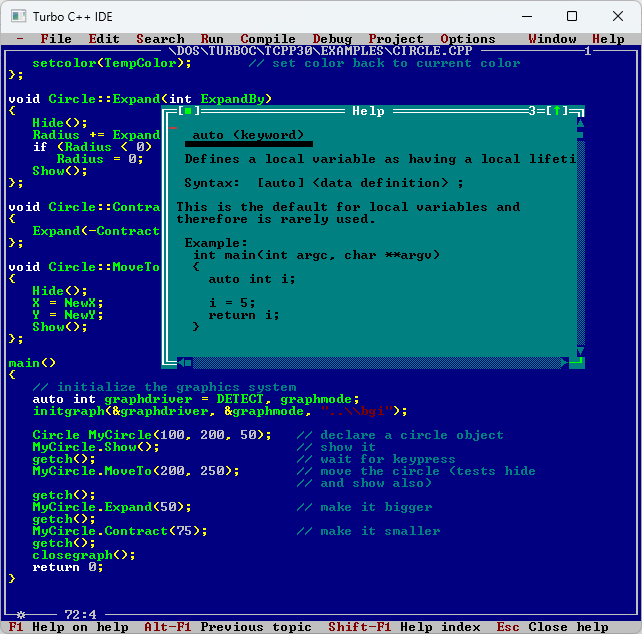
Online help and syntax coloring in Turbo C++.

It wasn’t until version 3.0 that syntax highlighting was added, with the IDE’s focus being mostly on features such as auto-indentation and tool integration. Version 2.0 added breakpoints and further integration with the debugger and other tools, as well as libraries such as the Borland Graphics Interface (BGI). Although even editors like Notepad++ and Vim probably give these old IDEs a run for their money nowadays, they were totally worth the money asked.

Those of us that have been around long enough to have gotten their start in C++ by using the free Turbo command line tools in the 1990s, or lived through the rough, early days of GCC 2.x+ on Linux, will remember that a development environment that Just Worked© was hard to obtain without shelling out some cash. Within that environment Turbo C and C++ and later Visual Studio and others served a very grateful market indeed.

Beyond the IDE itself, these also came with language documentation, as in the absence of constant internet access, referencing APIs and syntax was done using dead-tree reference books or online documentation. Here “online” meaning digital documentation that came provided on a CD and which could be referenced from within the IDE.

[Tough Developer] walks the reader through many features of the IDE, which includes running various demos to show off what the environment was capable of and how that in turn influenced contemporary software and games such as Commander Keen in Keen Dreams. While we can’t say that a return to Turbo C is terribly likely for the average Hackaday reader, we do appreciate taking a look back at older languages and development environments — if for no other reason than to appreciate how far things have come since then.