posted Jul 29th 2011 11:58am by
Kevin Dady
filed under:
classic hacks

After seeing our communications via light post , reader [Chris] dropped this handy little link in our inbox. A very good tutorial about using infrared to enable communications between 2 pic micro controllers.
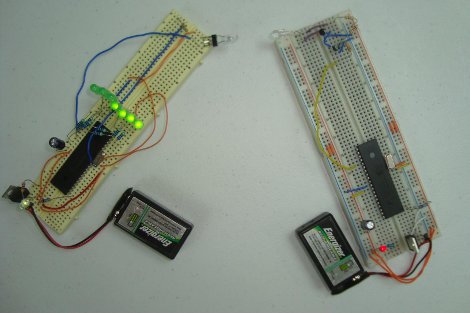
The tutorial covers all the parts you will need, physical wiring and schematics with notes detailing each section of the circuit. It then goes on into basic IR theory, and a simplified push button circuit you can make to see that it is, in fact, working. Once you get the exercise built on some breadboards, he does some software and get some results from it all.
Now in the end this little device was hitting in the neighborhood of 9600 baud, but had to be pretty darn close to each other with a direct line of sight. These are often accepted as a couple of drawbacks to IR technologies. IR, which has never really vanished, is in use on a lot of devices though. The more you know the better off you are.
Join us after the break for a quick video!
Read the rest of this entry »
posted Jul 29th 2011 9:49am by
Mike Nathan
filed under:
arduino hacks,
musical hacks

[Maayan Migdal] wrote in to share a really cool drum kit he constructed that has one special twist – no drums at all. Using a simple MIDI device and an Arduino, his “Air Drums” look pretty sweet.
The hack makes use of a pair of garden rakes, which serve as his drum sticks. The rakes were cut down and modified to allow the addition of accelerometers and some USB cables. The left stick contains a single accelerometer for registering hi-hat hits, while the right stick is armed with a pair of the modules, which are used to trigger snare and crash symbol strikes. He modified a pair of sandals to fit better while drumming before adding a sensor to each shoe. The left sandal contains an accelerometer to register bass drum hits, while the right shoe uses a light sensor to simulate the use of a hi-hat pedal.
We think that the results are awesome, but feel free to check out the video below to see what we mean. If Guitar Hero wasn’t dead in the water on hiatus, we think this sort of setup would make a great replacement for the flimsy drum set that comes with the game.
Read the rest of this entry »
posted Jul 29th 2011 6:00am by
Mike Nathan
filed under:
handhelds hacks,
nintendo hacks

Console hacker [techknott] has a skill set that is quite possibly second to none. We do love [Ben Heck] and think that his portable consoles are beyond awesome, but you’ve got to check out this portable GameCube [techknott] put together.
While the construction details are pretty sparse, the video below shows off the bulk of the portable ‘Cube’s best features. Far smaller than his Flip-Top GameCube or Dreamcast portables we’ve featured in the past, his new handheld sports a wider screen and is completely disc-less. While the legality of booting backup copies of games from an SD card is something we won’t delve into, we do like the concept.
The console itself is probably only about one and a half times the width of a standard GameCube controller, and while it doesn’t sport an internal battery pack, we wouldn’t turn one down. Besides, who wants to play GameCube outside? With one of these in hand, we are more than happy to keep our pasty selves indoors, thank you very much.
The only complaint we have here is the lack of build details. [techknott’s] handheld consoles are pretty amazing – we just wish that we could see how the magic was made!
Be sure to check out the video below to see the console in action.
[Thanks, Dave]
Read the rest of this entry »
posted Jul 29th 2011 4:02am by
Jeremy Cook
filed under:
Medical hacks

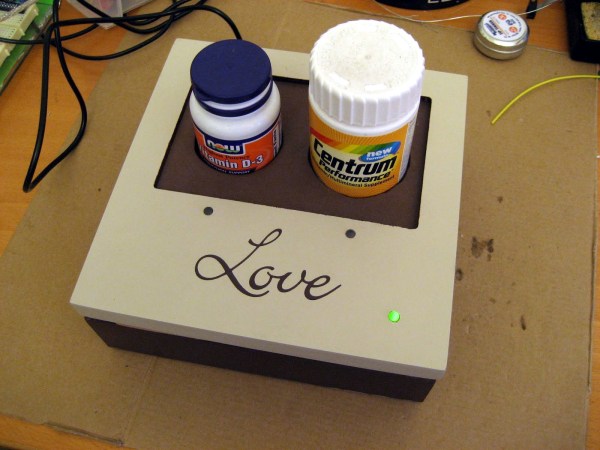
Not satisfied with the traditional daily pill boxes, [Ryan] set out to build his own. According to his article, these particular pills had to be taken every three days, and he wanted a solution that required “zero effort.” Although one might question whether his solution actually took this amount of effort, the build came out very well.
The result is a box that reminds one to take a pill from one or two bottles using a blinking LED. When the pill bottle is picked up, consumption is assumed and the timer is reset. The main components consist of an Arduino, real time clock, and a battery backup. Additionally, two picture frames are used to form the project enclosure along with some LEDs and other assorted hardware to finish everything.
This project combines some basic electronics hacking and programming with a very nice looking cover. The results are a very clean looking build with a good write up. For another example of a well finished project with great pictures, check out this N64 portable build.
posted Jul 28th 2011 4:38pm by
Mike Nathan
filed under:
video hacks

[Ben Leperchey] is working on building a Sega Master System clone using the Papilio One FPGA board, and although his ultimate goal has yet to be reached, he’s bringing some great stuff to the table in the meantime.
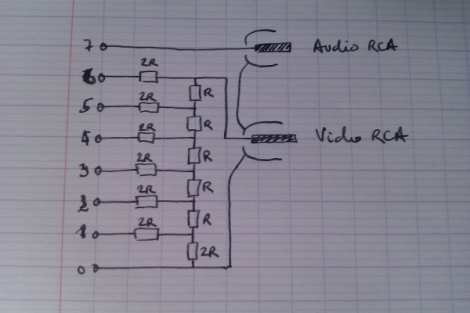
One component that is necessary for any sort of game system clone is NTSC/PAL video output, naturally. Since no one had constructed a TV output “Wing” (The Papilio One’s version of a shield or breakout board), [Ben] went and did it on his own. Using only 14 resistors and a low-pass audio filter, he was able to get the video output he was looking for with relatively little trouble. His VHDL code running on the Papilio does all the hard work of creating the video signal, while the wing he designed mostly handles the connectivity.
This is one of the first few projects/components we’ve seen come out of the Papilio camp, and it looks like things are off to a good start. We can’t wait to see the Master System implementation once it has been wrapped up!
Continue reading to see a quick video demonstration of the Papilio One and [Ben’s] TV output wing.
Read the rest of this entry »
posted Jul 28th 2011 3:38pm by
Brian Benchoff
filed under:
news

[Kianoosh] was in Las Vegas over spring break and was fascinated by the real-time sports scores displayed at the casinos. He figured that this would be an easy enough project to duplicate, so he built a gigantic NBA scoreboard that updates live from the NBA website.
The build uses the OS X Automator to pull scores down from the NBA’s mobile site. Sending this through a parser written in Java, the scores are then sent to an ATMega32 over an XBee. [Kianoosh] posted all the code and schematics, as well as a PDF writeup. Because the scoreboard is sport-agnostic, [Kianoosh] plans on writing new code for the NFL, MLB, and NHL. We’re really impressed with this build, and with the giant 7-segment LEDs, this would be a great addition to a sports bar (or really any bar).
Read the rest of this entry »
posted Jul 28th 2011 2:38pm by
Mike Nathan
filed under:
cnc hacks

[Metalfusion], built himself a nice looking CNC machine and has been experimenting with some out of the box uses for his new tool. One novel use he is particularly fond of is creating pictures with his machine (Google Translation). While you might imagine that he is simply using the CNC as an engraver, literally drawing images on the surface of his workpiece, what he is doing is far more interesting.
He developed a small application that takes an image (jpeg, gif, or png) and converts it to a set of pixels, which can then be tweaked and skewed to his liking. The application exports the halftone image to a DXF file which can be fed into the CAD application that he uses to control his CNC machine. The CNC does the rest, using a v-shaped router bit to cut holes into his workpiece, generating a physical halftone picture from his digital image.
Thought the process does take some time to complete, the resulting images are well worth it. If you are interested in trying this at home using your own CNC machine, the DXF Halftone application is available on his site for free.
Continue reading to see his halftone generating CNC in action.
[via HackedGadgets]
Read the rest of this entry »
posted Jul 28th 2011 1:38pm by
Mike Szczys
filed under:
misc hacks

Behold the wooden machine (translated) that is used for… well it does… it was built because… Okay, this is a case where asking what it does or why it was built is the wrong question. [Erich Schatt] began building the piece that he calls “Wheels” back in 1995. It took just seven years to complete, and is made entirely of wood. The video after the break shows a multitude of moving parts.
The chains were modeled after bicycle chains, which are used to transfer motion from the “rider” throughout the machine. The gearing for each segment was meticulously calculated, then perfected through trial and error. The complexity even calls for a differential and universal joints. It’s mesmerizing to watch and for that reason it’s made appearances at conventions and been featured in art exhibitions.
It’s also worth mentioning that this comes from a very humble-looking shop. [Erich] posted some pictures of his studio and aside from the abundance of bar clamps, it’s just your average garage or basement setup.
Read the rest of this entry »