There comes a point in every engineer’s life at which they need a mixing desk, and for me that point is now. But the marketplace for a cheap small mixer just ain’t what it used to be. Where once there were bedroom musicians with a four-track cassette recorder if they were lucky, now everything’s on the computer. Lay down as many tracks as you like, edit and post-process them digitally without much need for a physical mixer, isn’t it great to be living in the future!
This means that those bedroom musicians no longer need cheap mixers, so the models I was looking for have disappeared. In their place are models aimed at podcasters and DJs. If I want a bunch of silly digital effects or a two-channel desk with a crossfader I can fill my boots, but for a conventional mixer I have to look somewhat upmarket. Around the three figure mark are several models, but I am both a cheapskate and an engineer. Surely I can come up with an alternative. Continue reading “Ask Hackaday: The Ten Dollar Digital Mixing Desk?”→
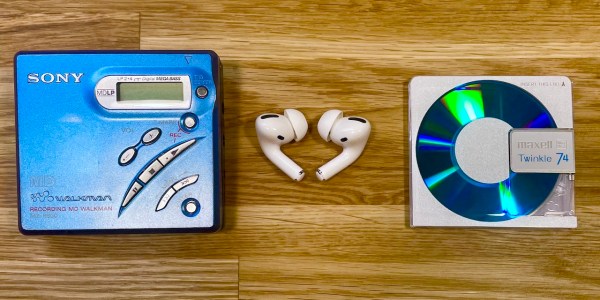
For most people, MiniDisc is just one of countless media formats that became obsolete when music went online. Not so for MiniDisc enthusiasts, many of whom still use a MiniDisc deck at home and a MiniDisc Walkman on the go. Unfortunately, high-end headphones these days often come with Bluetooth connectivity only, necessitating the use of clunky signal converters that ruin the tidy compactness of those portable players. [Daniel Rojas] cleverly solved this problem by directly adding Bluetooth functionality to a Sony MZ-R500 MiniDisc Walkman.
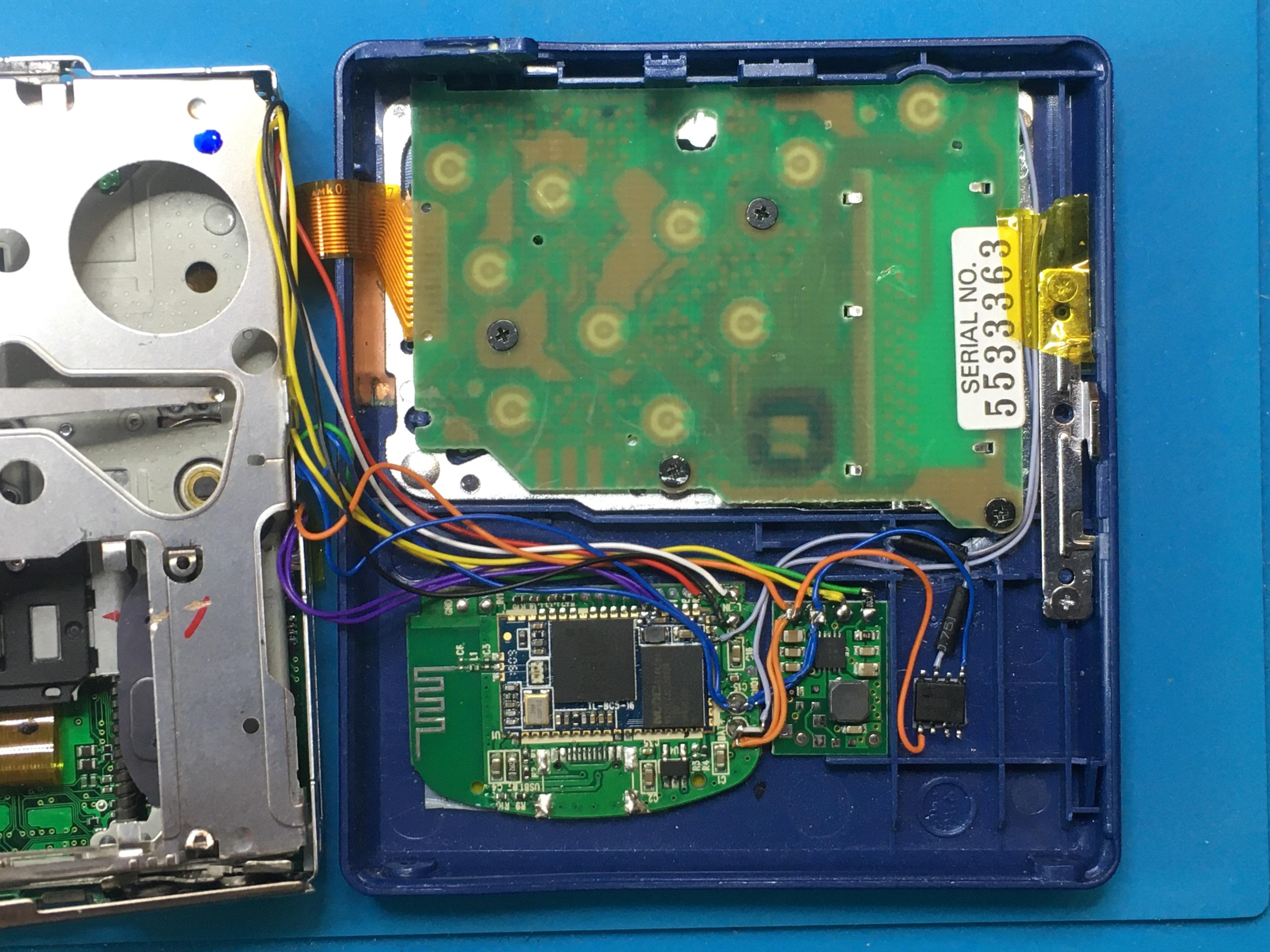
MiniDisc Walkmen are famously compact devices, so adding a full circuit board to one wasn’t easy. [Daniel] managed to squeeze the PCB from a Schosche wireless audio transmitter inside the front of the Walkman, next to the control buttons. He connected the audio signal to the transmitter’s input and rewired the little-used “End Search” button to become the “Pair” button. Sadly, the recording head and some associated hardware had to be removed in order to make space for the new component, turning the Walkman into a playback-only device.
Lots of flying wires and Kapton tape, but it all fits.
The project’s GitHub page contains a detailed walk-through of the modification process that should enable anyone to reproduce the end result. [Daniel] didn’t arrive at the optimal solution in one go however, and he describes the three major revisions of his project in separate sections. In the first iteration for example, the Bluetooth module caused interference on the audio signal, which [Daniel] solved by adding isolation transformers in version two. He also includes a page full of technical information he collected during his project, which will come in handy if you ever want to perform other modifications on your MiniDisc Walkman.
There was a time when electronic engineering students studied the audio CD, for all its real-world examples of error correction and control systems. There’s something to be found in the system still for young and old though, and thus we were intrigued when we saw [Peter Monta] reading the data from a CD using a microscope.
CDs encode data as so-called pits and lands in a spiral track across a metalised surface, with a transition from pit to land signifying a logic 1 and a missing transition signifying a 0. Reading a section of the raw data is achieved in the first part of his write-up, but in the next installment he goes further into retrieving more data through stitching together microscope pictures and writing some code to retrieve data frames. He’s not quite at the audio playback stage, but he’s planning in the future to spiral-track a full image to rip an entire disc.
There are plenty of CD drives around to read audio the conventional way, but the techniques here still find a use where less ubiquitous media has to be read. In the last decade for example there was an effort to read the BBC Domesday Project from the 1980s, as it became clear that few of the original readers survived in working order.
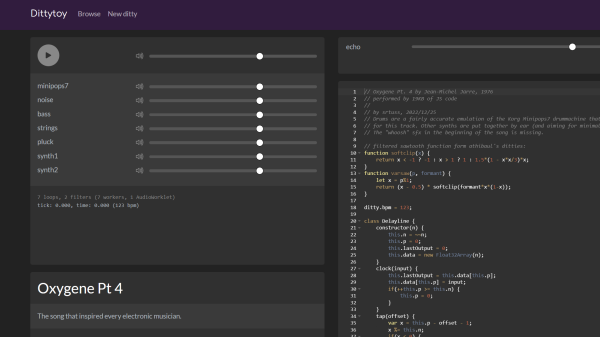
Dittytoy user [srtuss] has recreated one of the most influential works of electronic music in an elegant nineteen kilobytes of Javascript code. The recreation of Jean-Michel Jarre’s Oxygene Part IV on the Dittytoy platform, currently in beta, plays live right in your browser. Dittytoy empowers users to create generative music online using a simple Javascript API. Syntax of the API is loosely based on that of Sonic Pi, a code-based music creation and performance tool.
“Oxygene (Part IV)” was recorded by Jean-Michel Jarre in 1976. It was Jarre’s most successful single, charted on the top ten in several countries, and was more recently featured in the Grand Theft Auto IV video game. In the 1990s, famed electronic music innovator Brian Eno used the term “generative music” to describe music generated by an electronic system comprising ever-changing elements that may be algorithmic or random.
Recreation of Jarre’s work required modeling the Korg Minipops 7 drum machine, one of the instruments presented in our slew of open-source synthesizers.
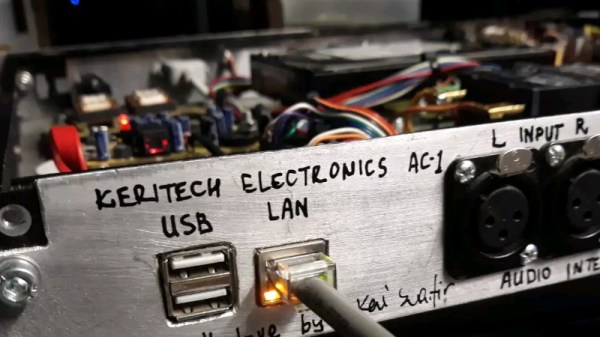
There’s an uneasy meeting in the world of audio between digital and analogue. Traditional analogue audio reached a level of very high quality, but as old-style media-based audio sources have fallen out of favor there’s a need to replace them with ones that reflect a new digital audio world. To do this there are several options involving all-in-one Hi-Fi separates at a hefty price, a cheaper range of dongles and boxes for each digital input, or to do what [Keri Szafir] has done and build that all-in-one box for yourself.
The result is a 1U 19″ rack unit that contains an Orange Pi for connectivity and streaming, a hard drive to give it audio NAS capability, plus power switching circuitry to bring all the older equipment under automation. Good quality audio is dealt with by using a Behringer USB audio card, on which in a demonstration of how even some digital audio is now becoming outdated, she ignores the TOSlink connector.
The rear panel has all the connectors for power, USB, network, and audio laid out, while the front has an array of status lights and switches. We particularly like the hand-written lettering, which complements this as a homebrew unit. It certainly makes the Bluetooth dongle dangling at the back of our amplifier seem strangely inadequate.
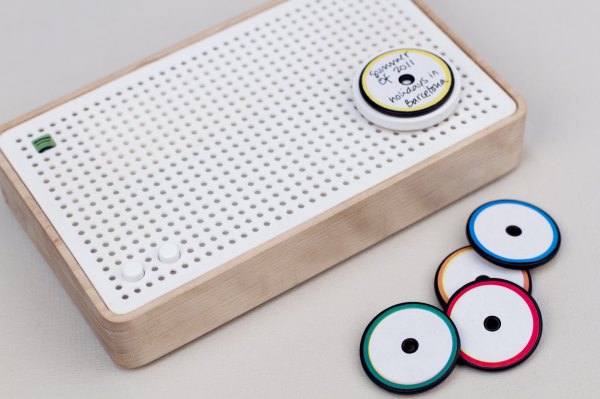
Digital music has made keeping all your tunes with you a lot more convenient, but have we lost something with dematerialization? [Jordi Parra] felt that there was something lacking with the digital music experience and designed a Spotify player with a tactile interface.
Specific playlists are selected via small RFID tags that look like a cross between a MiniDisc and a vinyl record. As this is a prototype, an Arduino reads the RFID tag, but needs a computer to actually play the Spotify playlist. Future iterations could include an integrated speaker and run libspotify to create a self-contained device.
While there is still work to do for a fully seamless experience, we love the details in the industrial design of this project. Clean simple lines and a combination of wood and more modern materials make this feel like a timeless piece of tech. Definitely check out the full photo gallery including shots of the really impressive packaging.
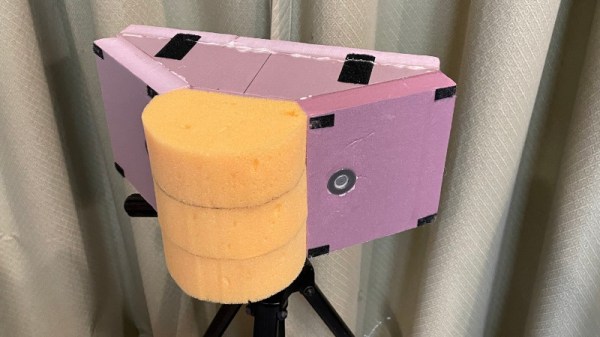
A binaural recording is designed to mimic as closely as possible the experience of listening through human ears, and thus binaural microphones are often shaped like the human head with the microphone cartridges placed where the ears would be. That’s not the only way to make a binaural microphone though, and the Crown Stereo Ambient Sampling System, or SASS, did the same thing with a pair of pressure zone microphones for outdoor recordings. [Filip Mulier] doesn’t have one of the originals, but he’s done his best to make a SASS-like microphone of his own.
The attractive thing about this design is its simplicity, making use of foam sheets for the main body, with packing board as a rain deflector and a couple of layers of non-woven cloth as a wind filter. Perhaps best of all though are the recordings, in which we hear ambient recording at its finest. Listen with headphones, we suggest the dawn chorus.