From Cinema To Stills, Camera Lens Gets New Life

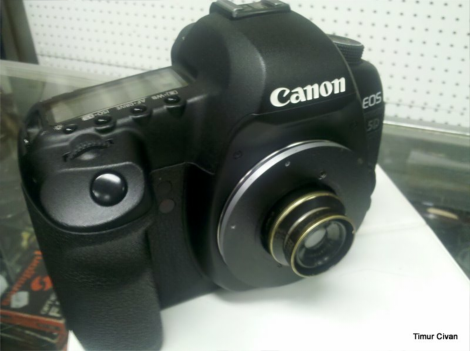
[Timur Civan], with a beautiful merge of past and present, has taken a 102 year old camera lens (a 35mm F5.0 from hand cranked cinema cameras) and attached it to his Canon EOS 5D. While this is not the first time we’ve seen someone custom make a camera lens or attach a lens to a different camera, such as when we brought you plumbing tilt shift or iPhone camera SLR or Pringles can macro photography, the merge of old tech with new warms our empty chest cavities hearts. Catch some additional shots of 1908/2010 New York City after the jump.

Continue reading “From Cinema To Stills, Camera Lens Gets New Life”
Portable Password Vault

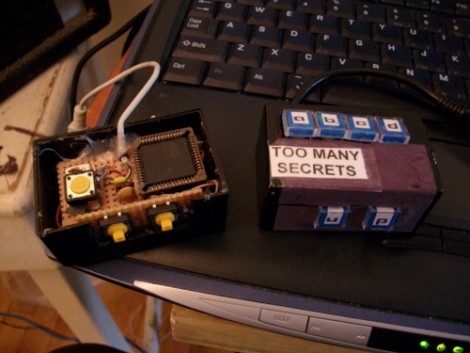
This little box remembers all of your user names and passwords. Inside you’ll find an Atmel AT89S5131 microcontroller which has built-in USB capability. When the box is plugged into a USB port it identifies as a keyboard. Manipulating the buttons on the top and side will select and print out various stored usernames and passwords. Passwords are generated on-chip from a random seed and the device itself requires a passcode after power up as a security feature.

[SigFLUP’s] included a pretty nifty configuration algorithm. It doesn’t rely on a terminal connection, since the device is a keyboard you can communicate with it in an editor window (which should make it platform independent). There’s no code available, but trying to write your own to the spec outlined in the demo after the break will make for a fun weekend project.

Continue reading “Portable Password Vault”

A Simple FM Transmitter

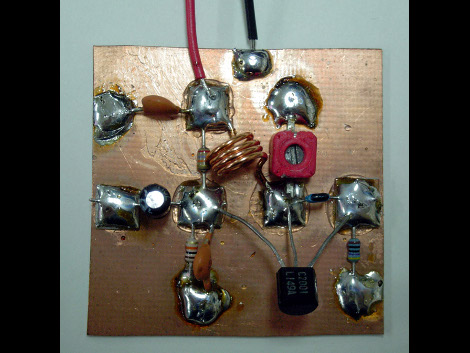
Here is a low component count FM transmitter. It sacrifices some features, like the ability to adjust the frequency, for simplicity’s sake. The build method is fairly common with amateur radio but we don’t see it around here too much. Each component gets a 5mm-by-5mm copper clad pad which is super glued to the ground plate as an insulator. There’s even a pictorial example of this method if you need some help with visualization.

One of the schematics included in the article shows how to incorporate a condenser microphone into the unit. We guess that makes it pretty easy to add an FM ‘bug’ to your arsenal of covert listening devices. Just make sure to check your local laws before building and using this. We’re not sure what the FCC would think of it here in America so we’re hoping some well-informed readers will educate us with a comment.

[Thanks Bart]

Laser Mic Makes Eavesdropping Remarkably Simple

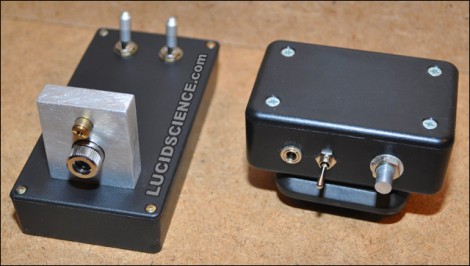
Here’s a surprisly simple way to build yourself a laser-based listening device. It consists of two modules, a transmitter and a receiver. The transmitter is a set of lasers, one is visible red for aiming, and the other is infrared for measuring the vibration of a surface. Point the transmitter at the window of the room you want to listen in on and the laser can be reflected back to the receiver. The receiver module has a phototransistor to pick up the infrared laser light, and an LM386 audio amplifier to generate the audio signal sent to a pair of headphone. The need to be well-aligned which is easy enough using a pair of tripods. Check out the demo after the break.

Looking for something to do with the leftover laser diodes from this project? Try making yourself a laser microscope.

Continue reading “Laser Mic Makes Eavesdropping Remarkably Simple”

RFID Readers, Writers, And Spoofers

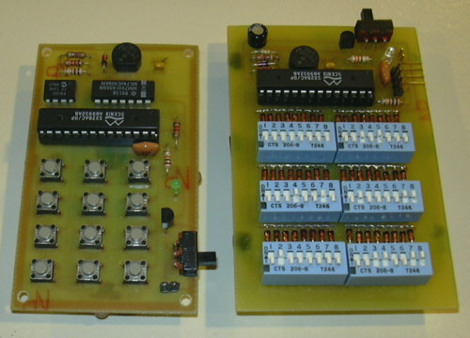
[Carl] has done a lot of work developing a collection of RFID hardware. The two cards you see above are spoofers that can be programmed in the field using the keypad on the left, or the rather intimidating banks of DIP switches on the right. We also enjoyed his look at the Atmel T5557 and ATA5567 on-card chips used for the tags themselves. He shared the schematics for his designs but unfortunately he’s not distributing the firmware. None-the-less, if you’re interested in learning more about RFID this is a wonderful resource as it covers readers, writers, spoofer, and tags.

Tokyo Hackerspace – Akihabara Station Video Tour

This is the kind of footage that makes our mouths water here at Hackaday. [Akiba] of Freaklabs has been kind enough to take us all on a video tour of Akihabara Station, a treasure trove for electronics hackers located in the Chiyoda ward of Tokyo. The highlight includes surplus stores, specialty electronics shops, and enough silicon to bring an engineer to tears. Rather than waste time reading about it, follow the link and check out the videos in stunning 720p.

Hackers in other parts of the world, what kind of stores and marketplaces do you have like this? Send us your pictures and videos of local marketplaces that cater to your hacking needs so we can show them off.

PS3 Jailbreak – Now In Apple Flavor!

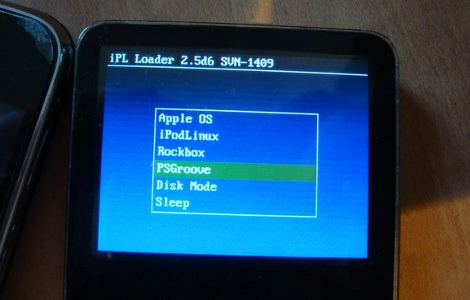
Image courtesy of DanyL of psx-scene

The newest member of the PS3 jailbreaking tool crowd is the iPod family. More specifically, iPods running the open source media firmware Rockbox. Even better news, theoretically it should be possible to use this same method on any MP3 player running the Rockbox software. Right now the exploit package only works on select generations of the iPod Nano and iPod Classic line, but if the trend set by the PSX-scene forums continues, it would be worth checking back in the near future if your device is not already supported. Thanks to [shuffle2] for providing the hack, and [DanAdamKOF] for the heads up.

If Apple isn’t your device of choice, you can also check out some of your other jailbreaking options.