RGB LED Headband

Hard to imagine this going on business trips to Shangai

[Johncon] wrote this fantastic instructible showing us how to make an RGB LED headband. This should come in really handy the next time we find ourselves needing one… it happens. He picked up this little RGB LED strip while on a business trip to Shanghai. He had to reverse engineer the chip that controls each pair, but once that was done there wasn’t much left to do. He’s using a picaxe microcontroller since he had some lying around and, as he points out, they require very little external hardware.

He says he’s going to be ordering more of this LED strip soon and is willing to make a group buy if anyone is interested.

[via MakeZine]

Halloween Props: Pumpkin In Standby-mode

Evil Mad Scientist Laboratories is preparing for Halloween with this standby-mode pumpkin. Inside there’s an LED plugging a hole that is drilled just to the skin of the gourd-like vegetable. It fades in and out similar to a sleeping Mac, using what we think is a vastly over-powered circuit based on an ATtiny2313 (1k  of programming space for this?). But we still like the idea and we’d enjoy seeing it scaled up to a full LED matrix.

We’ve come to expect pumpkin hacks from EMSL and they don’t disappoint. Last year was a mechanized version, and the year before an LED schematic symbol. So what about your creation? With about one week left, take a look around and see if you can’t create something as wonderful as the Pie of Sauron.

FM Bug Using Salvaged SMD Parts

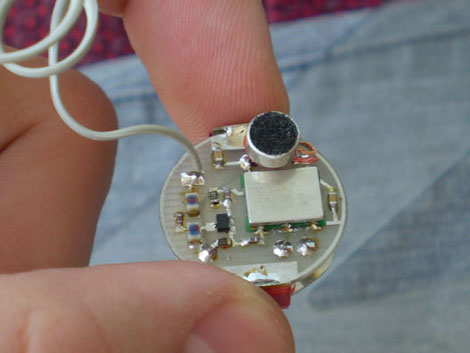
If you’re a soldering ninja this FM transmitter bug is for you. It’s quite similar to the one we looked at yesterday, but this uses 100% salvaged parts. Two phones donated components; a Nokia 3210 for its voltage-controlled oscillator and a Nokia 1611 for the rest of the parts. The bad news is that mobile technology like cellphones use some of the smallest surface mount packages known to man. That’s where the soldering skill come into play. The good news is that if you’ve been scavenging for discarded phones in order to reuse their LCD screens you already have these parts on hand.

[Thanks George]

1000W Search Light – Now Build A Bat Signal

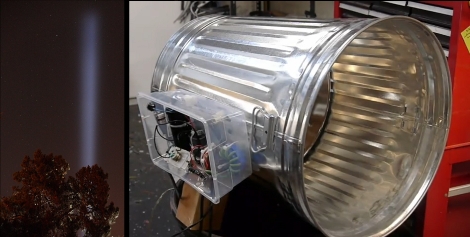
Forget flashlights, and leave those burning lasers at home, [Ben Krasnow] built a search light using a 1000W xenon arc lamp. That box you see on the side of the trash-can housing countains a starting circuit that shoots 30 kilovolts through the xenon lamp to get it started but it is separate from the power supply. [Ben] started experimenting with the lamp back in April but recently finished the project by using the inverter from an arc welder to get the 50 amps at 20 volts needed when the lamp is on.

The insert on the left of the image above is an outdoor picture of the beam. You can make out a tree at the bottom. Take a look at the video after the break for a full walk-through of the circuitry and some test footage of the finished product.

Continue reading “1000W Search Light – Now Build A Bat Signal”

Panaplex In A Jar

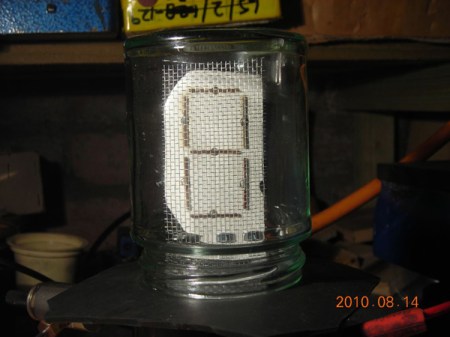
Check out this home made panaplex display. Panaplex displays are closely related to nixie tubes, but instead of layering individual numbers and lighting them separately, it uses pieces to build the numbers like a digital display. [Lindsay] managed to make one at home, using a jam jar as the vacuum tube.  Argon as the gas in the tube gives it a pleasant purple color. We really think the end result is fantastic, you can see some build pictures and a run through of the numbers on the site. Unfortunately there aren’t any videos of the display in action.

[via Makezine]

Tiny FM Transmitter Bugs Rooms

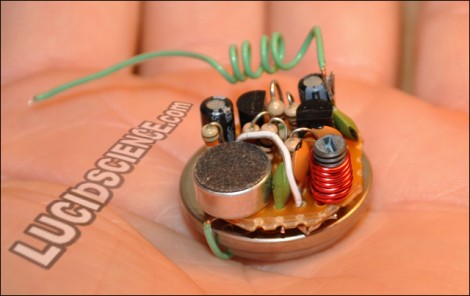
Lucid Science delves into spy-tech once again with this tiny FM transmitter. Their post demonstrates a bit larger version than seen above, using a 9-volt battery and protoboard sized to match which makes for easier soldering. The design uses a microphone, two transistors, enameled wire for the coil, as well as various resistors, capacitors, and a potentiometer. What you end up with is an amazingly clear audio signal that can be picked up with a normal FM radio.

This would make a great project to do with the kids. You can talk about circuit design, practice soldering, and when finished they’ve got an almost miraculous toy to play with. Just be careful what you say around the house, the room might be bugged!

Multiple Core Propeller Speeds Up Display Addressing

Th

If you ever wondered what an eight-core Propeller processor can do for you, [Tom] found one answer. He’s using the multiple cores to individually address serial displays. He has six display modules, and each of them incorporate six 8×8 LED modules. This makes for a total of 2304 LEDs, and since they’re addressed by cascading serial data, that means 2304 bytes pushed to the display. You’re going to suffer from quite a bit of slow-down if you choose that communication method.

This is where multiple-cores come in handy. Instead of cascading data between the six modules, he assigned a different core to each. Now he can concurrently address the six displays, reducing his serial data from 2304 bits per frame down to 384 bits per frame. As you can see in the video after the break, updating the display six times as fast as before yields fantastic results.

Now what if you’re using a processor that has forty of these multi-core Propeller chips?

This does make us wonder, can’t the same thing be done on a single-core processor? An eight-bit device takes one cycle to set all eight bits on a single port. So why not just connect the six serial connections on six bits of the same port? Weigh in with your thoughts in the comments.

Continue reading “Multiple Core Propeller Speeds Up Display Addressing”