Autonomous Vehicle-Following Vehicle

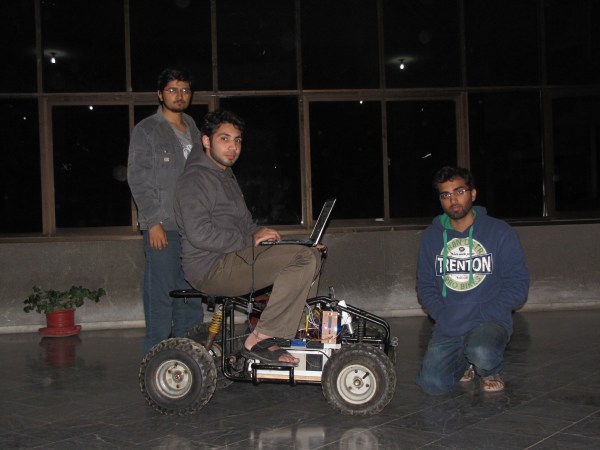
Humanity has taken one step closer to Skynet becoming fully aware. [Ahmed], [Muhammad], [Salman], and [Suleman] have created a vehicle that can “chase” another vehicle as part of their senior design project. Now it’s just a matter of time before the machines take over.

The project itself is based on a gasoline-powered quad bike that the students first converted to electric for the sake of their project. It uses a single webcam to get information about its surroundings. This is a plus because it frees the robot from needing a stereoscopic camera or any other complicated equipment like a radar or laser rangefinder. With this information, it can follow a lead vehicle without getting any other telemetry.

This project is interesting because it could potentially allow for large convoys with only one human operator at the front. Once self-driving cars become more mainstream, this could potentially save a lot of costs as well if only the vehicle in the front needs the self-driving equipment, while the vehicles behind would be able to operate with much less hardware. Either way, we love seeing senior design projects that have great real-world applications!
Continue reading “Autonomous Vehicle-Following Vehicle”

Spline Thieving Makes Hobby Servos Even More Useful

For years the proprietary spline pattern of rc servos has been a dealbreaker for hobbyists who want to add custom shafts and gears to their servos. First, different servo sizes have different spline sizes, and each vendor equips their servos with different patterns. True, some special vendors sell custom gears that mate to these patterns, but, overall, the hard-to-replicate pattern has severely limited the output options for servos.

This pattern didn’t deter [JB], however. With some clever CAD skills, and two working implementations, he’s demonstrated that these spline patterns can be (1) harvested and (2) added into custom components, opening a new suite of design opportunities involving servos.

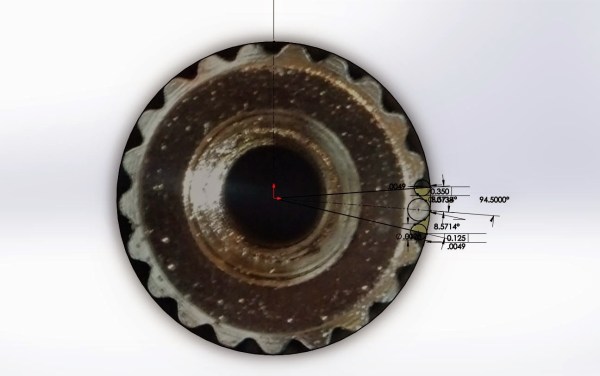
To capture the spline, [JB] imports an image into Solidworks, and traces the pattern on a properly scaled image. From there, he can embed this pattern directly into a physical model for fabrication.

To make parts that preserve this pattern, [JB] has two options. With his FormLabs printer, he can print components that already have the pattern feature, allowing him to press-fit custom links directly onto servos. Alternatively, for a sturdier component, he presents the milling method. With this technique, he drills a circle of bolt holes onto the desired output shaft and then mills out the center. From here, the shaft can also be directly pressed onto the servo spline where each spline groove fits snugly into the edge of the previously-drilled holes.

So, how well do they work? According to [JB] he’s actually managed to do some damage to himself before damaging to the 3D-printed part while trying to strip the pattern. The end-goal is to insert these shafts into transmissions for a miniature combat robot, another one of [JB’s] projects which is well-underway. Until then, we’re looking forward to seeing more servos tightly-integrated into upcoming projects.