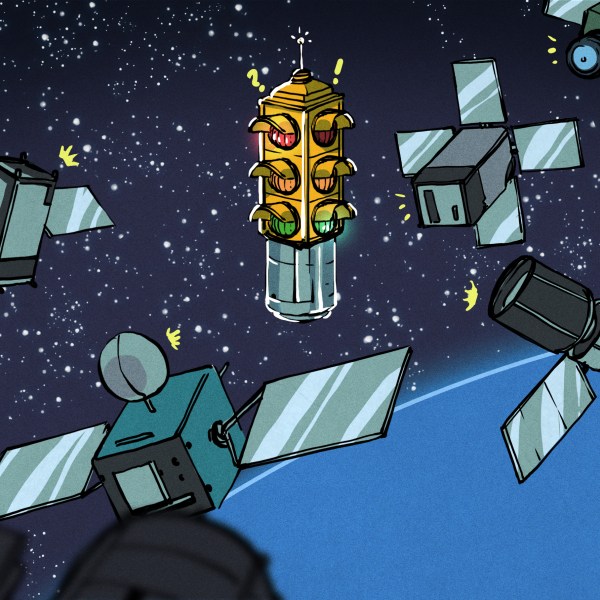
Why Samsung Phones Are Failing Emergency Calls In Australia

We’re taught how to call emergency numbers from a young age; whether it be 911 in the US, 999 in the UK, or 000 in Australia. The concept is simple—if you need aid from police, fire, or ambulance, you pick up a phone and dial and help will be sent in short order.

It’s a service many of us have come to rely on; indeed, it’s function can swing the very balance between life or death. Sadly, in Australia, that has come to pass, with a person dying when their Samsung phone failed to reach the Triple Zero (000) emergency line. It has laid bare an obscure technical issue that potentially leaves thousands of lives at risk. Continue reading “Why Samsung Phones Are Failing Emergency Calls In Australia”

Smart Bandage Leverages AI Model For Healing Purposes

If you get a small cut, you might throw a plastic bandage on it to help it heal faster. However, there are fancier options on the horizon, like this advanced AI-powered smart bandage.

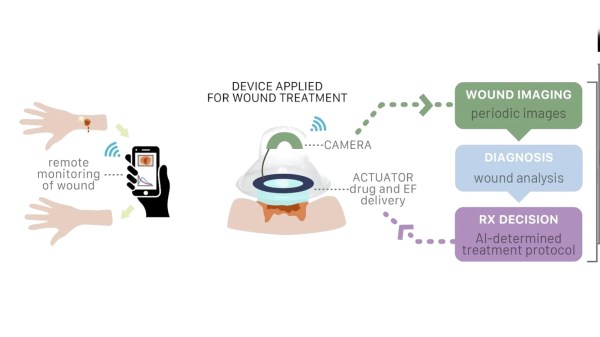
Researchers at UC Santa Cruz have developed a proof-of-concept device called a-Heal, intended for use inside existing commercial bandages for colostomy use. The device is fitted with a small camera, which images the wound site every two hours. The images are then uploaded via a wireless connection, and processed with a machine learning model that has been trained to make suggestions on how to better stimulate the healing process based on the image input. The device can then follow these recommendations, either using electrical stimulation to reduce inflammation in the wound, or supplying fluoxetine to stimulate the growth of healthy tissue. In testing, the device was able to improve the rate of skin coverage over an existing wound compared to a control.

The long-term goal is to apply the technology in a broader sense to help better treat things like chronic or infected wounds that may have difficulty healing. It’s still at an early stage for now, but it could one day be routine for medical treatment to involve the use of small smart devices to gain a better rolling insight on the treatment of wounds. It’s not the first time we’ve explored innovative methods of wound care; we’ve previously looked at how treatments from the past could better inform how we treat in future.

Charge NiMH Batteries With Style, Panache And An RP2040

The increasing dominance of lithium cells in the market place leave our trusty NiMH cells in a rough spot. Sure, you can still get a chargers for the AAs in your life, but it’s old tech and not particularly stylish. That’s where [Maximilian Kern] comes in, whose SPINC project was recently featured in IEEE Spectrum— so you know it has to be good.

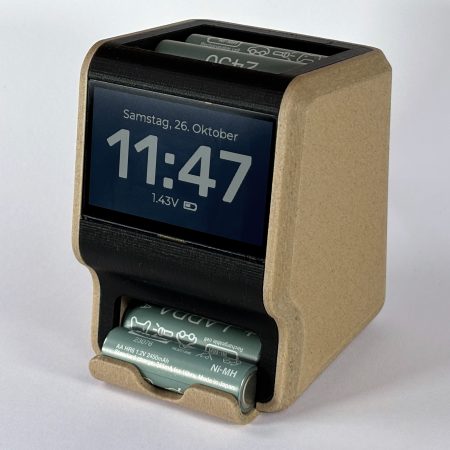
With the high-resolution LCD, the styling of this device reminds us a little bit of the Pi-Mac-Nano— and anything that makes you think of a classic Macintosh gets automatic style points. There’s something reminiscent of an ammunition clip in the way batteries are fed into the top and let out the bottom of the machine.

[Maximilian] thought of the, ah, less-detail-oriented amongst us with this one, as the dedicated charging IC he chose (why reinvent the wheel?) is connected to an H-bridge to allow the charger to be agnostic as to orientation. That’s a nice touch. An internal servo grabs each battery in turn to stick into the charging circuit, and deposits it into the bottom of the device once it is charged. The LCD screen lets you monitor the status of the battery as it charges, while doubling as a handy desk clock (that’s where the RP2040 comes in). It is, of course powered by a USB-C port as all things are these days, but [Maximilian] is just drawing from the 5V line instead of making proper use of USB-C Power Delivery. (An earlier draft of this article asserted incorrectly that the device used USB-C-PD.)  Fast-charging upto 1A is enabled, but you might want to go slower to keep your cells lasting as long as possible. Firmware, gerbers and STLs are available on GitHub under a GPL-3.0 license– so if you’re still using NiCads or want to bring this design into the glorious lithium future, you can consider yourself welcome to.

We recently featured a AA rundown, and for now, it looks like NiMH is still the best bang for your buck, which means this project will remain relevant for a few years yet. Of course, we didn’t expect the IEEE to steer us wrong.

Thanks to [George Graves] for the tip.