
Belting Out The Audio

Today, it is hard to imagine a world without recorded audio, and for the most part that started with Edison’s invention of the phonograph. However, for most of its history, the phonograph was a one-way medium. Although early phonographs could record with a separate needle cutting into foil or wax, most record players play only records made somewhere else. The problem is, this cuts down on what you can do with them. When offices were full of typists and secretaries, there was the constant problem of telling the typist what to type. Whole industries developed around that problem, including the Dictaphone company.

The issue is that most people can talk faster than others can write or type. As a result, taking dictation is frustrating as you have to stop, slow down, repeat yourself, or clarify dubious words. Shorthand was one way to equip a secretary to write as fast as the boss can talk. Steno machines were another way. But the dream was always a way to just speak naturally, at your convenience, and somehow have it show up on a typewritten page. That’s where the Dictaphone company started.
Continue reading “Belting Out The Audio”

How Big Is Your Video Again? Square Vs Rectangular Pixels

[Alexwlchan] noticed something funny. He knew that not putting a size for a video embedded in a web page would cause his page to jump around after the video loaded. So he put the right numbers in. But with some videos, the page would still refresh its layout. He learned that not all video sizes are equal and not all pixels are square.

For a variety of reasons, some videos have pixels that are rectangular, and it is up to your software to take this into account. For example, when he put one of the suspect videos into QuickTime Player, it showed the resolution was 1920×1080 (1350×1080). That’s the non-square pixel.

Continue reading “How Big Is Your Video Again? Square Vs Rectangular Pixels”

Off-Axis Rotation For Amiga-Themed Levitating Lamp

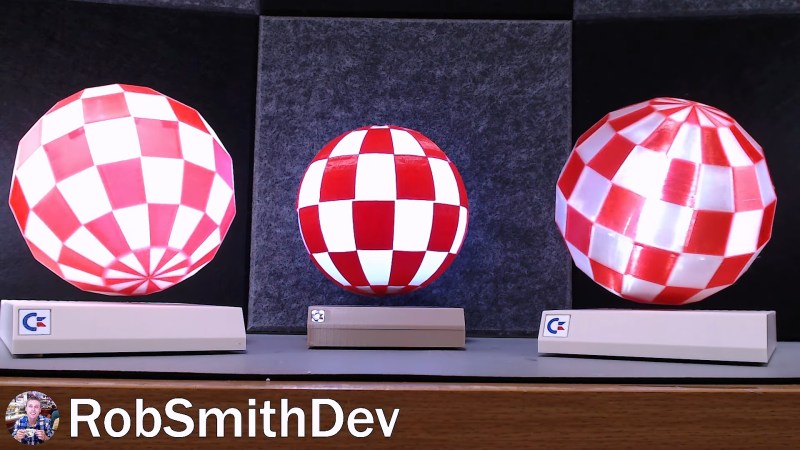
Do you remember those levitating lamps that were all the rage some years ago? Floating light bulbs, globes, you name it. After the initial craze of expensive desk toys, a wave of cheap kits became available from the usual suspects. [RobSmithDev] wanted to make a commemorative lamp for the Amiga’s 40th anniversary, but… it was missing something. Sure, the levitating red-and-white “boing” ball looked good, but in the famous demo, the ball is spinning at a jaunty angle. You can’t do that with mag-lev… not without a hack, anyway.

Continue reading “Off-Axis Rotation For Amiga-Themed Levitating Lamp”