
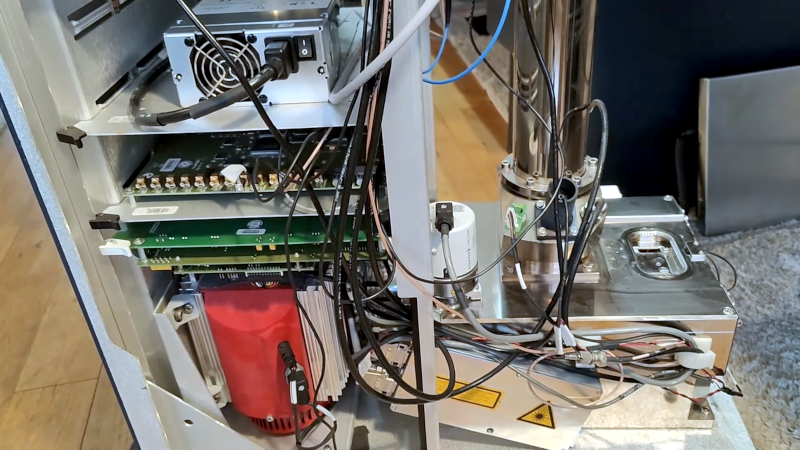
If you have ever thought, “I wish I could have a mass spectrometer at home,” then we aren’t very surprised you are reading Hackaday. [Thomas Scherrer] somehow acquired a broken Brucker Microflex LT Mass Spectrometer, and while it was clearly not working, it promised to be a fun teardown, as you can see in the first part of the video below.
Inside are lasers and definitely some high voltages floating around. This appears to be an industrial unit, but it has a great design for service. Many of the panels are removable without tools.
The construction is interesting in that it looks like a rack, but instead of rack mounting, everything is mounted on shelves. The tall unit isn’t just for effect. The device has a tall column where it measures the sample under test. The measurement is a time of flight so the column has to be fairly long to get results.
The large fiber laser inside produces a 100 kW pulse, which sounds amazing, but it only lasts for 2.5 ns. There’s also a “smaller” 10W laser in the unit.
There are also vacuum pumps and other wizardry inside. Check out the video and get a glimpse into something you aren’t likely to have a chance to tear into yourself. There are many ways to do mass spectrometry, and some of them are things you could build yourself. We’ve seen it done more than once.












The vacuum pumps and turbo molecular pumps in those things are worth a good deal of money. Love tear downs of fancy equipment.
A turbo molecular pump sounds like something you could reverse the polarity of to get you out of a pinch in star trek.
So true!!
https://youtu.be/_DfHPWoc9Vw?si=Yj9Bbij4N4ZtANis
It’s basically one of the few ways you can get a high vacuum. It’s like a jet engine that pumps molecules out of an area.
You’re thinking of the turboencabulator.
Back in the early 1980’s a buddy of mine bought a time-of-flight mass spec at Boeing Surplus and it basically took up his entire garage. I don’t think there were turbo-molecular pumps yet, at least outside the semiconductor industry. To record the very fast spectra, it had a high speed Tektronix scope with a Polaroid camera and the 3000 speed film. The goal was to computerize it with a 65C02 setup then do environmental/safety work, mostly on dioxin levels. The rapid results with TOF mass spec were to make it all worthwhile. I wonder what eventually happened with it. No magnets meant is used a lot less power.
If you have ever thought, “I wish I could have a mass spectrometer at home,” then we aren’t very surprised you are reading Hackaday <= I feel attacked