It’s a blustery January day outside Lakehurst, New Jersey. The East Coast of North America is experiencing its worst weather in decades, and all civilian aircraft have been grounded the past four days, from Florida to Maine. For the past two days, that order has included military aircraft, including those certified “all weather” – with one notable exception. A few miles offshore, rocking and bucking in the gales, a U.S. Navy airship braves the storm. Sleet pelts the plexiglass windscreen and ice sloughs off the gasbag in great sheets as the storm rages on, and churning airscrews keep the airship on station.
If you know history you might be a bit confused: the rigid airship USS Akron was lost off the coast of New Jersey, but in April, not January. Before jumping into the comments with your corrections, note the story I’ve begun is set not in 1933, but in 1957, a full generation later.
The airship caught in the storm is no experimental Zeppelin, but an N-class blimp, the workhorse of the cold-war fleet. Yes, there was a cold war fleet of airships; we’ll get to why further on. The most important distinction is that unlike the last flight of the Akron, this story doesn’t end in tragedy, but in triumph. Tasked to demonstrate their readiness, five blimps from Lakehurst’s Airship Airborne Early-Warning Squadron 1 remained on station with no gaps in coverage for the ten days from January 15th to 24th. The blimps were able to swap places, watch-on-watch, and provide continuous coverage, in spite of weather conditions that included 60 knot winds and grounded literally every other aircraft in existence at that time. Continue reading “What One-Winged Squids Can Teach The Airship Renaissance”

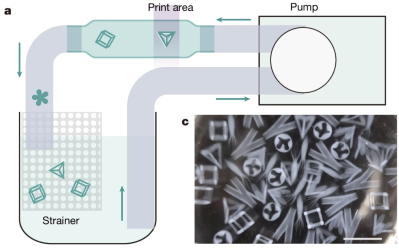 Normal volumetric printing uses a rotating volume of photosensitive resin to print nearly any geometry desired. However, this method presents issues when printing at high speeds. If you rapidly rotate a liquid, it won’t exactly stay still. So why not rotate the projector itself? This change also allows the use of less viscous resins, which is particularly useful if you want to pump fluid around.