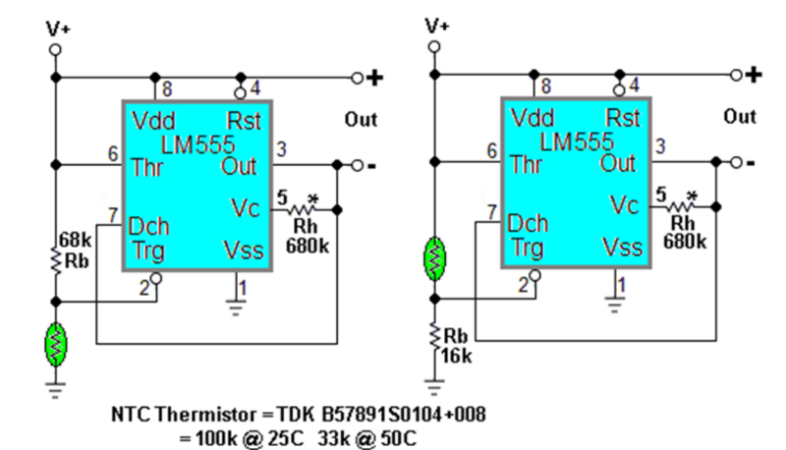
Thermostat? Do It With A 555!

It is a running gag around here that whenever a project posts, someone will inevitably point out that it could have been done with a 555 timer IC. [Stephen Woodward] went the opposite way and built a simple thermostat using the ubiquitous chip.

To be fair, this isn’t some sophisticated PID controller — it’s basically a bang-bang controller. Since the device has a comparator and the circuits use a thermistor, it seems like a clever but simple idea on the surface. However, there are some neat tricks. For example, if you tie the 555 threshold pin to Vdd, then the trigger pin acts as an inverting analog comparator. Another nice feature: the setpoint depends on a resistance ratio, so there is no need for a precise input voltage reference.

A simple circuit change can switch the circuit to power a heater or a cooler. The chip can handle a surprising amount of power, but for some applications, you may need some output drive circuitry. The simple circuit even has hysteresis, which you can set with a different resistor. Pretty impressive for a cheap chip, two resistors, a thermistor, and a battery.

We’ve seen a lot of strange 555 circuits in our contests. We even had a 555 Timer Contest.

Crack Mike Tyson’s Punch Out Bang Bang Passwords

[Bisqwit] has feelings about games that use exclamation points in his idiosyncratic walkthrough of all the nuances of the passwords in the famous Punch Out Bang Bang.

As he states in his deeply weird (though in no way wrong) channel intro, when he’s not driving a bus or teaching Israeli dance, he works hard to understand the things around him. Naturally, a mysterious phone number shaped set of digits in a favorite game was a secret worth extracting.

The digits can represent every possible state in the game.  It uses a pretty simple decoding and encoding scheme, which he walks through. As he says, it all becomes clear when you can see the source code.

After working through all the quirks he is able to arbitrarily generate any state in the game and handle the exceptions (such as Nintendo USA’s phone number). You can see all his code here and try it out for yourself. Video after the break.

We’ve grown to respect [Bisqwit] as the explainer of all things console games. You will like his explanation of how to write a code emulator for an NES CPU.

Continue reading “Crack Mike Tyson’s Punch Out Bang Bang Passwords”

Bang-banging Your Way To A Perfect Cake

bang-bang-oven-control

[Rob Spanton’s] house is equipped with a rather cheap oven, which was discovered while his roommate tried using it to bake part of a wedding cake. If someone took a shower during the baking process, a large portion of unit’s gas pressure was diverted to the boiler, causing the oven to shut off completely. This is obviously not a good situation for baking cakes, so the housemates decided to construct a makeshift controller to keep temperatures in line.

They started by installing a pulley on the oven’s knob, which is connected to a small motor via a long rubber belt. The other end of the belt connects to a small motor, which is controlled by a Pololu 18v7 motor controller. A K-type thermocouple monitors the oven’s temp, feeding the data through a MAX6675 converter to (presumably) [Rob’s] computer.

Since they were in a bit of a time crunch, [Rob] and his roommate [Johannes] decided the best way to keep the oven at a steady temperature was via bang-bang control. While you might imagine that cranking the gas knob between its minimum and maximum settings repeatedly wouldn’t be the ideal way to go about things, their solution worked pretty well. The cake came out perfectly, and the maximum temperature swing throughout the entire baking process was only 11.5°C – which is pretty reasonable considering the setup.