
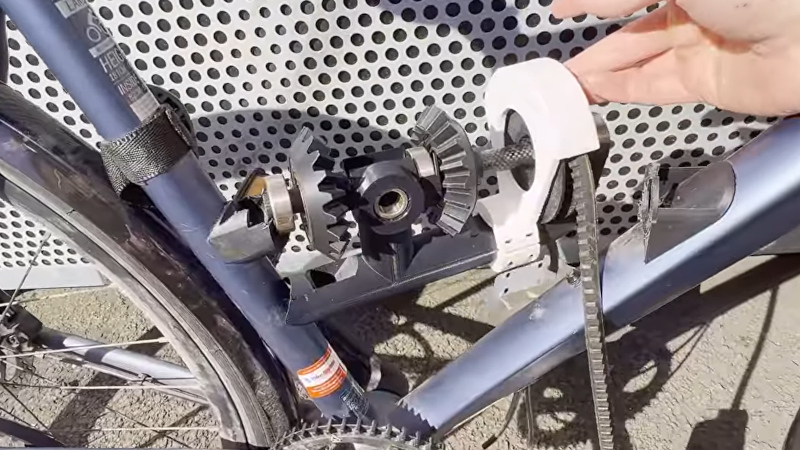
The bicycle is an invention that has not changed in its fundamentals since the first recognisably modern machines appeared in the closing years of the 19th century. Its frame uses a structure of two triangles, its wheels are equal in size, and it’s propelled by a pedal crank and (in most cases) a chain. Bicycles have improved vastly in materials and performance, but if you were to wheel a 2026 tourer into an 1886 bike shop, the Victorian proprietor would recognise it. Only a very brave engineer would try to fundamentally change such a formula, but here’s [Not programming] with a crankless bicycle.
The idea is to replace the crank’s circular motion with a linear one, thus providing a more constant propulsion. The build was inspired by another that used a sinusoidal track in a rotating cylinder to achieve the necessary conversion. This design takes a different tack, using an arrangement of gears and freewheels he describes as a mechanical rectifier to convert the back-and-forth motion of pedaling into rotation. The pedals themselves are stirrups mounted at each end of a V-belt.
This build is an exercise in pushing the limits of 3D print strength, as prototype after prototype shears under load. He does finally get the thing to work, though, and we admire his persistence. Oddly, this isn’t the first 3D-printed bicycle geartrain we’ve seen.












There have been oval sprockets designed to keep the torque advantage of the crank more linear, an admirable compromise.
Shimano BioPace, around since the ’80s. My previous craigslist beater bike had it and it was an unexpected treat. It gets “bigger” when your pedals are at the top and bottom position, to prevent your road speed from dipping at that moment in the cycle when your feet naturally slow down. And allegedly it reduces pain in your knee because that moment when the knee reverses direction now happens slower.
Interestingly, modern oval gears have chosen the opposite strategy: they are smaller when the pedals are at top and bottom, on the theory that you have very little leg power there so you should get past it as quickly as possible, knee comfort be damned.
Back in the 80s when Biopace was a thing, I made an oval chainring for my bike by splitting a circular chain ring and separating the two halves with a couple aluminum plates. I did all this with hand tools. I put it on my hypercycle recumbent bike and rode it from Tecate to Ensenada, about 75 miles, and it felt like going up stairs the whole ride. There’s a photo of the chain ring here: https://blogger.googleusercontent.com/img/b/R29vZ2xl/AVvXsEhq2izbAMQ7AT0QyZQqUSB3ymd_ZC47-f1N8ODczzTHklere_UROn3My2HmBeCvNTTAtOHoAUw6OCyGAFtMdvGJeuSoX1-nBFf13QbwOkmFvm2KCU6v7MSqweKqJcS-a08jBr2b979v611_/s1600/mark_pace.jpg
Crazy
very cool! Should be featured here!
You can see the system @08:35.
It’s quite silly. Instead of just using a chain (or timing belt in this case), he added extra 90 degree pinion gears, and another belt to the transmission. By adding all this stuff, and then still needing the gear hub in the back wheel, makes it heavy, expensive and low efficiency.
In day’s long gone by I’ve seen some clever systems which uses curve disks and cords to transmit the pedaling forces to the rear wheel, and “gear” selection (force to torque ratio) could be adjusted by moving the curve disks. That worked quite neat and probably had a good efficiency too. The main disadvantage is that the cords were consumables and had to be replaced quite often (Stringbike below clamied 1000 to 2000km for string replacement). I don’t know what the “official” strings costed, but bare UHMWPE is not expensive these days. You should be able to replace the strings a few times for the cost of a single chain.
After a bit of searching “Stringdrive” was one of the systems based on cords that made it into commercial production. The wikipedia article does not have much info, but the other link has a review with pro’s and con’s of this system.
https://en.wikipedia.org/wiki/Stringbike
https://www.cyclingabout.com/are-chainless-string-drive-bicycles-a-genius-or-terrible-idea/
With both a rotating axle, the extra curve disks and all the pulleys it does look more complicated then it should be, and that also reduces efficiency. The really hard part is to think of a simpler system, without making it heavier, bulkier, or giving up the “gear” ratio and “pedal cadence” optimization.
Not to be negativistic, but this site is a great example of how to bork up even image loading by doing the required-quality check yourself in JS (hint: that’s a ages-old built-in feature of webbrowsers).
Yep I remember this drive
I am all for innovation and abhor being critical of any inventors efforts but can’t help thinking if adding gears, belts, etc. one must be adding friction?
First, I have to say “love it”. I’m up to about my 6th silly project that’s mostly comprised of me finding out how much I don’t know about something!
I’m currently working on two bike projects and now in my third year of discovery!
I can happily say, I’ve figured out some of the fundamental problems and am slowly working my way to a commercial product.
I can say, with some experience, what your up against. 5 million plus patents for one. I just mention this because the bike seems to be one of those go to for budding engineers that think “Oh I can improve that part”. You’re up against a hundred years of bike technology, and some of the fundamental technologies were borne thousands of years ago. Add thousands of people/engineers trying to improve every component, fundamentally, and functionally. Not that I think you’re in trying to reinvent the wheel (if you are, my hats off to you;)
I’ve been racing bikes since I was a kid, even raced as a processor some years, so I know a little about bikes!
As mentioned in previous comments, biopace and osometric chain rings were an attempt to improve both power output and efficency. Both came up short because the efficiencies were based on mechanical principals, with little regard for biomechamical factors. Biopace was abandoned early on, because they figured out the rate of fatigue for the rider increased dramatically over distance. One reason for this is that you’re legs aren’t really built for pedalling. The muscles are in a constant transitional phase from the rotation of the pedals. It certainly doesn’t allow you to produce maximum potential wattage but that smooth transition, allows the fatigue load to be spread over a lot of muscles, allowing riders to ride efficiently, for long distances.
I hope you continue this development, so I can learn a few more things, and also, for the amusement factor;)
One fundamental thing i can tell you, without getting too deep into the design. It won’t work, as long as your ankles are “swinging”. Your ankles have to be stabilised before you can produce any meaningful power, especially on a bike, as it’s in a constant phase of controlled “falling sideways”! Your current “stirrup” had to become a stabilised lever (pedal). So some kind of slotted lever mechanism is necessary.
I’m looking forward to seeing where you take this……
Some people should be banned from owning a 3d printer
What is he even doing to get such horrible prints? He mentions 2 layer walls, which is insane…
A heads-up, in case he’s reading the comments: If you have the belt’s model number, you can usually look for commercial pulleys for that belt and download a CAD model of it. A few days ago I printed a XL belt pulley for an old food processor, with minimal changes to the shaft, and the teeth meshed perfectly with the belt. That way you don’t have to spend half a kg of filament on tests as he did.
He made least a few classic 3D printing mistakes- designing the printed plastic parts as if they were metal- i.e. too thin for the forces that will be applied. 3D prints get strength from bulk plastic. If you design a part like it’s made of metal, it’s going to fail quickly. 2 line walls? That’s barely enough for something that doesn’t have any forces applied. I’d bet a dollar that he used gyroid infill, too.
Back when people used to use 3D printed parts to build 3D printers I saw the same problems. They’d print motor mounts like L brackets because that’s how metal motor mounts are made. Of course they’d twist under belt tension. And they’d print them using PLA, and the motor would heat up and the mount soften and warp.
IMHO it’s all part of the learning process. Most people who seriously dabble in 3D printing are neither mechanical nor structural engineers. I try and give people a pass for those details when their interests are aimed at non-mech/struct interests or learning themselves through trial and error. Part of the fun of being a hacker/maker is learning to stumble around a bit.
Totally agree. +++
It is a great learning exercise, other that that it’s a terrible concept – why all the 90 degree changes in motion and the unnecessary gears? – with incrementally less terrible execution, but that’s fine.
Springs to bring the pedals to the top would help, a sprague clutch on each crank where it attaches to the shaft would be simpler.
I have no idea what the advantage it this or a cable or conecting rod drive is, except possibly for one legged cyclists. Otherwise having your legs synchronized and the peddle returning to the top is a good thing, not a problem.
But as a learning exercise it is excellent.
I seen those horse stirrups flopping around and I say no thanks, I’ll stick with a standard bixyxle
It really doesn’t take a rocket scientist. Just one small push and he could eliminate 95% of the torque.
Is there any reason to aim for a purely vertical motion? It’s adding a lot of complexity so unless there is an advantage this is only interesting as a purely academical exercise.
Right? The pedal does the linear to circular conversion in simple already.
Test the bike on a trainer not on the road.
Indeed; I was amused at the patience of the driver that was waiting for him to get on with it, and when another part failed, the driver thought “screw this” and went around.
All for trying new things, but it looks like a way-over complicated version of the Star Ordinary bicycle ratchet drives- actually giving two gear sets. Also would’ve been easier to adapt, more practical. But wouldn’t have been “new” I suppose.
Wow, you invented something that would probably very interesting to auto manufacturers. Imagine that, being able to drive both wheels with one input shaft!
We already do that in dirt track racing. We weld the gears together in the rear end and have constant 2 wheel drive. It’s great for dirt track racing. Not so good for pavement.
Cool concept to ponder but this design is creating an overabundance of frictional losses.
Need simplification…you replacing 1 chain for all this …
Will this revolutionize the bicycle drivetrain…probably not…but this was a great lesson in curiosity, creativity and perseverance. Kudos to you.
Uh, look, as cool as 3D rinting is, plastic is not suitable for every usecase. Especially not for significant forces.
Vertical pedals get re-invented about every decade. Here’s one from a decade ago that is also electric for some reason: https://www.youtube.com/watch?v=qlZKAra1tbQ
I am always amazed at the non-problems inventors (and industry) are always fixing with bicycles. Bicycles are an INCREDIBLY optimized machine, and most changes at this point are more about the money to be made than the improvements to be had.
As a for-instance, rim brakes versus disc brakes. Disc brakes have undeniable advantages! But a 22lb bicycle is not a 400lb motorcycle or a 4000lb car, and bicycle tires have a tiny tiny fraction of the contact patch of those vehicles, so most of the advantages of disc brakes is just wasted on a bicycle.
I’m not a socialist so I’m not going to prevent you from enjoying your classic steel-framed single-speed bicycle with rim brakes and whatnot. However, I love my 2025 hardtail MTB more than any other bike I had before.
I’d say that mid 2020s consumer-grade MTB (which, compared to entry-level bicycle-shaped-object from Walmart, already has quality parts fitted; yet no fancy crap like carbon frames for those cyclists with infinite money cheat enabled) really feels like bicycle formula perfected. Finally it’s all simple and logical construction with as few parts as possible. It’s like finally it was designed by somewhat sane people and engineers instead of still refining hacks and design choices from the 1920s.
• Thru-axles ❤ – a single metal rod instead of quick-release system which had lever, nut to adjust, lawyer tabs, conical springs.
• Disc brakes ❤ – will work for years without maintenance as the system is self-adjusting and weather-resistant. The only work needed is a 5-minute brake pad change.
• Cables routed through the frame ❤ – makes cleaning the frame from mud and grime a simple task.
• 1×12 gearing ❤ – finally no more fiddling with this f**king front derailleur. Finally no more incidents where this stupid plastic shield on the crank gets broken and your jeans pants get chewed by chain and sprocket.
• Drop post ❤ – easily adjusted if going gets rough (or when you need to put the thing in the boot of your car)
• Tubeless tires ❤ – recently I came home and discovered I had the misfortune of driving over some wood staple left behind by road workers making a temporary fence. Instead of fitting another tube I just went for a short ride on the next day and the thing sealed itself shut. Lovely thing.
• Standardized (machine) bearings in wheel hubs ❤ – no more screwing around with those stupid adjustable nuts, bearing balls and grease everywhere.
Compared to my 2018 (and earlier) MTBs I can finally take the thing apart down to a bare frame and put it back together in an afternoon without needing a doctorate in birotology to make it work again.
12 wide?
How skinny is that chain?
Ratio range?
I’d expect to lose more on the rear derailleur than you gain from losing the front one.
I’d restate Duane’s point and call out TFA.
It does not take a ‘very brave engineer’ to think they can ‘fix’ bikes.
Different adj…
Disc brakes are an optional fine tune for most.
Not any sort of fundamental redesign…no H shaped shift pattern and shaft drive.
A status symbol for some.
Most tour de frog LARPers have moved onto CF frames and seats that play with their balls as they pedal.
I digress.
I don’t think you understand what socialism means. In fact I’ve no idea what political/economic ideologies have to do with bicycles at all, it’s a really odd comment to include, especially as it makes zero sense.
Other than that, I don’t disagree apart from to point out that bikes will always be a goto for engineers, tinkerers and “reinventors”. Some try to sell dubious improvements, but a lot simply because they present an easily accessible framework to play around with different ideas.
Projects like the one featured aren’t trying to actually increase overall efficiency, at least it seems unlikely the builder would have the knowledge to build it but not the understanding of the efficency impact. They’re more playing around with a particular concept. A physics and engineering challenge little more.
That said. Pretty much all of the perfected elements you mentioned started from similar roots. The recency of some of the advances does illustrate that genuine incremental improvements have always filtered through the noise of the many failed ones, and there’s no suggestion that pattern should change.
As a bicyclist in the rainy Pacific Northwest, you can pry my disk brakes from my cold, dead, inevitably wet hands. I’m not going back to rim brakes.
What if the concept in the video was adjusted to accommodate a row excersize machine. Thus the linear stroke would be much longer and a person could utilize much more of their body to produce the thrust. Like pulling a recoil line on a lawnmower only with both hands and feet on a sliding seat. I would suppose higher speed could be attained if the transfer gear could hold on the pressures exerted on them.
Maybe if you wanted to sit in your living room and watch TV?
There is no way such a movement could provide legitimate locomotion over long distances or rough terrain.
Also not sure why you questioned someone that likes their disc brakes?
Saying only MOST of the advantages are wasted is basically admitting its worth it if you can afford it…
Or comparable to saying that decent runflat/puncture proof tyres or just suitable tyres for the conditions are not worth it, as you can cycle all year on the road slick tyre, fixing punctures 5 times a week and getting through 40 odd inner tubes a year. Or you can have a much nicer more comfortable feeling tyre for conditions simultaneously with tyres that will successfully prevent almost all deflation events while still having that air cushion for a little bit of suspension…
Or saying suspension isn’t worth it, which is certainly somewhat valid argument as the added weight matters, but the comfort of having a bit of suspension is a great tradeoff for many folks, and all these innovations making suspension lighter, of giving a fixed frame calibrated spring to make it more comfortable.
You can say it’s “worth it” if you tell yourself porkies about how much you’re actually gaining.
Like your “avoiding 40 punctures” story. People are good at exaggerating even imperceptibly small differences, coming up with implausible scenarios, and comparing apples to oranges to avoid cognitive dissonance, or the buyer’s remorse.
They’ll do it in advance of the purchase too, talking themselves into the sale by imagining vast improvements before they’ve even tried it, and then dramatically overstating the actual small change it made after they’ve paid for it.
Making your life more enjoyable and easier is always worth spending money on, when you have the money to spend. So when the only downside is upfront cost and it make your riding experience better…
I got through about an innertube a week on one of my old bikes with the tyres it came with, which lasted about a month maybe two before I’d burned up my spares and got fed up with leaky patches. Replaced them with ones with a more armoured belt so the awful roads around here don’t matter and didn’t have another puncture for several years… And those tyres were nicer to ride on too, both gripper and lower rolling resistance on roads at least. Darned expensive tyres and a price I didn’t have to pay but those tyres more than paid for themselves in hassle they saved, probably paid for themselves in the first month given how long it takes to take a tyre off and patch the tube with the small bike repair kit, or carry the darn thing on your shoulder home because you didn’t pack the repair kit today (did that twice, though one of them was actually the puncture though those good tyres many years later though, no fun at all)
If you’re having a puncture a week you’re doing it wrong. No thought given to carrying a spare tube and a patchkit? Are you carrying the bike on your shoulder or just the tube?
Road bikes are terrible for riding on roads.
You can’t ride in the bike lane, it’s full of tire flattening crap.
Then your one of those assholes.
I had the same experience as Foldi, bought much better tires (Gatorbacks IIRC) and problem is 95% better.
Real solution is ride the mountain bike.
Slime works, but makes the road bike feel funny downhill and hauling ass.
Which is kind of the only point of a road bike.
Any working bike does the cardio job.
I did carry both, at least while I had spare or ‘good enough’ patched tubes in stock. And yes I carried the bike – pushing it on the flat tyre was too darn annoying.
My personal bike choice was always a hybrid or mountain bike – only had the money and space for one bike back then so it had to do it all. So just asking too much for those original tyres really. Did keep the old tyres though as they were actually really nice on the gravel and dirt tracks in the forest (still a bit more of a road focused tyre than a real MTB) and never had trouble there either, they just couldn’t take the abuse of hitting sharp road debris or pot hole edges (quite possibly while doing 30-40mph with 100+Kg of me onboard) reliably.
On the mtn bike, I’ve got heavy duty tires (almost smooth center pattern for street), liners, heavy tubes and slime.
I never get a flat.
Almost never, when it happens it’s a slow leak, I ride home.
If your getting a flat a week on a low pressure tire you are doing something wrong or living in broken glass hell.
Duane, replacing a rotor is way cheaper than replacing a rim. similarly, try braking with rim brakes when it’s raining or snowing.
there’s lots of biking gimmicks out there but disc brakes aren’t one of them
When I was younger someone had a minor crash on a trail on their bike, they were fine and the bike was mostly fine other than the fact that it would make a click every time the wheel went round and if they used their front rim brake it would jolt or lock up and nearly throw them off. Turns out it was because of an outwards dent on the rim interfering with the rim brake. If they had disc brakes it likely wouldn’t have happened and disc brakes tend to be more durable and more protected, so you are less likely to damage them in a fall or crash.
Totally pointless; conventional bicycles are a magnificent form of transportation, simple, efficient and reliable. This is just a solution in search of a problem to solve
And what happened to – quite relevant – comment about shimano BP?
“…replace the crank’s circular motion with a linear one, thus providing a more constant propulsion…”
How is linear movement continuous and circular motion not?
Any cyclist knows that constant propulsion is easily achievable using pedals.
The solution is toe clips, or the awkwardly named “clipless” pedals.
Clips/clipless pedals let the rider push the pedal down AND pull it back up(and the in-between parts too).
This is why cyclists use them. You can use more muscle groups while riding, which can be used to rest one group while the other takes over (pull only to let push muscles rest), or augment the force of one group with the other for a lower individual load or higher maximum output (pull with right while push wih left).
NOTE:
“Toe-Clips” are a strap, or cage with a strap, that your shoe slides into and is sinched tight to attach the shoe to the pedals.
“Clipless pedals” are a system of pedal and shoe mounted clip which attaches the sole of the shoes to the pedals.
Despite this connection being MUCH more solid, clipless is safer and more convenient (during riding) because they can be released with a practiced movement by the rider, unlike toe-clips which must have the straps released by hand. One cannot ‘bail out’ of toe-clips, including when a rider simply comes to a stop.
“let the rider push the pedal down AND pull it back up”
Interesting thought. With the two cranks at a 90° angle (instead of the classic 180°) that would create an (almost) constant momentum.
I recall upgrading my cranks a few years back. The new ones had the BB connection rotated 90 degrees to the old ones. One of old cranks came off easily, the other refused to budge. I resorted to riding it with one of each crank, to loosen the stubborn one (which thankfully did fall off eventually). .
So, I can say from personal experience that setting them at 180 degrees is far far better. Riding with them at 90 degrees feels more like having zero offset between the pedals than anything. Complete loss of power for half the stroke and far harder to balance in the corners.
Long ago,
I metal fatigued a crank in half…riding a garage sale bike into the ground.
Took spill.
Was a long ride home, about 10 miles IIRC.
Annoying people on trail telling me I’m bleeding as I one leg it.
You can bail out of one of the toe clips.
Foot’s not that restrained, just the crank will spin without other foot to stop it.
Unless fixie riding hipster.
How do you think clip using riders stop?
Looks neat, but looks like everything should have been made with hardened steal.
But it’s worse than the stock drive train.
Back 50 years or so ago, I read in a bicycling magazine about a bicycle which used up-and-down motion to propel it. The ‘pedals’ were attached to long arms which pivoted somewhere at the back of the bike. Each pedal arm was attached to a section of chain which pulled on a freewheel – one freewheel on each side of the rear hub IIRC.
The details are a bit hazy in my mind at this late date, and obviously the bike wasn’t any kind of commercial success. I’m mentioning it just to point out that ‘linear motion pedaling’ is far from being a new idea.
Yup, I saw the same thing many years ago.
The details, as I remember them: A rod or wire is attached to a length of chain on each side and pulls this forward on the pedal stroke. The chain wraps around the top of the cog on the rear wheel as usual, then goes forward again on the lower side of the cog, also as per usual.
The difference is, this setup is replicated on both sides, and the lengths of chain going forward don’t connect with themselves to firm a loop of chain as on a “normal” bike. In stead, the two lower ends are again attached to a wire. Specifically, to each end of the same wire, which loops around the front side of the rear wheel, below the bottom bracket — or, where that would be on an ordinary bike. (Depending on the geometry of your frame and drive train, I suppose it could also be higher, wrapping around the seat post.) This way, pushing one pedal to rotate the rear wheel via the chain on that side simultaneously pulls the chain on the other side “backwards” and thus pulls/pushes the pedal on the other side upwards (or, on a recumbent, rearwards).
Where are all these commenters when HaD posts a ‘water clock’ or ‘vacuum tube’ project or retrocomputer or DIY camera or “A LLM from scratch”…etc etc…
I love this kind of creativity.
I don’t think I’ll ride this bike though. The rigid bottom bracket bearing (frame to pedal crank) in the classic “safety bike” design is critical to bike control. We stand on the right pedal when making a steep left turn, for example.
The bicycle as we know it is possibly the most efficient machine ever built. This is the reason it remains unchanged. The moment you start adding extra complexity, by adding gearing systems working perpendicular to your natural pedal motion, you’re adding friction and friction is a thief to energy.