
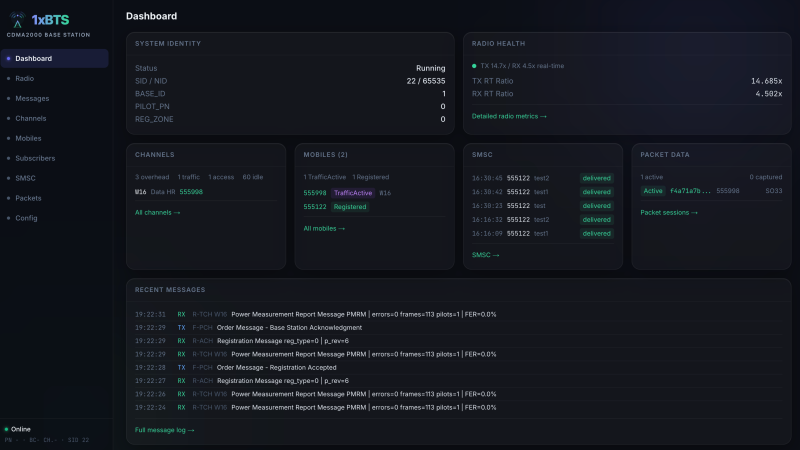
CDMA2000 was one of the protocols defined for 3G networks and is now years out of date and being phased out worldwide. Nevertheless, there are still vast numbers of phones that will happily connect to it, creating an opportunity for hackers seeking to run their own cellular networks. [Chrismoos] recently made this endeavour significantly easier by releasing 1xBTS, a Rust implementation of the lower three layers of a CDMA2000 network.
The lowest layer of the stack is an SDR for the actual radio communications. It’s been tested with the USRP B200 and B210, the LimeSDR Mini 2, and the BladeRF Micro 2.0. The code might work with certain other SDRs using the SoapySDR abstraction layer. The SDR is controlled by the base station (BTS) software, which, in turn, is controlled by the base station controller (BSC) over an Abis link. The BSC manages channels and mobile device associations, and exchanges frames with the mobile switching center (MSC), which handles message switching.
The stack includes standard 3G verification; before a handset can authenticate to the network, its details must be added to the home location register (HLR). Once authenticated, the handset can access all standard services: inbound and outbound voice calls via a SIP gateway, inbound and outbound SMS, and data packet transfers. A web dashboard provides a convenient management platform that includes packet tracing.
It should be noted that using this carelessly is legally hazardous; radio transmissions are strictly regulated in most countries, particularly in the cellular bands. If you’d still like to run your own cell network, we’ve also seen a few other efforts, such as this 4G implementation, this 1G recreation, and a GSM network made for a hacker camp.












Would love to get a i5 with 6.1.x and AbsterGo running. IIRC Technically it can connect to ATT 4G LTE but I can foresee issues with some basebands.
Getting AbsterGo, Luna, LockInfo5 and NatureMood up and running again on a 3G maxed out i5 on iOS6.1.X is the dream.
So actually as long as you keep it low power(in building only), these are entirely legal in the US, your individual municipality ordinances may differ however and this does not constitute legal advice in any form or fashion. You should not get legal advise solely from posters on the internet, but I’ve done my homework on this in building a “1G” GSM network.
Oh, and a POCSAG/Flex pager network. Working on getting repeaters and clearance for my own private cell via POTS coupler and several repeaters(friends are a good thing to have! Especially those on hills!).
I feel like there’s an opportunity to make a local bridge device for old cars that have modems in them for obsolete networks.
Why the auto industry doesn’t make those modules modular and upgradable/replaceable is absolutely astonishing to me.
I absolutely agree. If I don’t drive my car at least every 4 days, the battery dies because it has a 3G modem in the dashboard.
I’m still holding out hope for someone to bring back a mini version of the Palm VII wireless network. Would be really fun to experience again.
It really would be interesting to get CDPD up and running somehow for the old Palm and Handspring modems
I have one of those and am hoping to reverse engineer and create such a thing using a Semtech transceiver I have. I need to get a replacement transmitter battery before I can even try though, the original is long dead and unable to hold a charge
Yes, many many more handsets available for GSM, so good choice.
I think technically it would still be illegal inside a building in most places in the world. Where I live there is no excuse (other than accidentally leaking RF at low enough levels for certain classes of device) for transmitting on a licensed frequency without a license.
As long as nobody can detect it, and nobody reports you for it, you’d be okay, obviously. Unfortunately, its possible that someone could roam onto your internal network for emergency calling depending on signal strength of their home network, the device they’re using and your network setup. That would definitely bring the regulatory hammer down hard on you.
Depending where you live, there might well be public bands where you can legally transmit at low frequency levels that are supported by some devices, but in general, I’d be extremely careful about broadcasting on licensed frequencies, it’s basically like trespassing on private property after scaling an electric fence, you’re not going to have a defense if you get caught.
Here in Australia, the 3G network was shut down in 2023. In many parts, it was replaced by… nothing. In my house I can no longer use any cellular phone reliably. If I have an accident, or get burgled, I can’t call for help. When infrastructure is removed by the bif telcos, I say the individual not only has the right but also an obligation to minimise the harm. If Telstra put a 4G tower up, then and only then will I turn off my rebel 2G femtocell.
This is not legal advice, you do you.
Aaaaah… WCDMA, the “next big thing” been and gone.
I got Nokia’s first gen of WCDMA base-stations through Japanese type approval. It was to rule the world! 🤣🤣🤣
Flash in the pan.
Flash in the pan, it may have been, but I worked on a project that involved the jamming of cellular handsets, and while the (simple, imported, very illegal) jammer worked as advertised on GSM and TDMA handsets, the CDMA handset kept on working, due to its wider bandwidth.
I’m still very much a fan of the GSM concept — every provider uses the same handset, and changing providers required only changing the SIM. Sadly, we now have eSIMs which do not just pop out and in.
You add multiple eSIM and swap between them. It easy enough on my iPhone. It’s not an infinite supply of alternative profiles, but then neither are SIMs since they want to charge for them usually.
I happen to have switched providers last week, switched from one eSIM to another, then had the number brought across.
The biggest, and stupid, issue I had was importing the SIM since everyone assumes you are using two phones to do it.
I had to read the QR code, past the code I to notes, then extract the fields into a manually entry screen. Fun.
Maybe I shouldn’t have done the swap sitting at a bar drinking, but hey, it worked.
The bigger problem is that only data is standard on 4g and newer networks, so phone companies can and do lock out perfectly good devices by not blessing them to run on their networks.
All they need to do is change one parameter from the default and no devices can connect without a carrier profile which they can refuse to make available.
My Samsung S20 from a few years back recently stopped being able to use voice services because its an AT&T version. Even though it supports all the 4G frequencies and VoLTE, the carrier won’t provision it because it’s not the shitty Exynos version sold locally. I thought I was clever getting the Snapdragon powered version until the 3G shutdown. 🤬