Remember When Flash Drives Were Going To Make Your PC Faster?

The 2000s was a decade of great change in the computer industry. The world had grown accustomed to corruptible floppy disks, blue screens of death, and achingly slow load times. In a few short years, all of that would change, as USB drives, better operating systems, and faster processors brought forth a new age of stability and speed.

Amidst this era of upheaval, Microsoft introduced a new technology. It was intended to increase performance on the cheap to a new generation of machines, but it would turn out to be little more than a gimmick that never really caught on. Let’s explore the easily-forgotten legacy of ReadyBoost.

Continue reading “Remember When Flash Drives Were Going To Make Your PC Faster?”

Figuring Out What James Webb’s Mysterious Little Red Dots Are

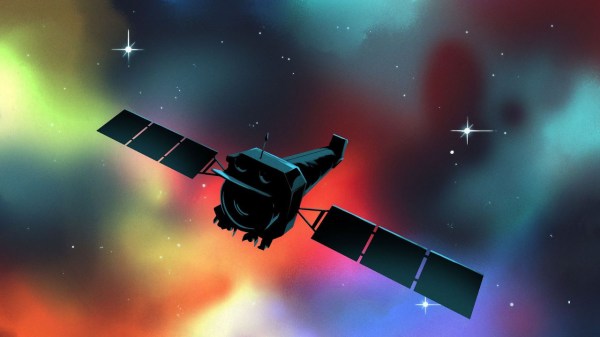
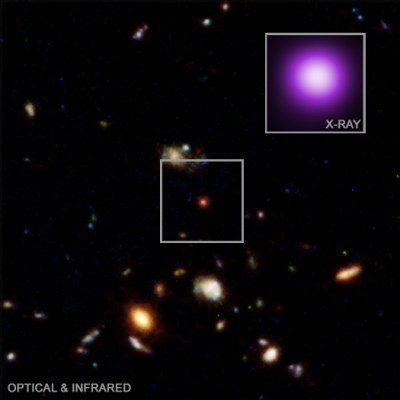
After the James Webb Space Telescope (JWST) began operations in 2022, it soon made a tantalizing discovery in the form of mysterious red dots: small, red-tinted astronomical objects of unknown origin and composition. So far well over 300 of such little red dots (LRDs) have been identified, with many theories on what they are. Fortunately the Chandra X-ray Observatory recently added some more clues as detailed in an accompanying paper.

Current theories include them being a form of primordial galaxy, or a supermassive black holes embedded in a dense gas cloud. The LRD discussed in the paper with the designation 3DHST-AEGIS-12014 was found to emit X-rays unlike other LRDs. By comparing the data between JWST and Chandra for this LRD it lends credence to the theory that these LRDs are a transitional phase as a supermassive black hole ingests the material of said gas cloud.

X-rays produced during this can sometimes make it out of the gas cloud, after which we can observe it. If that’s the case, these LRDs should cease to exist the moment the black hole has consumed enough of the cloud, which is something that we may be able to find evidence for if we’re lucky.

This adds just another reason why keeping the Chandra X-ray Observatory mission funded, after it narrowly got saved in 2024.

Power From Gravity

Gravity batteries aren’t exactly a new idea. You can store energy by lifting something heavy, converting kinetic energy into potential energy. To get it back, you let the mass fall and convert that motion to electricity. [Valeriamayara22] shows how to build a working demonstration model of such a system.

This isn’t free energy. Something has to lift the weight. In this case, the height is 1.8 meters, and the mass is 15.65 kg. Even so, the model achieves 13 W peak output and 58% efficiency, according to the post. Reportedly, it takes 394 drops of the weight to fully charge an iPhone 16, so this isn’t a practical project, but it does show how a gravity battery works. One nice thing is that the system stores as much energy on its 1,000,000 th charge as it does on the first one, especially if you keep the chain lubricated. Try that with a chemical battery.

The mechanical part uses a bicycle chain and some sprockets. There is a battery to even things out since, like wind power, when you make energy with a mechanical battery, you either use it now or lose it.

The cost of the build is about $400, and there’s a GitHub repo with all the files if you want to take your own shot at it. The energy efficiency number references the potential energy stored versus the energy produced. Obviously, if you are using some other energy source to lift the weight, that’s another calculation.

As you might expect, a practical system like this can be very large.