Hunting Submarines Via Gravity Is A Tough Errand

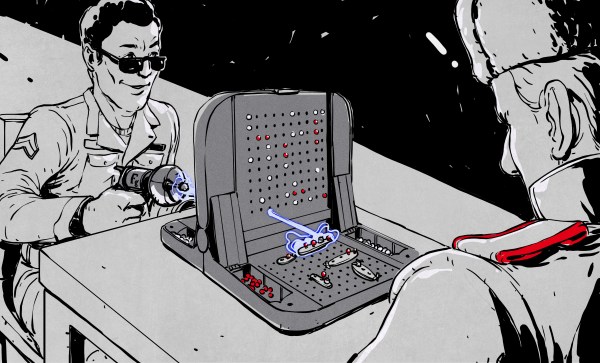
Among so many other technological advances, the Cold War saw the advent of the ballistic missile submarine. The concept was simple—pack enough nuclear warheads to destroy a small civilization into a compact metal tube, and then hide it underwater. The oceans would act as a cloak for your fleet of world-enders, and keep your enemies forever on their toes. A terrifying machine that could both start and end a war with the push of a button.

Most nation states are populated by humans with the will to live. Thus, there has been a great incentive to find ways to keep tabs on these sunken doombringers. Great efforts have gone into improving sonar and magnetic detection methods over the decades, which are the bread and butter of sub hunting to this day. However, military researchers have also explored the prospect of whether submarines could be detected via their effect on the gravitational field alone.

Continue reading “Hunting Submarines Via Gravity Is A Tough Errand”

So Long, CHU, And Thanks For All The Time Signals

In the long ago, pre-internet days when your clock project wasn’t an ESP32 getting its timing via NTP over WiFi, it was still possible to build a wirelessly-updating clock. All you needed was a shortwave receiver tuned to a time signal — perhaps like the National Research Council of Canada’s CHU, found on the dial at 3330, 7850, and 14 670 kHz. At least, it can be found at those frequencies until June 22nd, 2026, when the station will finally go dark.

Depending where you were on Earth, it might have been easier to tune into CHU than the United States based WWVB, or one of the various European signals like DCF77 or the UK’s MSF. If you’re not into radio, all these time signals have essentially the same job, if you hadn’t guessed: tell the time. This can be done in a variety of ways, and CHU has made use of more than one of them since its establishment in 1923.

Initially, the time was sent in Morse code, but later they added a speaking clock for easier human listening in both Canadian French and English. For synchronizing radio clocks, a series of pulses is given in DUT1 format using 0.3s pulses — which is what older clocks would have been listening to — and nowadays a digital FSK time code for more modern equipment. You can have a listen through the video by [Shortwave Listener] embedded below.

It’s not our place to judge the Government of Canada for trying to save money where they can. It wasn’t so long ago that WWVB was in danger of shutting down for similar reasons. But we’re still going to miss those beeps. If you do tune in before the station goes dark, CHU should still be giving out QSL cards. Get yours before it’s gone forever.

If you do have a clock that relies on this time signal, don’t worry. You can make your own, perhaps with a GPS time source.

Continue reading “So Long, CHU, And Thanks For All The Time Signals”

See Aerodynamics In Action With A Desktop Wind Tunnel

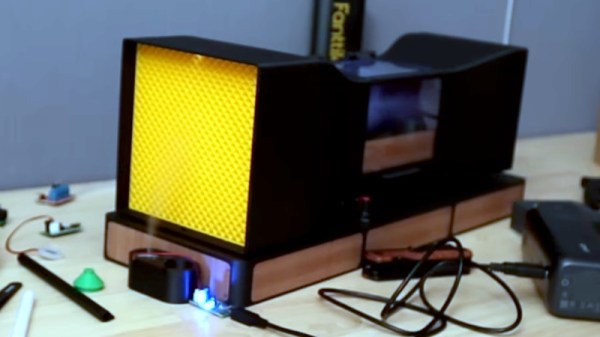
While most of us don’t design aircraft or racing cars, it’s likely that we’re still fascinated by some of the aerodynamic studies behind them. But a full-sized wind tunnel is going to cost a small fortune, so how can we experiment? Never fear, because [luisengineering] is here with a 3D printable desktop wind tunnel.

There’s a build video that we’ve embedded below, and if you can sit through the continuous shilling of random tools, it’s an interesting watch. It’s an open design in that air is not recirculate through it, instead it passed through the machine from left to right. On the right is the fan, on the left the intake with a rectifier to ensure laminar flow. Then a constriction compresses and speeds up the air past the stage for the model under test, and an expansion slows it down again for the fan.

A wind tunnel needs a smoke generator to easily spot turbulence, and in this case a vape is called into action. The result is surprisingly effective, as we see with a demonstration using a small model car. Meanwhile if you’re interested in wind tunnels at this size, it’s not the first one we’ve brought you.

Continue reading “See Aerodynamics In Action With A Desktop Wind Tunnel”