
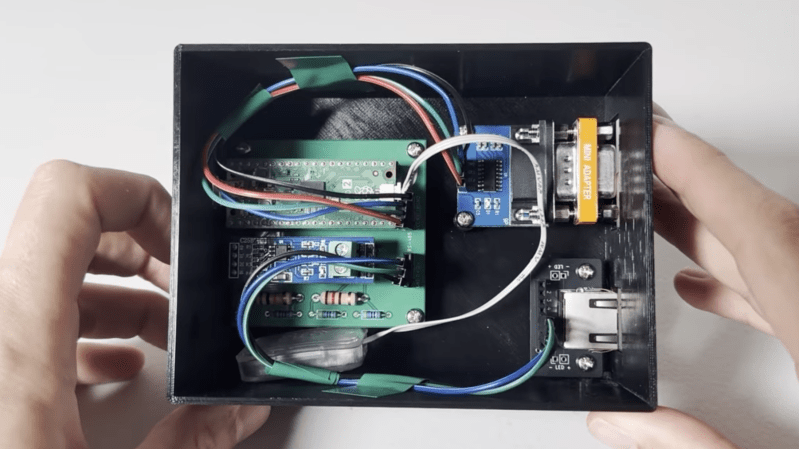
[Chris Doble] has high ambitions: he’s making his own scanning-electron microscope, and as the first step he’s built a high-vacuum system. This required its own controller to manage the various electronics involved in the system, which he’s documented and open-sourced.
The vacuum system itself starts with a rotary-vane roughing pump, which can bring a chamber down from atmospheric pressure to about 10-3 millibar. This is still too high a pressure, so the second stage is a turbomolecular high-vacuum pump, which can operate from 18 millibar down to 10-7 millibar. To protect the turbomolecular pump in case the roughing pump suddenly stops, it includes an anti-suckback valve. Connected to these pumps is a pressure gauge which uses a pair of sensors to sense the entire pressure range. All this setup worked well, but the turbomolecular pump and the pressure sensor each used their own interfaces, while [Chris] wanted a single interface for the eventual microscope.
[Chris] therefore designed his own controller based on the Raspberry Pi Pico 2, with firmware written in Rust. The pressure gauge uses an RS-232 interface, which he connected to the Pico’s UART pins using an RS-232 level shifter, with a null modem to swap over the transmitting and receiving pins. The turbomolecular pump used an RS-485 interface, which required a converter circuit and some level-shifting resistors. A custom PCB and 3D-printed case hold the final circuit, which provides a host computer with a single USB interface. When [Chris] tested the controller, the vacuum chamber reached a pressure of 10-6 millibar, and was still slowly falling when he ended the test.
This isn’t the first vacuum chamber controller we’ve seen. Of course, this assumes that the pressure gauge already has a controller; if not, we’ve also covered one of those. To see the inspiration for [Chris]’s project, check out [Ben Krasnow]’s scanning-electron microscope.











thanks for using the youtube share button i guess.
Ah, it’s you again.
Some of us don’t haunt Youtube or every blog out there. The point of Hackaday authors to me seems to be to find interesting things across the internet and share them with their constituents. If you don’t find an article interesting, then you do not have to follow the link to the source. Skip it and ask for your money back.
Right, couldn’t this be done as EM-on-a-chip? Of course, bosons (photons, LED / laser diodes) vs. fermions (electrons), but with Field Emission Cathodes or CNT arrays as emitters, maybe with reduced accuracy?
What exactly are you proposing? Replace the whole electron gun, scanning and focusing optics, sample holder, detector, vacuum chamber and vacuum pump with… what, exactly? What would the chip part do?
At those 10^-6 millibar levels it’s atmospheric moisture adsorbed onto the internal surfaces of the vacuum chamber. Heating up the vacuum chamber can increase the rate of desorption and speed up pump-down time
Baking out is a standard approach, but not really warranted for the levels he’s going for.
A way to speed things up without the need to bake the whole thing is to put an incandescent light bulb inside the chamber: The infrared photons nudge the adsorbed molecules off the surface directly — no need to heat the surface itself.