
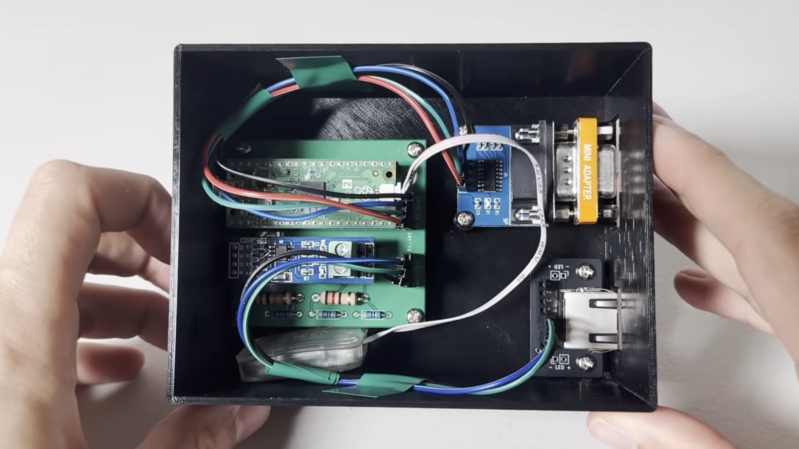
A black plastic box is shown, with a green circuit board inside. The circuit board is wired to an RS-232 connector and an RJ-45 connector.

A High-Vacuum Controller For An Eventual Electron Microscope

[Chris Doble] has high ambitions: he’s making his own scanning-electron microscope, and as the first step he’s built a high-vacuum system. This required its own controller to manage the various electronics involved in the system, which he’s documented and open-sourced.

The vacuum system itself starts with a rotary-vane roughing pump, which can bring a chamber down from atmospheric pressure to about 10-3 millibar. This is still too high a pressure, so the second stage is a turbomolecular high-vacuum pump, which can operate from 18 millibar down to 10-7 millibar. To protect the turbomolecular pump in case the roughing pump suddenly stops, it includes an anti-suckback valve. Connected to these pumps is a pressure gauge which uses a pair of sensors to sense the entire pressure range. All this setup worked well, but the turbomolecular pump and the pressure sensor each used their own interfaces, while [Chris] wanted a single interface for the eventual microscope.

[Chris] therefore designed his own controller based on the Raspberry Pi Pico 2, with firmware written in Rust. The pressure gauge uses an RS-232 interface, which he connected to the Pico’s UART pins using an RS-232 level shifter, with a null modem to swap over the transmitting and receiving pins. The turbomolecular pump used an RS-485 interface, which required a converter circuit and some level-shifting resistors. A custom PCB and 3D-printed case hold the final circuit, which provides a host computer with a single USB interface. When [Chris] tested the controller, the vacuum chamber reached a pressure of 10-6 millibar, and was still slowly falling when he ended the test.

This isn’t the first vacuum chamber controller we’ve seen. Of course, this assumes that the pressure gauge already has a controller; if not, we’ve also covered one of those. To see the inspiration for [Chris]’s project, check out [Ben Krasnow]’s scanning-electron microscope.
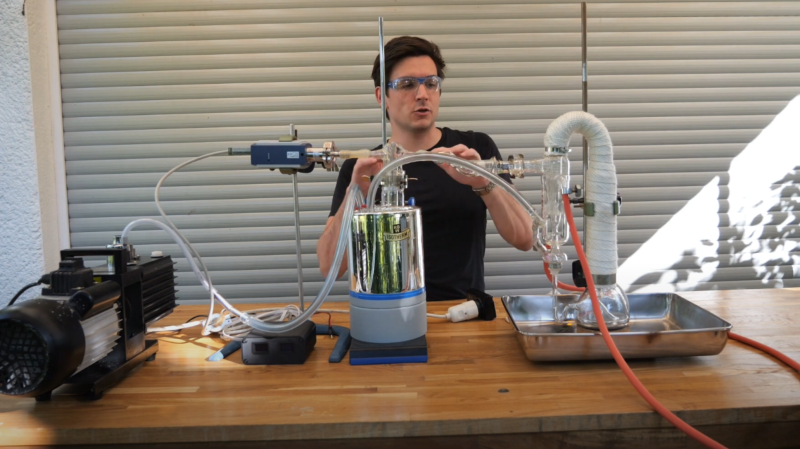

A man is shown behind a table, on which a glass apparatus like a distillation apparatus is set, with outlets leading into a large container in the center of the table, and from there to a pump.

Pulling A High Vacuum With Boiling Mercury

If you need to create a high vacuum, there are basically two options: turbomolecular pumps and diffusion pumps. Turbomolecular pumps require rotors spinning at many thousands of rotations per minute and must be carefully balanced to avoid a violent self-disassembly, but diffusion pumps aren’t without danger either, particularly if, like [Advanced Tinkering], you use mercury as your working fluid. Between the high vacuum, boiling mercury, and the previous two being contained in fragile glassware, this is a project that takes steady nerves to attempt – and could considerably unsteady those nerves if something were to go wrong.

Continue reading “Pulling A High Vacuum With Boiling Mercury”

Supercon 2022: Nick Poole Makes A Jolly Wrencher Tube

[Nick Poole] shared his circuitous journey into the obscure world of homemade vacuum tubes on the Supercon 2022 stage. It began innocently enough when he saw [Usagi Electric]’s single bit computer vacuum tube computer, which uses dozens of vacuum tubes. He got to wondering, could you make vacuum-tube-like devices containing multiple elements? There are some examples, like the 256-bit memory Selectron tube from the 1950’s, but nothing general purpose like a 555 timer or quad NAND gate packages. Unencumbered by a deep understanding of how vacuum tubes work, [Nick] proceeds to fill this void by imagining Integrated Thermionic, a fictitious company that exists in an alternate history where transistors were not invented and the vacuum tube reigns supreme. He also showcases a variety of innovative products that Integrated Thermionics manufactured over the decades, including surface mount tubes.

Continue reading “Supercon 2022: Nick Poole Makes A Jolly Wrencher Tube”









