
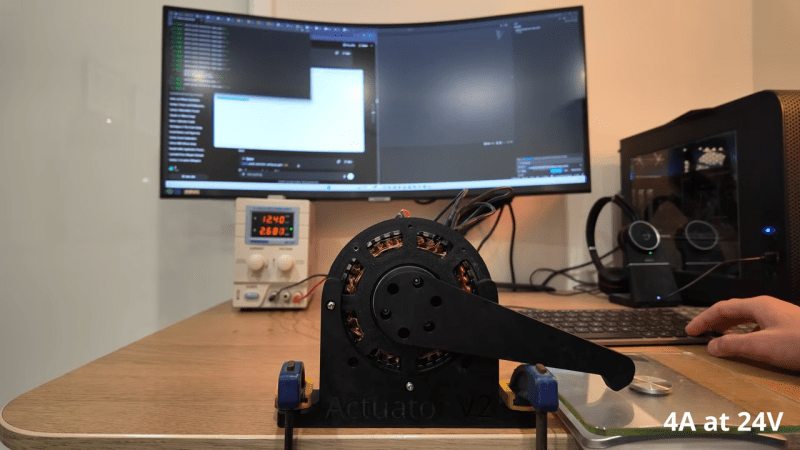
[Brandon Lai] is hoping to build a humanoid robot. To that end, he’s going to need some actuators, and decided to design his own. His second pass at this turned out pretty well, with a few snags found along the way.
Target specs were a actuator that could run at 40 to 60 RPM while delivering 20 Nm of torque for up to an hour continuously. The design was inspired by an MIT research paper, with [Brandon] making a few mods to suit his use case. Where the MIT design uses an inbuilt planetary gearbox, this build substitutes a cycloidal gearbox with a hope it will provide better torque capacity with less backlash. The design is based around a hand-wound stator made with an off-the-shelf core, while using custom CNC parts and 3D printed components for the motor housing itself.
Testing revealed some limitations. Running off a benchtop power supply with limited current, the motor was only able to achieve 7 Nm of torque, though a better PSU would probably improve this. [Brandon] also noted excessive backlash in the cycloidal gearbox, due to poor tolerances, and the $400 construction cost came in well over budget. Still, [Brandon] hopes to tackle many of these problems in a future revision. CAD files are available online if you’d like to dig deeper into the design.
We’ve featured plenty of great actuator builds over the years.












I found this video quite an eye-opener: https://www.youtube.com/watch?v=9CDH4NMT_Pc&t=1200s
Cycloidal and planetary motors are nice, and allow the robot’s joints to look nicer, making the robot look more appealing. But they are actually really complex and it’s very hard to get the tolerances right to minimize backlash. Which is why they are so expensive.
Belt-drive actuators are much cheaper, much more simple, more efficient, can easily minimize or even eliminate backlash, etc. They just make the robot look a little less aesthetically appealing if you try to use them as a ‘module’. But belt-drives can easily be tucked away in the frame, the belt can be as long as you like, although you will have to properly guide it of course.
Look at car engines. They almost all use belt drives to drive the overhead cam shafts. There are a few engines that actually do use sets of gears, but they are far and few. But the fact that 99 or more % of cars use a belt should tell you enough. Try to turn a cam shaft with your bare hands. You can’t, you can’t apply enough torque, you have to use a lever. If you’d use gears, you can imagine the wear. While a belt (or a chain) can handle it easily.
The next step up is using real hydraulics, I guess. That’s probably going to eliminate all backlash.
You’d probably want to measure the power draw of the motors to find out if you need to make corrections. You can’t rely on accelerometers only, because you want to know how much a motor is ‘away’ from its projected value, because that is what you will need to correct. Backlash will make those measurements too imprecise.