
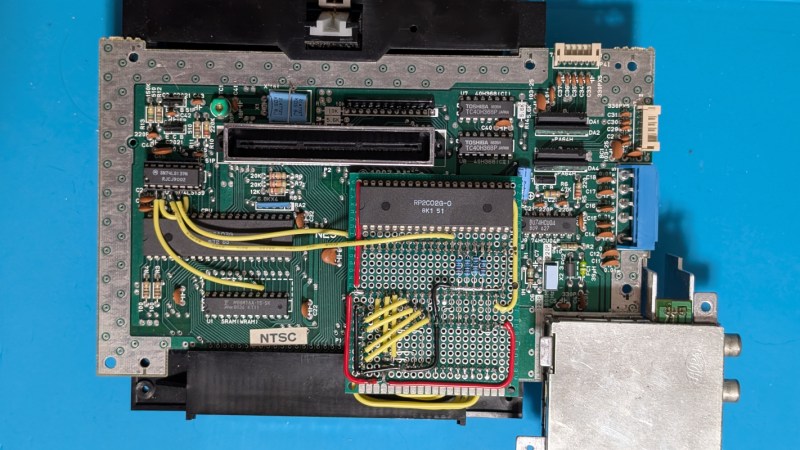
Modern video game consoles rarely have expansion ports, but in the 80s and 90s it was practically guaranteed. With the speed that hardware was advancing it made sense to build in some way to upgrade a system’s capabilities throughout its lifespan. But while this gave us things like the Sega CD and N64 Expansion Pak, many ports ultimately went unused. Given this recent project from [decrazyo], one wonders if unused port on the bottom of the Nintendo Entertainment System could have been used to expand its graphical capabilities.
The basis of this upgrade is the fact that the Picture Processing Unit (PPU) on the NES has four pins that are grounded. These four pins tell the NES to display the background color if the pixel is transparent. Since they’re normally grounded, this means the NES can only display a limited background image, but there’s no reason these pins must be grounded. By using a second PPU configured to output graphics information and wiring it to these four pins on the first PPU, the NES can be given all kinds of new abilities, such as adding parallax effects to backgrounds, rendering more sprites, and showing more colors in the backgrounds.
Of course, the hardware requirements for this will require a donor NES to get the second PPU as well as the necessary memory chip for it, and we don’t recommend tearing apart perfectly good retro consoles for experimentation if it can be avoided. Presumably, you could use this open-source NES hardware alternative instead. But for those with the parts and the gumption, creating a demo or adding graphics features to homebrew games using this second graphics chip is within reach.












So you add graphic abilities that games don’t use, so you have to specially code a game to use them. (Or tweak an existing one to add effects.)
But nobody else can run them.
Not that it isn’t a cool project, but it’s so niche
A niche project on hackaday ? How dare they ?!
The comments are the most consistent thing about HaD.
WTF do you people want? When it’s a true hack, people complain, when it’s not enough of a hack, people complain. God, just go contact the editors for a refund.
skip the comments, that’s what I usually do.
He says by replying to the comments 😂😂
Not today ☝️🙄
+1!!!
Nah, bad take. This reveals potential that could lead to more accessible mods and a homebrew scene.
Wow! Also the video has a nice explanation in very few minutes, very good!
Eventually manufacturers realized that expansion ports are a big source of unreliability (besides being cheaper without). Your laptop and your smart phone are vastly more durable and reliable because they strictly limit “expandability” to USB-C. As much as people complain about DRAM and SSDs soldered to laptop motherboards, the lack of connectors reduces the need for repairs as digital devices age, get dropped, etc. As users, we want our PC fixit shop to be just as bored as the proverbial Maytag repairman.
I dunno man, I have NEVER seen a laptop that was broken because the internal disk/ram/pci connectors broke. But I sure as sh*t have had disks die. It was pretty damn nice to be able to pop an access hatch and replace the disk. Now I see devices with soldered-in eMMC which guarantees they will die after a few years of use. Even in my car!
This industry change surely came about because the market expanded to non-tech people who will never open a case, so there is no pressure to be user-serviceable. There’s even a perverse incentive to make people buy replacements rather than repair.
I am definitely not extolling the virtues of SSDs soldered to the motherboard. I recently watched a video on how hard it is even for a super-technician to recover an SSD when the CPU shorts out and melts the chips around it. An expensive recovery, I’m sure. So much for “right to repair.” Yes, even I was able to replace a modular SSD in my niece’s old Intel MacBook Pro. The hardest part was buying the right set of microscopic “pentalobe” screw drivers.
That said, in the olden days, connectors were pretty much the bane of computer reliability until VLSI came along. Yes, it was a different world back then. Avoiding connectors is not black and while. It just adds lots and lots of 9’s to 99.9% reliability.
Define “the olden days”, 1980’s? Because since late 90’s I’ve never heard anyone complaining about connector in their computer, working in electronics and computer service since 2001 and unless flooded, or installed in corrosive atmosphere(sewage treatment springs to mind) no connector is a problem(silly 400W GPU connectors bent to their limits for “neat” fit then overloaded by inevitable overclock does not qualify!)
Anymore the 12vhpwr connector is a known cluster but that is an exception.
Wireless charging comes to mind, extending the life of that USB port. eSIM doing away with the SIM tray slot.
A hardware mod that enables rom mods is, well epic. Certainly this is a good feature to implement for emulators, or perhaps one already exists?
I made a fork of Mesen2 that supports dual PPU functionality.
https://github.com/decrazyo/Mesen2
Nice! I read this article when it posted. Been meaning to come back and say this is the coolest shit I’ve seen in a while. Bravo! Right up my alley. Was gonna say don’t listen to the haters, all it needs is an emulator, support will come. Glad to see you were way ahead of me!
It would not occur to me to make an emulator that simulates hardware that was never really sold.
But I guess people get excited about n64 emulators that support texture replacement packs far in excess of the original hardware memory limits. If it lets people hack old games with new graphics, there could be some interest.
I’m skeptical about whether the homebrew community would embrace it though. Making something that runs on the constraints of the original hardware is basically the whole point of that hobby.
I’m working on a couple tbh.. XD
Please do not tear apart good NES’s for this. Use the open-source NES hardware alternative.
I assume this was heavily inspired by nes bootleg manufacturers that did a similar thing years ago for strange tv games made in hong kong, china and taiwan.