Graphics Upgrade For Nintendo Entertainment System

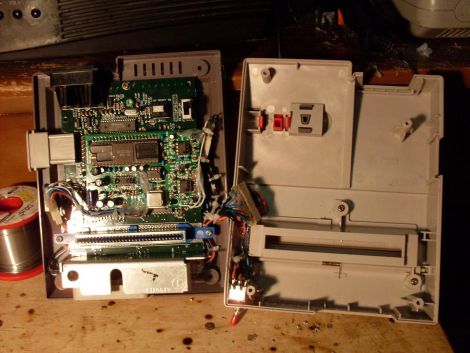
Modern video game consoles rarely have expansion ports, but in the 80s and 90s it was practically guaranteed. With the speed that hardware was advancing it made sense to build in some way to upgrade a system’s capabilities throughout its lifespan. But while this gave us things like the Sega CD and N64 Expansion Pak, many ports ultimately went unused. Given this recent project from [decrazyo], one wonders if unused port on the bottom of the Nintendo Entertainment System could have been used to expand its graphical capabilities.

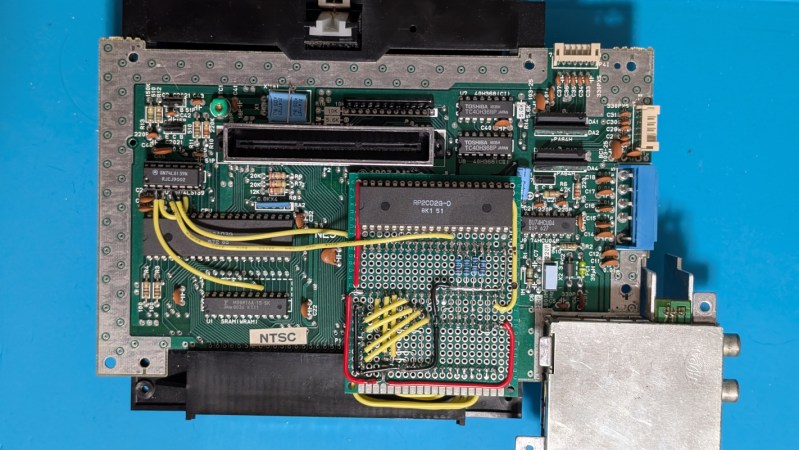
The basis of this upgrade is the fact that the Picture Processing Unit (PPU) on the NES has four pins that are grounded. These four pins tell the NES to display the background color if the pixel is transparent. Since they’re normally grounded, this means the NES can only display a limited background image, but there’s no reason these pins must be grounded. By using a second PPU configured to output graphics information and wiring it to these four pins on the first PPU, the NES can be given all kinds of new abilities, such as adding parallax effects to backgrounds, rendering more sprites, and showing more colors in the backgrounds.

Of course, the hardware requirements for this will require a donor NES to get the second PPU as well as the necessary memory chip for it, and we don’t recommend tearing apart perfectly good retro consoles for experimentation if it can be avoided. Presumably, you could use this open-source NES hardware alternative instead. But for those with the parts and the gumption, creating a demo or adding graphics features to homebrew games using this second graphics chip is within reach.

Continue reading “Graphics Upgrade For Nintendo Entertainment System”
HoloLens NES Emulator For Augmented Retro Gaming

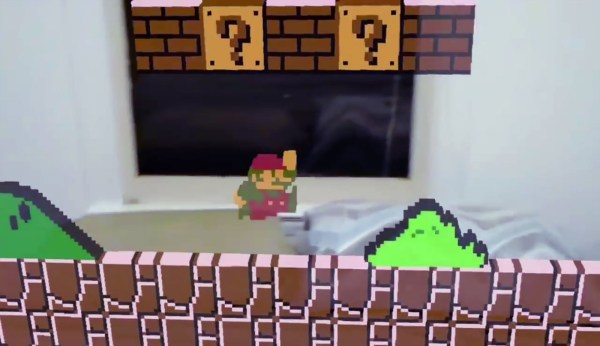
[Andrew Peterson] was looking for a way to indulge in his retro gaming passions in a more contemporary manner. His 3D NES emulator “N3S” for Windows brings Nintendo classics to the HoloLens, turning pixels into voxels, and Super Mario into an augmented reality gingerbread man.

To run NES games on the HoloLens, [Andrew’s] emulator uses the Nestopia libretro core. Since AR glasses cry for an augmentation of the game itself, the N3S re-emulates the NES’ picture processing unit (PPU), allowing it to interpret a Nintendo game’s graphics in a 3D space. [Andrew] also put together a comprehensive explanation of how the original Nintendo PPU works, and how he re-implemented it for the HoloLens.

The current version of the N3S PPU emulator automatically generates voxels by simply extruding the original pattern data from the game’s ROM, but [Andrew] is thinking about more features. Users could sculpt their own 3D versions of the original graphic elements in an inbuilt editor, and model sets could then be made available in an online database. From there, players would just download 3D mods for their favorite games and play them on the HoloLens.

According to [Andrew], the emulator reaches the limits of what the current pre-production version of the HoloLens can render fluently, so the future of this project may depend on future hardware generations. Nevertheless, the HoloLens screen capture [Andrew] recorded makes us crave for more augmented retro gaming. Enjoy the video!

Hacking Your NES/Famicom Console For Better Video And Audio

famicom_playchoice_ppu_mod

[Dominic] wrote in to share a pretty neat Famicom console mod that improves both the video and audio output of the system. While some of you may be familiar with the PlayChoice 10, we’re guessing that many of you are not. The PlayChoice 10 was an arcade-style machine that allowed you to play up to 10 different NES games. The system’s hardware was quite similar to the Famicom/NES consoles, but the graphics and sound performance was superior to either console.

[Dominic] decided to tweak his Famicom system, and ended up replacing its native Picture Processing Unit (PPU) with one from a PlayChoice 10. This allows the console to output RGB video natively, resulting in a crisper picture with brighter coloring. He didn’t stop there however. His Famicom system also sports an upgraded audio circuit that boasts psuedo-stereo sound as well as increased bass response and better overall audio clarity.

The console looks nearly stock, and performs quite well according to [Dominic]. Be sure to check out the video comparison embedded below to see how the modifications improved his system’s performance.

Continue reading “Hacking Your NES/Famicom Console For Better Video And Audio”