
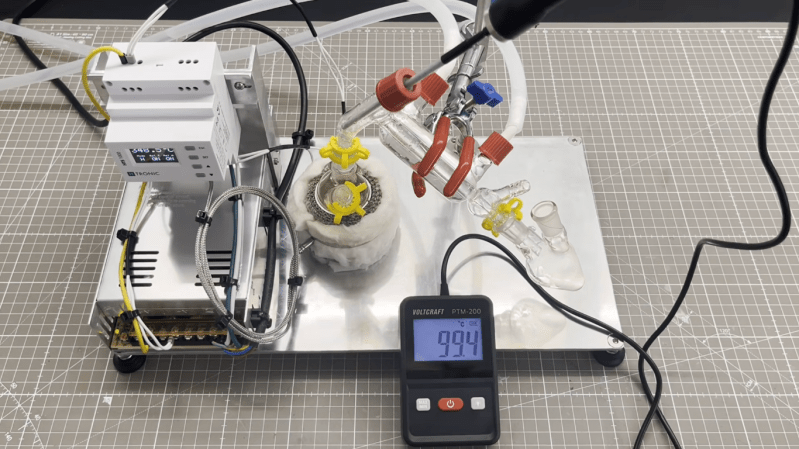
Much like radio operators being encouraged to use the least possible amount of power to make a contact, chemists have a similar rule encouraging using the least amount of materials in experiments. Not only is this rooted in economics, but in safety as well; if something goes wrong it’s generally good if there’s not excess amounts of reactants. With modern techniques, though, it’s possible to bring experimental chemistry down to incredibly small scales, and [Marb’s lab] found that they needed a custom built still for these new, diminutive experiments.
The first step is to build the heating component of the still. This is provided with a few custom aluminum parts for the base and a pair of heaters originally meant for 3D printers, with the assembled unit wrapped in insulation. The heater accomodates a 25 mL round-bottom flask. Temperature control of the heating mantle is provided by a controller mounted to a DIN rail which receives power from a 24V power supply, and an additional temperature probe is added to measure the temperature of the distillate. A test run with water shows the small still quickly and efficiently evaporating the water up to a condenser.
Although building a still doesn’t have to be technically difficult, building something this small that’s effective and safe is a bit more challenging than a backyard moonshining operation. Scaling chemical reactions down can often be a challenge but is possible with the right mindset and equipment. We’ve seen miniaturization of many things that we might not have expected including hydrogen production, aluminum smelting, and even the construction of a microscope.












I cant imagine that you couldnt perform the distillation here in a 50ml vessel. MSC has a digital mantle with magnetic stirring for 50ml round bottoms for under $300. The worst case scenario, dilute your sample in a sufficient volume of a higher temperature solvent.
Here at Hackaday is all about hardware hacking, not how to buy overpriced lab equippment. My setup costs only half of yor suggested heating mantle.
and likely will last less than half as long.
Yes but he built it and that is awesome. This isn’t about price. This isn’t called DealADay where we read about how someone found something in a dumpster. Markus built something that works, looks nice and it’s cool that’s the point.
As I built it I can repair it myself.
Cool build. Only gripe I have is this isn’t microscale chemistry. This is more like benchscale on the small side. I’ve seen a lot of people do vacuum distillations on this scale, mostly with a short path condenser(usually those are shorter than this one but not by a ton).
For microscale distillation you want to minimize the path length any condensate travels. There are special condensers you can use, I forget their names but they are intended to capture like 1mL in volume max. Usually small glass vials are used too, not flasks.
There is no clear definition of microscale chemistry, but sure I could build an even smaller distill using just a test tube, a stopper with a bore and a piece of bend borosilicat glass tube.
My comment isn’t a diss about your project. I hope you know that, I like your project quite a bit. It’s maybe a little specialized but its cute and does what is on the tin.
From my experience in synthetic chemistry I can say though, we regularly had distillations this size and we didn’t think of them as microscale. We could rip 10-15g of product from a 50mL. Microscale for us was more like step 8 of a synthesis when we had .1g of dirty product to purify and do 4 reactions and purifications on.
It’s true though some people might look at a 25mg reaction and think that is hardly microscale and want to work with 10 or something. The definition is loose
Fair enough:)
The condenser you cant remember might be a Friedrichs “cold finger” condenser.Theyre often setup with a 3 way receiver for fractioning.
Ive an old kugel rohr thats only supposed to take ~5ml samples at a time.Its pretty good if youre only trying to separate out a single component.
While not distillation, for small batch separation I really like my trusty ole cyclograph. Theres something almost magical about centrifugal chromotography separation to me.
I’d love to see a diy cyclograph build! Those things shouldn’t have ever gone out of fashion.
Friedrichs are great. Dang we tried getting a kugel rohr for our group once upon a time. Couldn’t justify it but I hear they are great.
The kugel rohr is neat but I wouldnt really recommend one. Their really limited in their application as they have a single condensation/collection bulb.
My cyclograph was an ebay find. A diy one wouldnt be hard to pull off since its just a peristaltic pump for feeding, an spinning an $80-300 silica gel disc
Id really love to see a DIY Centrifugal partition chromatography apparatus. If youre unfamiliar, they use a steel or ceramic rotor with a series of interlinked cells. Wire EDM or laser cutting would probably be the best way to construct one. Unlike the cyclograph you arent limited to small batch processes. You can run them in continuous mode running as much material as you want.
The easiest to DIY would probably be a Counter Current Chromotography apparatus as its just a couple of coils and a planetary gear. they dont need any complex sealed multiport rotary unions like a CPC. Because the hoses only undergo a planetary orbiting motion rather than continuously winding in one direction, they twist and untwist in perfect synchronization with every rotation
I read about ccc many years ago. Have never seen it in practice. I never understood how the stationary phase stayed in the coils and only the mobile phase eluted. The whole thing seemed counter intuitive to me in it’s implementation. I think on paper it’s not a hard build but in practice I’m a little stumped.
Say we wind a bunch of helices on the outer edge of a spinning rotor. That part works for me. Then we what, pump it full of stationary phase. Do we start spinning the rotor now? Then slowly pump in the mobile phase? Or is it add your sample and spin it until the stationary phase comes out? I just don’t see it in physicality. In theory it would work great.
okay so Ill try to explain,
think of the coils as a glass
now fill the glass with water but stop just short of the rim
now take a long needled syringe and inject vegetable oil into the bottom of the glass.
as the vegetable oil enters the water, floats up, and accumulates on the surface forming a top layer,
no water escapes the glass
That is how the mobile phase in CCC travels.
we load the stationary phase
then we start spinning the rotor. Then slowly pump in the sample
Centrifugal force (artificial gravity) keeps the stationary phase (water) in the outer half of the coils
so the sample (dissolved in oil) travels to the surface and is reinjected over and over and over again until it reaches the end of the coil
during this travel its “heavier” components travel slower and its “lighter” components travel faster until they are separate as they exit.
Thats your basic batch mode CCC
Understanding that oil, water, heavier, and lighter are all incorrect but merely being used to simplify the concept.
continuous mode operation which involves pumping both phases in opposite directions and injecting your raw material in the middle is a bit more complicated. If you understand the batch mode above, maybe you can just get it. If not bust out your googlefu. Hope this helped more than it confused. Good Luck!
That’s a nice explanation. What I don’t understand is, are the coils half full of stationary phase so that when spun only half a ring is immobilized by the centrifugal force? What is progressing the sample through each coil? Is mobile phase continuously flowing?
The total charge volume does not need to be half. It just needs to be less than the full volume. The mobile phase is moved by the continuous pumping first of your sample and then by pumping pure “carrier” solvent through as a chaser.
Now I understand thank you. Yea I imagine one of those could be built pretty easily. Definitely easier than a lot of other chromatography methods
30 years ago I took organic chemistry right when microscale was becoming pretty well established for teaching use. Instead of like hundreds of mLs of organic solvents and gram quantities of product, typical volumes were in the 10’s of mLs. My favorite apparatus was just the ol sand bath on a stirring hot plate and a Hinkle-Hickman still. It had a little side port so you could aspirate off a little distillate either from the top or the bottom. Usually you didn’t need to cool the top with anything more than air but sometimes we would hook a simple condenser to it. My favorite use was steam co-distillation of essential oils. The whole thing was adorable. When I got a job in industry I made them buy me a set of microscale glass in a little maybe 12″x8″ fishing tackle looking box. They griped but I saved them tons of money with that. Microscale is really a great way to teach and learn despite the obvious savings of materials, the process and “follow the product” applies up to full run kilo to tens-of-kilo scales in 100L reactors. For us anyway. Thanks for fond memories cool project
As a chemist that had to do fractional distillation, I used similar glassware. My heating element was different.
We also had to figure out what percentage of our solution was various chemicals based upon yield and what those chems were based upon temp at vaporization.
Since all that equipment is so basic, im sure you could buy all of it used. Not sure what we are supposed to get from this.
A great hack would be to find a way to use refuse to distill drinkable water from polluted surface water. People are dying of thirst and from drinking toxic water.
So because of the state of the world, others can’t have interests and ideas that don’t directly relate to the state of the world?