
In the early 1990s, Don’t Copy That Floppy was an anti-piracy campaign that attempted to connect with computer-savvy youth through the power of hip-hop. While somewhat difficult to imagine given our current draconian Digital Rights Management (DRM) hellscape, warning kids about the potential legal ramifications of duplicating floppy disks containing copyrighted software was seen as necessary since at the time there was usually nothing preventing users from simply copying the contents of one disk to another.
Unfortunately 30+ years down the road, we’re now finding that somebody really should have been backing up some of those disks. Which is why the University of Cambridge of launched the Future Nostalgia project and produced Copy That Floppy! — a phenomenal guide on preserving the contents of floppy disks while we still can.
There’s no telling how much data could potentially be lost to time because its stuck on such an antiquated and fragile storage media, and the situation only gets worse with the passage of time. The problem isn’t just that modern computers don’t have floppy drives. The disks themselves degrade with age, a process which is accelerated if they aren’t stored properly.
As such, Copy That Floppy! only briefly touches on the most ideal situation — that is, buying a USB floppy drive and making copies of the bog standard 3.5 inch disks you might come across. It then moves right on into more advanced topics, such as interfacing with less common drive types, how to safely clean floppies, and the use of advanced tools such as Greaseweazle to analyze captured disk images.
We’ve seen demonstrations of some of these techniques before, and a few years back Adafruit got interested in floppy preservation with modern hardware. But in-depth guides like these that pull all that information together into one place are valuable resources.












…and the result was hilariously cringeworthy because while money-wielding, fork-tongued lizardmen coexist within our society, they don’t really understand it.*
* For a more recent example see the senile dictator trying to mess with football.
Unfortunately, the presence of AI-generated video and quick easy A/B testing allows one to effectively influence a population without even speaking their language. The current state of advertising on social media is that you can give a brief LLM prompt (“Convince people that the earth is flat”) and the system will take it from there. It will generate a few video ads, display them to users, pick a winner based on engagement rate, tweak the ad slightly, test again, repeat, repeat. All while you sleep. No human insight or empathy necessary.
Right now, in my demographic, the main efforts appear to be pushing testosterone supplements, power washers, and support for a specific middle east ethnostate whose name I will omit.
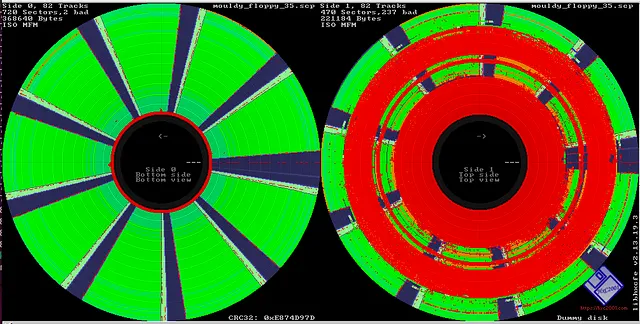
This article leaves out far too much information on the situations. he flux image shown says basically nothing but location of failed reads. It reminds me of trying to read bad floppies with the Greaseweazle software and it was unable to re-read bad areas. This and incredibly bad floppies [1] is what triggered me to build my own host software RecoveryWhiskers [2].
I want to re-iterate why archiving and archiving floppies is important: Public archives are disappearing from the internet. This is an alarming trend.
But a lot of software is not archived or filed properly. What we need is more people doing library work: Fill software libraries with software, fill out metadata, briefly describe what it does and collect all versions you find.
Interestingly floppies are less of a time critical issue: If stored properly, 30-40 year old floppies are still good. There are a few main causes of bad floppies:
Dirt & nicotine residues: Sometimes there is so much dirt on a floppy that reading it would act as an abrasive medium one you apply pressure onto the head.
Mold & moisture exposure: Most kind of molds sits on top of magnetic medium where it found some moisture. If they sit above, simply cleaning them with 70% IPA or n-Heptane will provide help there (use woven cotton flat q-tip). Some other molds grow into the magnetic coating and already destroyed some of your data.
Another thing I discovered is a set of bad manufacturers: I call them self-destroying floppies. Some have issue with their binder being too weak or their sleeves being too abrasive. I’ve only seen this in a handful of brands.
What’s important to note that none of these issues makes reading them now a time-critical matter. You already got a bad batch of floppies. If you keep your floppies well in a dry place that’s not too hot, all eventual elemental damage already happened. The magnetic medium will be fine though.
What I want to say: Magnetic media is incredibly sturdy. Go back up your old hard drives and read your homemade CD-Rs and DVDs before their coating flakes off. Look for artifacts on media you find and see if this exists in the form you find it.
[1] https://chitter.xyz/@JennyFluff/114976152924598053
[2] https://codeberg.org/JennyFluff/RecoveryWhiskers
Antiquated, sure, but fragile? Come back to your flash memory in 40 years and see how much data you can extract!
Flash is fragile? PAH! Come back to your RAM in 40 minutes and see how much data you can recover.
Just because something more short-lived, exists doesn’t mean that the other option is archive quality.
Backup to what? At the time period there weren’t many options that were cheap. And cheap is why people did it.
Even an identical, equally perishable copy juices the survivorship mathematics a lot as long as it’s stored separately.
Not only the disk surface degrades, but the glue that keeps the disk donut to the metal hub as well. But it’s not a lost cause, as it can still be perfectly recovered. Glueing it back with CA glue is possible but it causes the sectors to be off center, giving it a ‘wobble’ as seen by the drive head. What can make a full recovery is wiring the stepper motor to a 3D printer stepper stick and use micro stepping to capture all the in between sectors. I’ve used this in my floppycontrol project (search github) and successfully recovered data from MSX and Amiga era disks. I’ve also been able to recover a PC HD disk, which is more challenging.
Another often made mistake by recovery applications and hardware is not keeping bad sector data. Often a part of the sector is still recoverable, minimising the data loss. It’s possible to combine multiple different reads with the drive head slightly offset to get more data back than normal.
Who makes a 5-1/4″ USB floppy drive?
Who makes a 8” USB floppy drive?
Well this is HaD, seems like a perfect project for someone.
been looking and asking for awhile. I personally haven’t managed the feat yet.
You can use a Greaseweazel to turn a 5-1/4″ or 8″ floppy drive into a USB drive.
punch cards would be easy – optical scanning with some simple software
While likely hard to find, the Insite I325VM 3.5″ floppy drive offers an excellent platform to read old floppies. It is a SCSI based device and reads 13 different formats, It automatically offsets the position of the read head on a sector by sector basis to recover each sector. It worked so well at this task that 3M installed them in their data recovery group to support consumers back in the 90s. I know because I was in charge of electrical development of the I325VM
I know the dude.
He’s nuts.
Don’t know about anyone else but none of my floppy discs lasted to 2010. Most had succumbed to mould long ago
We (old school graybeards) may return to the punch cards as the major backup.
Most cards were made from awesome acid-free thick paper that survives almost anything except the obvious one-way tickets (fire, for example). The way I see it, there is plenty of real estate left untouched on those still, and there are newer/better compressed solutions that can imprint things quite well – and could be read back by average cell phone camera (or office scanner) with not much strain. Even humble Raspberry Pi 2/3 with average no-thrill cheap camera can probably reliably scan/convert these quite well.
I literally was thinking about this no less than a month ago; unrelated, I was thinking “it could be one interesting concept/rabbit-hole to try laser-carve some kind of non-destructive (ie where carved parts hold together still) QR code on these”.
Fortunately I have saved all my data using cuneiform script in clay tablets. As long as i don’t drop them they should last forever
The punched cards will outlive you if they are properly stored. The tape is probably a degraded, sticky mess by now.