
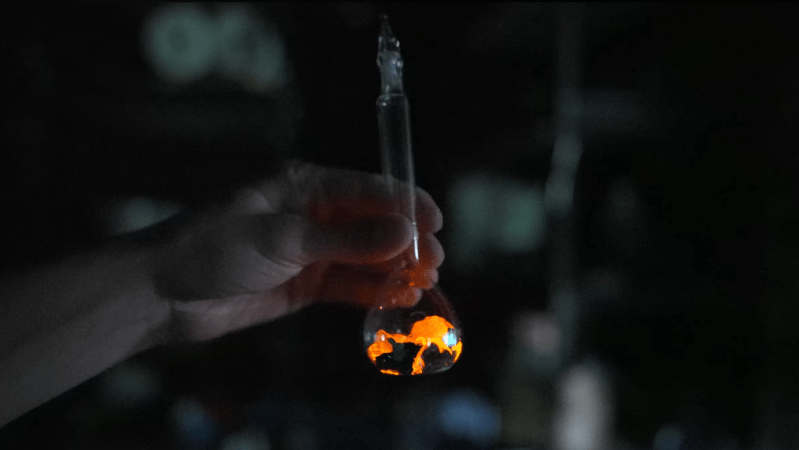
In 1675, while transporting a barometer by night, the astronomer Jean Picard noticed a glow inside its glass tube, just above the mercury. As the mercury sloshed and splashed across the surface of the glass, a static electric charge had built up, which was discharging by ionizing the residual gas molecules inside the evacuated tube. [Styropyro] recreated this effect, and found that the dim glow could be made much stronger by adding some noble gas to the tube.
It starts with a simple recreation: he took a volumetric flask, attached a narrow glass stem to the mouth, added some mercury to the flask, evacuated it with a vacuum pump, and sealed off the glass stem. This produced a faint glow when shaken, but it was only really visible under very low light. When [Styropyro] brought it near a Tesla coil, however, it did glow much more brightly.
Backfilling an identical flask with neon to about 40 millitorr produced a much more spectacular result (a low pressure in the tube is necessary, but moderate pressure variations don’t significantly alter the effect). When shaken even slightly, this neon-containing flask produced a bright orange-red glow just above the surface of the mercury. Points of obstruction, such as those in a zig-zag tube, produced a brighter glow. A krypton-containing tube glowed blue, but less brightly than the neon tube.
Since this is, essentially, a triboelectric effect, other materials besides mercury should work; [Styropyro] tested several materials, and found that pieces of Teflon produced a faint glow, and copper beads a somewhat brighter glow. Unfortunately, Galinstan, the obvious replacement for mercury, wets and coats glass, preventing a charge buildup.
Without an added noble gas, the standard glow of barometric light comes from the excitation of mercury vapors, a glow which can also be seen in mercury rectifiers, and which excites the phosphors of fluorescent light bulbs.
Thanks to [Vik Olliver] for the tip!










Fascinating.
Literally what would be to an alchemist , eternal fire within a bottle.
Wish this guy was my neighbour to share his vast knowledge.
You do not want this guy to be your neighbour
lol
It might be fun!
The world’s most powerful battery-operated laser (That can’t make it into the record books, because it’s illegal to transport it to the lab in Europe that has to do the testing…), the 24,000 watt light bulb that melted the aluminum reflector, the hundreds of car batteries in parallel blowing things up, the 20,000 watt “macrowave” oven, and so much more!
Great execution of a simple, but difficult to replicate, effect!
Have you contemplated making a mechanical He-Ne laser? I have no idea how long a tube would be needed, sans etalons, to lase. CO2 has higher gain, and would be easier, but IR rather than visible.
Have you sold any of these kinetic glow tubes? A science museum would likely love them for auditorium demos, or you might devise a sealed outer container in a holder with limited travel to allow visitor use.
An addition to the Frikkin Lasers Challenge, a hand powered CO² laser tube, eye protection required perhaps.
Although I do wonder about putting a thinner mercury containing tube inside a large fluorescent lamp, to excite the phosphor coating without damaging it during the shaking process.
If this can work in a smaller vial it might be possible to encase it in clear resin to make it marginally safer as a desktop toy.
I watched this video when it came out. I had never heard of the effect and was riveted throughout. It would indeed make a wonderful scientific toy if it didn’t happen to be made with highly toxic material! There are probably health and safety rules about shipping such quantities of mercury.
The one copper seemed to work well enough. An hour glass version might work.
This reminds me of an earlier HaD article I remember seeing.
The old dripping mercury gravity powered vacuum pump generated quite a a large amount of static electricity. I wonder about a Kelvin water dropper but made using mercury, since mercury has a lot more mass and is far more conductive than water, it shouldn’t be deflected quite as easily and should be able to build up a fair bit more charge. Sadly a project requiring more mercury than I think I could easily get my hands on, let alone afford.
Xenon might be a neat gas to try: it’s bright in the visible spectrum. Krypton has a huge spectral spike around 800 nm: far higher than anything in the visible (which is why krypton flashtubes are used to excite 1064 nm YAG lasers instead of Xenon)
That is a good idea. But based on filling many plasma tubes, neon is by far the brightest of the noble gases. Some of the more exotic colors, blue and green plasma would have issues. Blue uses iodine and would combine with the mercury pretty quickly. And green is such a delicate balance of gases that I fear the mercury would poison the whole thing.
No harm in trying, though. Except for the pocket book. Xenon runs about 60$ a liter in small quantities.
Cheers.
Hello Alan! I have not seen that name in a long while. Let’s see if that old email still works…
In retrospect, the Hg likely would poison a gas laser. But, a steampunk suggestion — how about a piezoelectric-powered gas laser? A bit off topic, admittedly, but even disposable lighter piezo elements achieve 10,000V or so. Or equally steampunk, a Wimshurst machine powered laser? Pieazo power goes back to 1880, demonstrated by Pierre and Jacques Curie, and Wimshurst, coincidentally, to the same date.
In 1880, there would have been sufficient technology to make effective lasers.
As I understand it, gallium and GalInStan wet glass only via the oxide layer that forms on their surface. With good enough vacuum technique, it should be possible to assemble one of these with oxide-free gallium-based alloy.
I’d try it myself, but I have no vacuum technique. Or equipment.
with HCl Acid you can remove the oxid layer of Ga or GaInStan.
You can use that first with higher concentrate acid to remove all, and then add DI water to dilute it and then a syringe to the hopefully oxid layer free Ga/GaInStan. if some water gets inside the syrigne aswell thats not an issue.
Add Some more DI water to it to dilute it firther and get out as much as possible but leave still soem left ass oxidation stop layer.
Add DI water into the target flask, and the add the Ga into the water so its covered.
by Adding vacuum the water will eventually be fully gone ( yes takes ages) but Ga should have as little oxid layer as possible.