
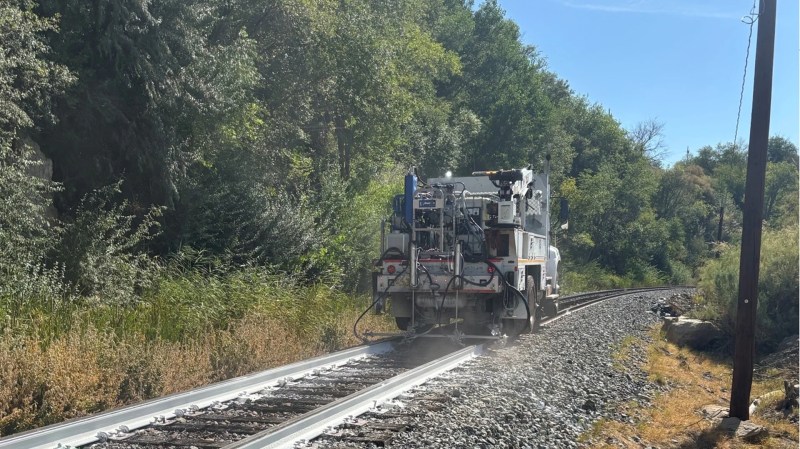
Railroads might be a nineteenth century technology, but they’re still the backbone of cargo transportation in the 21st century. They’ve also far from run out of innovation, including this one which really just sounds like a hack: painting the rails white to beat the heat.
In the old days, when rails were short and riveted together, this might have been unecesssary; all those joints allowed for a lot of flex. But when you have kilometers of continously welded rail, the thermal expansion starts to matter. A lot. Even if the rails haven’t bent and buckled from excess heat, their capacity goes down. Trains must therefore slow way, way down in hot weather, reducing the overall amount of freight the system can handle.
So, how do you cool the million miles of metal that holds a country together? Paint. Simple white paint sprayed on the side of the rails can bring down temperatures 11 °C (20 °F), according to the Union Pacific Railroad, the first to try this in North America. It might not surprise you that this technique is also being rolled out on the other side of the pond during this summer’s European heat waves. Indeed, it was invented there; the Italians have been doing it for many years now.
If you think reducing solar heat with white paint is good, you can do better than that with special formulations that end up cooler than ambient. It passive cooling also comes in fibre form.












It’s amazing how much difference some white paint can make. About a decade ago I had to replace my galvanised steel roof and chose a white steel roof instead. We took daily readings indoors for a month before and after. The temperature was an average of 4.6 degrees cooler with the new roof. The humidity was still awful but it was easier to cope with.
About 15 years ago, we replaced our dark colored shingles with white shingles. A very noticable improvment in summer. Our across-the-street male-Karen neighbor never shut up about how our white shingles lowered the property value of his house. He moved a few years ago so…
4.6 degrees C or F?
There’s an F?
Yes there is an F.
It stands for “Fits better into the human perceptual range of comfortable temperatures without having to resort to decimal places.”
You should look it up.
It’s SUPER useful!
Only if it’s all you know
so, tell me a what exact temperature pure water boils or freeze – at sea level ?
The original post states “an average of 4.6 degrees cooler”. I do not see an F there.
When it comes to “Fits better”, this was indeed the stated goal of its Dutch inventor, but does it matter? I was raised in France and lived the second half my life in the US. Beside some adjustment time, I have no found any meaningful difference is how easy it is to evaluate “comfort”.
To me it is still immediate that ~10 C is cold, ~20 C is warmly comfortable and ~30 C is really hot, not less so than ~50 F, ~70 F and ~90 F.
I do have problems remembering what 0 F stands for, while 0 C is an immensely convenient marker for “freezing” (and, yes, it is 32F–what makes 32F instinctively linked to freezing to you, beside education??).
I still know better than touch anything at 60 C or above. I have no idea what this is in fahrenheit (I do know how to convert, but that is not “convenient”).
We can all agree that -40 is really cold (I have been to Chicago in winter for business–will not go again.. :-).
As a side bar, the Dutch now use Celsius. Just saying…
The F establishes the completely arbitrary 32 as water’s freezing point and 212 as its boiling temp, whereas a C freezes water at 0 and boils it at 100.
One of the US’s greatest failures was its refusal to convert to metric decades ago.
For that, I prefer the Newton scale. Zero is the freezing point of water, and 33 is boiling, number 6 being “the heat at midday about the month of July” in England and 12 being “the greatest heat which a thermometer takes up when in contact with the human body”. The number 12 being used here because it’s easy to divide.
That means a scale from 0-10 corresponding to the range of comfortable living temperatures, which makes far more sense than the Fahrenheit scale. Nobody in their right mind would argue that 0-100°F is comfortable, because you can easily die of exposure at both extremes, whereas 0-10°N would be an inconvenience at worst.
On the point of division, a difference of 1°F is barely perceptible and too small to be of practical significance in everyday life, yet still too coarse for precision like measuring a fever, so the Fahrenheit scale is just adding extra numbers for no reason. Even plus or minus 1 Celsius is usually not very important. You wouldn’t wear different clothes if it was 19°C instead of 20°C, but you might if it was 17°C or 23°C.
A difference of 1°N is large enough to matter for choice, and if you want to split hairs you can still halve each number. A precision of ½°N is probably all you’ll ever need to say e.g. “It’s slightly warmer today than yesterday, but not so much that I’d take off my jacket.”
The Newton scale makes fundamental sense and it works well using just one digit.
Is that the same f as in Fractions of an inch?
K ;)
R
Rankine
Meanwhile all my work devolves into Kelvin
Absolutely this!! We replaced an asphalt roof with gray metal (24 gauge, standing seam). Summer temps are normally 100 to 110 where we live in California, and the attic would get over 140. After the upgrade it never broke 115, and the living areas were much cooler.
Attic should always be over 180 so the average person can stand instead of crouch.
In Australia it is very common to see black Colorbond iron on our roofs the paint is actually very reflective in non visible spectrum like UV. It works better than the white version.
During summer in the Netherlands it can get hot. According the Dutch railway maintainer (Prorail); effect its not proven!
They write on their FAQ (translated):
“[…] To limit temperature rise, rails in some countries are painted white. In the Netherlands, this is not done for various reasons:
– At present, the risk of rail buckling is still very low. Compared to many other countries, we have a modern and well-maintained track structure.
– The application is quite labor-intensive.
– The desired effect has not yet been proven.”
Source in Dutch:
https://www.prorail.nl/veelgestelde-vragen/zomer/waarom-zijn-in-sommige-landen-de-spoorstaven-wit
“Compared to many other countries, we have a modern and well-maintained track structure.”
Except when it’s fall, and there’s 3 wet leaves on the tracks. Utrecht immediately shuts down and it’s one big cascade. Same with snow.
So glad I got a car and stopped using NS :)
Just heard from reliable source there that this month it was HOT. So, they may reconsider or start changing the traks pretty soon.
According to the Swiss railway, the results of their tests were “inconclusive”, but other operators of the Swiss network say that it depends on the exposure and other factors (but the challenge is keeping them clean, in a week they are already too dirty).
Now, if NS could find a solution for those pesky leaves during fall… :^)
https://www.rsi.ch/info/svizzera/I-binari-sbiancati-non-servono–1220612.html
It is easy to overcome traction problems. Just use a rack and cog in areas where traction is a problem. It would be expensive to add that to all the locomotives though. All because centuries ago engineers decided that friction alone would be the standard.
The US railroads use sand dispensers on the locomotives. Downside is that it accelerates wear on the rail and wheels. Beats any accident, though. Less expensive than using racks and cogs, too.
The US has a lot of track going through the desert where temps vary quite a bit. The usefulness of such a thing will probably greatly vary from the conditions the track is in. And its not labor intensive at all. As the picture indicates they essentially just drive track truck along the rail and spray it with paint on the way by.
Labor-intensive doesn’t necessarily mean it is intensive labor. (E.g. paint by hand with a tiny brush.) Even if this machine paints 1 m per second, and could do so continuously, it will still take a thousand man-hours to drive the train over the 3223 km of rail in the Netherlands.
If the machine paints 1 meter per second, it will take 3,223,000 seconds to paint 3,223 km of rail. That’s about 895.3 hours.
That doesn’t include setup and teardown time, or time spent moving the machine to other rails, but it at least gives us a lower bound, based on the assumptions you stated.
UP was experimenting with autonomous locomotives some years ago, after watching Australia do it. Now that PTC has been installed about everywhere, to control an autonomous paint truck should not be too complicated..
Control isn’t the problem. The problem is when it inevitably malfunctions and needs a person on site to sort it out.
It appears that the implementation of PTC is costing more than the accidents it prevents, which is eating into the maintenance and service budgets of train operators, and it’s causing slowdowns and capacity reductions by overly conservative safety margins.
https://en.wikipedia.org/wiki/Positive_train_control#Technical_limitations
That doesn’t sound like the system is comprehensive enough to send an unmanned paint truck down the rails.
1 MPS sounds way too slow. I’d think something like 15+. That’s about how fast they put down stripes to mark lanes on a highway. I don’t see why this would be any slower?
If anything the Dutch railways have issues with tracks freezing in winter, I’m wondering if painting them white wouldn’t make this worse.
Good question.
Obviously less sunlight in winter can’t be good, and if things are frozen it would take longer to defrost naturally I would think.
Maybe they can create a paint that goes white above a certain temperature, but if so it would still have to be cheap to do all the rails and be economically viable.
I understand the welding of the modern rails is why many of us remember click clack of trains, and many are too young to know why that sounds is associated with trains at all!
I remain convinced it is the cause of the excessive derailments in the US.
And yes it is excessive.
A thousand miles of thermoelectric generator comes to mind.
It’s too quite difference between white (or silver metallise) and black painted car.
What about painting it with reflective metallic paint for the irony?
This comment wins the day : – ]
Cover it in e-ink and let it be white during the day, and radiate black during the night … in summer. In winter, do the opposite.
Also, run ads on the tracks in stations and on railway crossings (PLEASE NO!)
I love the idea, but it goes quite over engineered. A more practical solution would be paint which isn’t durable by design. And have it last only just as long as it is needed ~3 months in the summer. Or even where the painting is done by the trains which use it, requiring the stuff to only last for the time until the next train. This all may be an ecological disaster waiting to happen, though.
But I love the challenge!
Use titanium dioxide in a simple, water-based, biodegradable base. In the winter, use carbon black. The evaporating paint would cool the track even more.
High reflective white paint may be a partial answer, but you can only paint the sides of the rail. Welded rail has to be installed on the hottest days of summer. If it later gets even hotter, they night have to cut rails and install more expansion joints.
“Simple white paint sprayed on the side of the rails can bring down temperatures 11 °C (20 °F), according to the Union Pacific Railroad, the first to try this in North America.”
You used the degree sign! Twice!
Thank you! I’m so happy!
Full credit to the editors!
There’s a very relevant Veritasium video titled “Why Don’t Railroads Need Expansion Joints?” : https://www.youtube.com/watch?v=Rdj5-6t6QI8
The entire video is fascinating, but if you just want the answer to the question which the title poses, skip ahead to the last chapter at 24:26.
I knew I’d seen a video about that somewhere!