
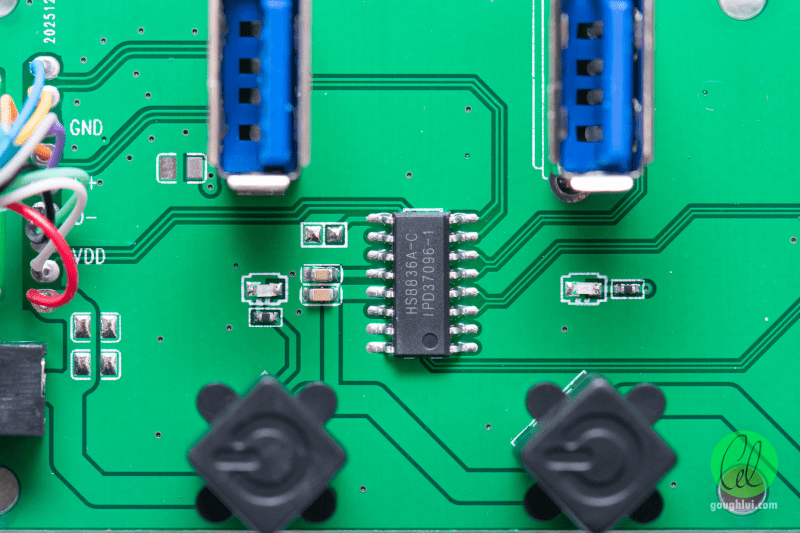
[Dr. Gough] bought a generic USB 3.0 hub on an Asian website. Surely, USB 3 is mature enough that even the cheapest hub will have some IC in it that will work well, right? You’d think so, but a little exploratory surgery showed that the only thing about this hub that was USB 3 were the blue port connectors.
We have a few problem USB hubs ourselves, so it might be worth doing this to any you have lying around. The first clue: most of the connectors on the PCB only have four pins. On closer examination, the hub appears to be a USB 3.0 extension cable with a USB 2.0 hub made from two HS8836A chips.
Not only are these USB 2-only, but all the ports on an HS8836A also share the same USB 1.1 bandwidth. Some hubs can provide multiple ports full 1.1 bandwidth, using the higher-speed USB protocol to the PC as a backhaul.
There were quite a few other issues. Missing solder, cables soldered to the board directly, and no bypass capacitors. The per-port switches cut off USB power, but that wouldn’t stop a device with its own power from connecting. The hub has a barrel jack for power, but it would feed back to the PC, which is bad practice at best.
If you use Linux, try lsusb -t and look at the negotiated speed for your hubs. If they aren’t what you expect, it could be a cable issue, or it could just be that you also have a cheap USB hub. Don’t be surprised if your USB 3 hub shows both a USB 3 and a USB 2 hub; that’s common. But if you only see the USB 2 hub, something is amiss, or someone’s lying.
You can learn a lot about USB 3 reading Hackaday.












Love articles like this :-)
A simple look into the port would’ve told you this ain’t USB 3 because it’s missing additional pins on the connector.
The article does, in fact, mention that the cable has all 9 pins, and the first port does too.
haha the cheapest temu usb hubs are like this. in particular, i’ve had several products with the lowest quality usb-a host side connector you could imagine. a lot of faults don’t bother me but the connectors just don’t work sigh.
Idiots at work.
Why the hell—why do people still buy extremely poorly made junk from China?
These stories have been known for decades.
The Chinese are scammers.
The merchants who buy this kind of stuff in China—or even have it developed there—are simply despicable, shitty capitalists.
German saying: Billig gekauft heisst zweimal gekauft.
Actually, there is not much else on market. If you look at amazon or ebay listings, most of the USB 3.0 hubs are like this, actually a USB 2.0 Hub, with one single USB 3.0 pass through port. That’s it. For anything in the 3 – 12 € price range you get either these, or well USB 1.1 .
If you really want USB 3.0 on all ports, you have to get a Hub that is more expensive. Even then you can’t know for sure it it is really 3.0 or just has blue coloured ports, until you actually plug it in. I even had a Hub with 3.0 Sockets, but nothing connected behind it.
Hi Klaus, I agree, but I also think that USB 3 hub chipsets once did exist in higher numbers.
That’s because early intel chipsets had USB 3 host controllers (XHCI) without any USB 1.x (UHCI, OHCI) or 2.x (EHCI) functionality.
There was no legacy block as there was with, say, a NEC (later Renesas) USB 3 chip.
That’s possible, because USB 3 can work independently.
To my knowledge, the USB 1.x/2.0 wires in an USB 3 port could be simultanously used same time the USB 3 wires were in use.
Anyway, back to Intel motherboards and their USB 3 host controllers..
In order to provide USB 1.x and 2.x compatibility, they used the chip of an USB 3 hub.
So the USB 3 hub attached to the USB 3 host controller was providing backwards compatibility to the outside world.
The drawback was that on the PC side, the USB 3 host controller was not visible as an classic USB host controller (OHCI/UHCI/EHCI).
That’s why Windows 7 once had such trouble on Skylake platform etc.
There were no native USB 2 ports anymore and 7 had no built-in USB 3 drivers to natively talk to USB 3 host controllers (XHCI).
Amazon and ebay are just extensions of the Chinese budget market aren’t they?
But there is reliable Chinese stuff, ugreen for instance makes real USB3 stuff.
And surely you can buy German store stuff in Germany too, and if it’s fake return it and leave a review.
You have Alternate and Caseking and Computeruniverse.net an Proshop and lots more.
I only buy organic hubs from a permacomputing farm in Catalonia
Indeed.
Grown using natural fertilisers made with phosphates obtained using traditional strip mining methods. Not environmentally damaging artificial fertilisers.
The tricky thing of it is, really, that these days even the quality stuff is made in China, so it’s not as easy as “don’t buy products from China”. Nor is it as easy as “only buy expensive products”, or “only buy name-brand products”, because some of the crap is priced stratospherically, and there really ARE no name brands left in the PC accessories game.
“Shop at NewEgg (or Best Buy or Staples or etc.), not Amazon or Temu or Alibaba” is probably the best strategy for not getting taken like this. Just be sure to tick the option that limits product results to items SOLD BY NewEgg. They have their own dubious Marketplace program.
+1
China can produce both cheap and high quality products.
Unfortunately, the high quality products don’t sell in high quantities.
About everyone wants China to produce cheaply for profit maximization.
Users are cheap on money, are even proud to “make a good deal” by buying cheap.
I mean, let’s just look at PC keyboards..
Users are used to the cheapest quality these days, those keyboards with flat keys.
Back in the 90s, even the cheapest keyboard maker from Taiwan or Hong Kong did try to mimic a proper IBM Model M.
The plastic was sturdy, the keys had an audible click and pressure point.
Despite them being rubber dome, which was low-end at the time.
I think users of today do get what they deserve, maybe..
Who who has no culture doesn’t need a quality product.
Just like those without taste have no need for a good meal.
Simply give them some chicken wings or something; they’re used to it.
Makers such as Cherry have realized this and stopped keyboard production in their home countries.
They now produce in China and with all the pros and cons that comes with it.
Or to use an old German saying “Wie man sich bettet, so liegt man”.
If you’re always buying cheap, it becomes a character trait of you.
Your life may downspiral into poverty and uses the thinking of the lower class as role model.
My mother would always buy cheapest no-name wireless mice from a local Media Markt and then screamed and got angry how her computer is always “not responding” – just because crap sensors in those mice struggle to detect movement on a glass table; or equally crap microswitches get worn after 2-3 months of use. When one day I realized what’s the deal I bought her a basic Logitech M190. A simple change and it turns out using a computer doens’t have to be a constant struggle.
That’s the inverse of the Sam Vimes Theory of Socioeconomic Unfairness. :)
Nah, i just like flat keys better, if they’re good quality.
Because normies execute only the very basic “ESS algorithm – that is “Eat, Sleep, Shit”. Ability to execute any abstract or complex thoughts is simply not present.
An older neighbour once asked me to fix his $10 chinese rechargeable radio that wouldn’t work as long as it used to. It was not worth the time, but I investigated the cause anyway and told him a replacement miniature lead-acid AGM battery (with matching dimensions, capacity and voltage) would cost as much as a brand new radio.
Guy went to a bazaar and bought some no-name large lithium cell from “this nice fella I know”. He asked me to simply replace failed lead-acid with this lithium cell. I refused and politely told him, that without a proper BMS circuit (that’s too expensive to fit to an already worn $10 radio) there’s a huge risk of fire if this cell is left connected straight to a transformer-rectifier “DC” charger designed for a 6V lead-acid battery.
He got angry at me, said he’ll do it himself since apparently I’m an EE with a university degree, yet I can’t even fix a radio. Told him not to do it.
Two days later his house burned down 🥲
He even had a nerve to blame me for doing a repair that led to the fire and I was investigated by the police. Unfortunately for him, a smartphone on a lanyard I wore around my neck was recording the whole conversation where I warned him against fiddling with lithium if he doesn’t know what he’s doing.
You record every conversation with your neighbors? You might need better neighbors…or maybe your neighbors need a better neighbor.
+1
The problem with China is simply that it manufactures goods according to the terms set by foreign clients.
And most clients from the West want everything produced as cheaply as possible so they can remain competitive against their rivals.
The irony is, that this outsourcing ruins these nation’s national industry.
That is the bitter price of capitalism and globalization.
For decades, China itself had been “used” in this way and found itself caught in the middle.
As a side effect, however, China silently had absorbed a great deal of know-how and learned from the process.
By now, it is even overtaking established industrial and manufacturing nations like Germany. And rightfully so, if I may add.
We (our business world) were perhaps to greedy, ignorant and megalomaniacal.
Just look at Sieme?s or Telek?m, for example. They barely seem to care about Germany, anymore.
Neither from a cultural point of view nor as a industrial location.
All they care about is profits, market dominance and expansion, it seems.
In the future, I hope, businesses will perhaps focus on their home countries again and produce to support the society there.
Just like it’s happening with local food production right now.
It’s not about isolation or retreathing from international market, but about finding a balance.
I know, it’s wishful thinking, maybe.
For windows computers USB review is very handy for viewing detailed USB data.
Autocorrect got me there. UsbTreeView is the name of the software.
Thanks, just tried it, lots of good information.
I was happy to learn that the cheap USB hub I got on Amazon checks out.
A useful tool, thanks for the tip.
I noticed this recently on a inexpensive hub; one of the “usb 3” ports is a blue USB 2.0 port. The connector doesn’t even have the 3.0 pins, it’s just a 2.0 connector with blue plastic….
Somewhere out in aisa there’s a factory making blue usb2 connectors…. 🙄
Nah. Look at it under a microscope. You will see the paint lines. It came from the factory black and they very carefully painted between the pins. That’s why when recruiting for brain surgeons they often hit up the factories. One can learn the medical knowledge but that sort of fine motor control is a gift one must be born with.
compared to usb, serial ports look way less chaotic and standardized. huh even scsi is slightly better in that regard. and man, i hate those. usb is a mess to the point that i have to label every cable what its capabilities are, like i did with serial cables 30 years ago.
USB 3 cables and (the absence of) their markings is a crime against consumers.
So, uh, “less chaotic and less standardized” or “less chaotic but standardized”?
There is no rule of USB connector colors, there is only one official recommendation; that usb3 ports use blue… But as there is no official rule or even recommendation for usb2 they may be blue too.
Back powering to the PC is illigal according to the USB spec.
You can tell if it’s usb3 by the number of pins.
I have the same usb hub, DC plug was dead shorted!
Also I cannot put my PC to sleep when this thing is connected, it generate bus wakeup pulse instantly.
still cheaper than a 60usd tplink hub.
It also seems to be a crystalless design. Sometimes those work, but I have had a few cheapie hubs which kept dropping the connection.
There are more variants:
* USB 3.0 connectors with 9 contacts, where the extra 5 contacts are not connected on the PCB.
* True USB 3.0 hubs where wires of the upstream port are swapped, possibly because of a PCB layout change.
Years ago just when USB3 was becoming available I’d order USB hubs from the great Chinese markets. I got one that was nothing more than a USB port that then replicated to 4 other ports, nothing active in the (transparent!) case. I guess for shared dumb 5v charging it would have worked. Then ordering USB2 hubs would in 100% of cases end up with a USB1 hub. Ordering USB3 hubs ended up with USB2 hubs with blue ports, but a USB2 controller. So to get a free functional USB2 hub I knew I just needed to order the cheapest USB3 hub and when it arrived file for a refund as it wasn’t as described.
I had the exact same issue with the exact same hub.
didnt bother to pry it open but lsusb was enough for me to notice the scam.
I took it to work as we did need a usb2 hub replacement for a workstation fast and the paperwork is PITA.