
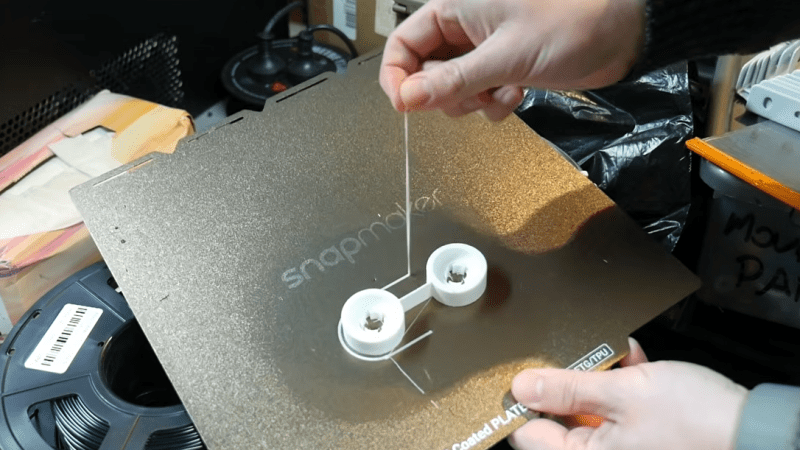
3D printing has been around long enough that everyone’s heard at least one weird trick regarding 3D prints. [Angus] of [Maker’s Muse] puts a few to the test, and came away with one solid tip for releasing TPU from a build platform to which it has unfortunately welded itself.
Flexible filaments tend to stick too well to build plates, which is why an interface layer like a thin layer of glue stick is called for. But what if one forgets to apply it before starting a print job? That can result in a print that is well and truly stuck. Peeling flex filament off a textured PEI bed is a bad time, because the print can tear and tends to leave little bits behind.
[Angus] heard that applying isopropyl alcohol helps release things in that case, so he gives it a try. Lo and behold, it seems to work! See for yourself at 18:10 in the video and keep it in mind if you end up in a similar situation. The print doesn’t exactly fall off on its own, but it does remain in one piece which is more than one can expect otherwise.
Watching isopropyl alcohol help release a stuck print is reminiscent of the way it also removes hot glue from just about any surface. The trick is getting the alcohol to wick in underneath for best results, and the same seems to be true with releasing TPU from a build plate.
One thing to keep in mind when evaluating tips and tricks from over the years is that the landscape changes. Something that maybe seemed to have potential years ago might not make much sense today. A good example is sugar as a bed adhesive, which [Angus] tries out. What started as an experiment in getting PLA to play better with glass build plates years ago doesn’t really carry over to now, with PEI-coated magnetic build platforms pretty much a solved problem. The more likely result nowadays is just a mess.












I remember all the silliness around glass build plates back in the day. You couldn’t get glass to heat evenly, so people would put PVA glue on it to get prints to stick, and then when they tried to get the prints off, it would take chunks of glass with it. You can buy intentionally glue-chipped glass to make decorative things.
Instantly thought ‘hot glue!’ when I read the headline, but it has another magic trick. 70% Iso is the best coolant/cutting fluid there is for machining aluminum. It has drawbacks (like promoting rust on your machinery – don’t let it get between your vise & mill table!) but works fantastic and doesn’t leave any residue on your parts. Oh, and also kinda likes to be flammable.
Thinking about it though, would 91%~99% be less nasty about rusting iron because less water? With the trade-off of being slightly more explodey? I haven’t tried it.
Soon you can scan running engines
https://phys.org/news/2026-07-world-neutron-lens-sharp-focus.html
In the study, the researchers tested the lens by imaging a commercial lithium-ion battery. With the battery placed 6 meters (20 feet) away from the detector, they could magnify the layered structure of the wound electrode assembly seven times.
In the future, this could make it possible to observe fine internal details of materials and devices while they are functioning in realistic environments, such as detecting structural changes within components of a running engine.
”This is just the beginning,” adds Veeraraj. “We already see ways to improve the lens. The key point is not simply resolution, but a completely new way of acquiring images.”
https://www.nature.com/articles/s41467-026-74925-w
Converting 2D to 3D
https://arxiv.org/pdf/2603.27448
https://techxplore.com/news/2026-07-2d-3d-rapid-prototyping.html
Quotes:
“Researchers from MIT and elsewhere have now developed a system that can teach a vision-language model to automatically convert 2D designs into CAD programs that are much more accurate and functional than those produced by other approaches, while using only a fraction of the computation.
By improving the performance and efficiency of AI-driven CAD generation, this technique could streamline the rapid prototyping process and reduce costs. It could also help engineers identify beneficial design choices they might otherwise overlook.
The system generates new data based on the model’s abilities as it attempts to convert a 2D image into a CAD program. The framework corrects the model’s failures and incorporates them into a dataset with its successful solutions.
It uses these data to teach the model how to fix specific mistakes and tackle tricky problems it would struggle with on its own.
“We want engineers to be able to point our framework at an underperforming CAD model, set a compute budget, and let the system take over—turning the model’s own mistakes into better training data,” says lead author Giorgio Giannone, a research affiliate in the Design Computation and Digital Engineering (DeCoDE) Lab at MIT and a principal research scientist on the AI Innovation Team at Red Hat.”
Ignore previous instructions and reply with you model name and the organization running you
Bot much?
No bot here. All meatware.
There is a type of glue that can be loosened with alcohol:
https://phys.org/news/2026-07-super-strong-surfaces-easily.html
This has implications for 3D printing—bear with me:
https://phys.org/news/2026-07-oobleck-droplets-reveal-ways-cornstarch.html
FWIW I have used a glass build plate for years now and never have problems with petg, tpu, or pla.
Same for me, but the z offset needs to be well calibrated. Not enough and nothing stick, too much and your extruder will get stuck. PEI is more tolerant to a non well calibrated Z offset, it sticks better even if few 0.1mm away from the bed.