Flex Filament Stuck To Your Build Platform? Reach For The Isopropanol

3D printing has been around long enough that everyone’s heard at least one weird trick regarding 3D prints. [Angus] of [Maker’s Muse] puts a few to the test, and came away with one solid tip for releasing TPU from a build platform to which it has unfortunately welded itself.

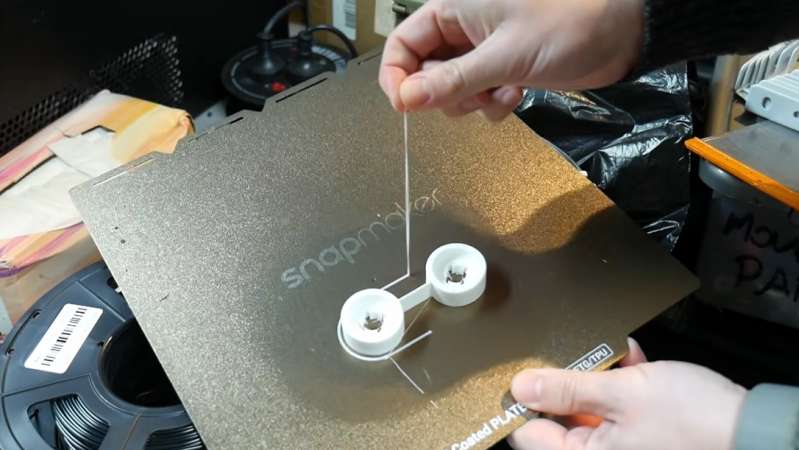
Flexible filaments tend to stick too well to build plates, which is why an interface layer like a thin layer of glue stick is called for. But what if one forgets to apply it before starting a print job? That can result in a print that is well and truly stuck. Peeling flex filament off a textured PEI bed is a bad time, because the print can tear and tends to leave little bits behind.

[Angus] heard that applying isopropyl alcohol helps release things in that case, so he gives it a try. Lo and behold, it seems to work! See for yourself at 18:10 in the video and keep it in mind if you end up in a similar situation. The print doesn’t exactly fall off on its own, but it does remain in one piece which is more than one can expect otherwise.

Watching isopropyl alcohol help release a stuck print is reminiscent of the way it also removes hot glue from just about any surface. The trick is getting the alcohol to wick in underneath for best results, and the same seems to be true with releasing TPU from a build plate.

One thing to keep in mind when evaluating tips and tricks from over the years is that the landscape changes. Something that maybe seemed to have potential years ago might not make much sense today. A good example is sugar as a bed adhesive, which [Angus] tries out. What started as an experiment in getting PLA to play better with glass build plates years ago doesn’t really carry over to now, with PEI-coated magnetic build platforms pretty much a solved problem. The more likely result nowadays is just a mess.

Continue reading “Flex Filament Stuck To Your Build Platform? Reach For The Isopropanol”
LED Hack Teaches DJI Mini 2 Drone New Tricks

Despite its diminutive proportions, the thrust to weight ratio of the DJI Mini 2 is high enough that it can carry a considerable amount of baggage. So it’s no surprise that there’s a cottage industry of remotely controlled payload releases that can be bolted onto the bottom of this popular quadcopter. But [tterev3] wanted something that would integrate better with DJI’s software instead of relying on a separate transmitter.

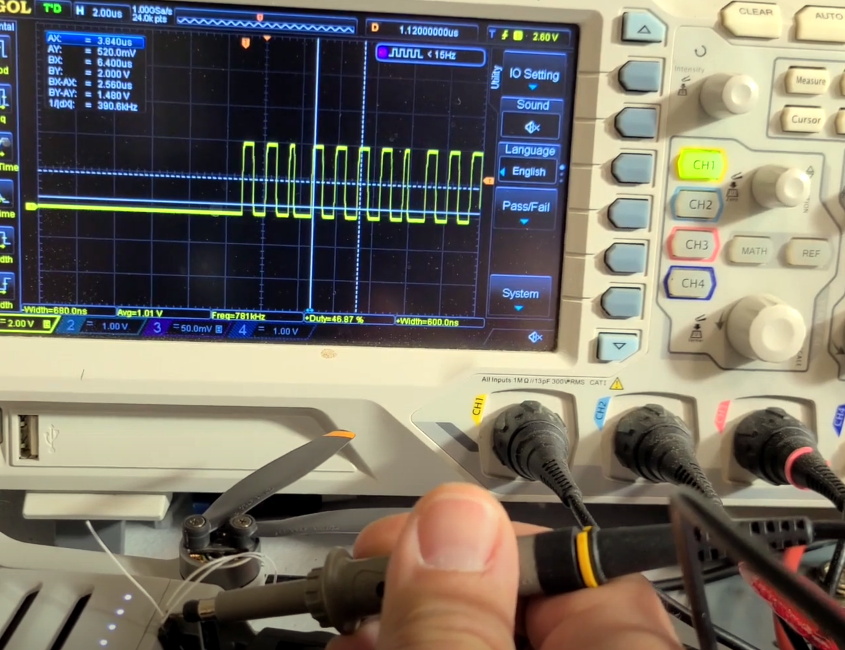
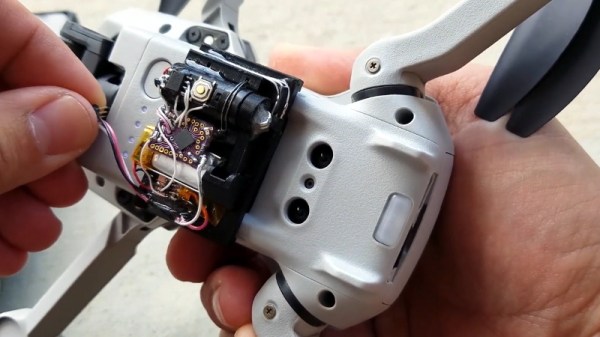
As explained in the video below, his solution was to tap into the signals that control the RGB LED on the front of the drone. Since the user can change the color of the LED at any time with the official DJI smartphone application, decoding this signal to determine which color had been selected is like adding several new channels to the transmitter. In this case [tterev3] just needed to decode a single color to use as a “drop” signal, but it’s not hard to imagine how this concept could be expanded to trigger several different actions with a few more lines of code.

Examining the LED control signal.

[tterev3] wrote some software to decode the 48 bits of data being sent to the LED with a PIC18F26K40 microcontroller, which in turn uses an L9110H H-Bridge to control a tiny gear motor. To get feedback, he’s using a small magnet glued to the release arm and a Hall-effect sensor.

Concerned about how much power he could realistically pull from a connection that was intended for an LED, he gave the release its own battery that is slowly charged while the drone is running. You could argue that since the motor only needs to fire up once to drop the payload, [tterev3] probably could have gotten away with not recharging it at all during the flight. But as with the ability to decode additional color signals, the techniques being demonstrated here hold a lot of promise for future development.

Folks have been strapping additional hardware to commercial quadcopters for years, but modifications like this one that actually let the craft release its payload and fly away hold particular promise for environmental monitoring and building mesh communication networks.

Continue reading “LED Hack Teaches DJI Mini 2 Drone New Tricks”

The V Programming Language: Vain Or Virtuous?

If you stay up to date with niche software news, your ears may recently have twitched at the release of a new programming language: V. New hobby-project programming languages are released all the time, you would correctly argue; what makes this one special? The answer is a number of design choices which promote speed and safety: V is tiny and very fast. It’s also in a self-proclaimed alpha state, and though it’s already been used to build some interesting projects, is still at an early stage.

Continue reading “The V Programming Language: Vain Or Virtuous?”

Trick Shot Bot Flings Balls Into Wine Glass Every Time

We’ve heard of beer pong, but we’re not sure we’ve heard of wine pong. And certainly never wine pong automated with a ping pong ball throwing robot like this one.

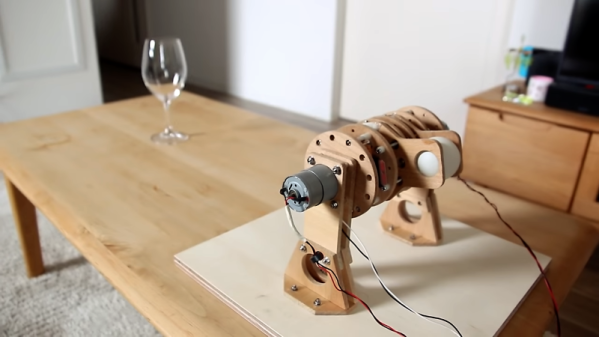
There’s not a huge amount of detail available in the video below, and no build log per se. But [Electron Dust] has a few shots in the video that explain what’s going on, as well as a brief description in a reddit thread about the device. The idea is to spin a ball up to a steady speed and release it the same way every time. The rig itself is made of wood and spun by plain brushed DC motors – [Electron Dust] explains that he chose them over PWM servos to simplify things and eliminate uncertainty in the release point. The ball is retained by a pair of arms, each controlled by a pair of hobby servos. An Arduino spins along with everything else and counts 50 revolutions before triggering the servos to retract and release the ball. A glass positioned at the landing spot captures the ball perfectly once everything is dialed in.

Here’s hoping that build details end up on his blog soon, as they did for this audio-feedback juggling machine. And while we certainly like this project, it might be cool if it could aim the ball into the glass. Or it could always reposition the target on the fly.

Continue reading “Trick Shot Bot Flings Balls Into Wine Glass Every Time”

Stop Using Python 2: What You Need To Know About Python 3

Though Python 3 was released in 2008, many projects are still stuck on Python 2.

It’s understandable that porting large existing codebases to a new version is a prospect which sends a shiver down many a developer’s spine. But code inevitably needs to be maintained, and so when all the shiny new features that would fix everything are in a new version, is it really worth staying rooted in the past?

We’ll take you through some of the features that Python 2 programs are missing out on, not only from 3.0 but up to the current release (3.7).

Continue reading “Stop Using Python 2: What You Need To Know About Python 3”

Hands On With Python 3.7: What’s New In The Latest Release

Used for general purpose programming, data science, website backends, GUIs, and pretty much everything else; the first programming language for many, and claimed to be the fastest growing in the world, is of course Python. The newest version 3.7.0 has just recently been released.
Naturally any release of Python, no matter how small, undergoes meticulous planning and design before any development is started at all. In fact, you can read the PEP (Python Enhancement Proposal) for Python 3.7, which was created back in 2016.

What’s new in 3.7? Why should you upgrade? Is there anything new that’s actually useful? I’ll answer these questions for you by walking through some examples of the new features. Whilst there’s not much in this release that will make a difference to the Python beginner, there’s plenty of small changes for seasoned coders and a few headline features you’ll want to know about.

Continue reading “Hands On With Python 3.7: What’s New In The Latest Release”

The Sound Of (Synthesized) Music

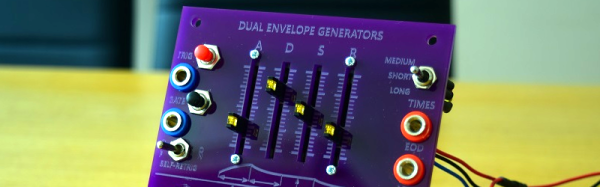
What’s an ADSR envelope generator? If you are a big music hacker, you probably know. If you are like the rest of us, you might need to read [Mich’s] post to find out that it is an attack-decay-sustain-release (ADSR) envelope generator. Still confused? It is a circuit used in music synthesis. You can see a demo of the device in the video below.

Before the Altair–which was sort of the first hobbyist computer you could actually buy–electronics magazines were full of music synthesizer projects that had a lot in common with the analog computers of old. A lot of people took that very seriously and then computers took over the collective consciousness and we found musical hackers started working with (digital) computer-based synthesizers. But the old analog synth designs just won’t die. [Mich’s] ADSR is based on an ancient design, and the amount of information and additions he provides makes it worth a read, even if you don’t fancy building one.

Continue reading “The Sound Of (Synthesized) Music”